What are bioidentical hormones, and how do they differ from synthetic hormones?

Written by Dr Cristina Lenzi
What are bioidentical hormones?
Bioidentical hormones are compounds with a chemical and molecular structure exactly identical to that of the hormones produced naturally by the human body, such as oestrogens (estradiol, estriol, estrone), progesterone, testosterone, DHEA and pregnenolone.
Unlike traditional synthetic hormones, bioidentical hormones are not foreign to our biological system: thanks to their perfect molecular match, they are recognised by the cells of our body, which interact with them by binding in a physiological way to the same receptors and carrying out the same biological and enzymatic functions. This removes most of the side effects typically associated with the synthetic hormones of traditional HRT.
Although the term is often linked to a vague idea of “naturalness”, bioidentical hormones are not simple herbal remedies or raw plant extracts. They are purified molecules, produced and standardised through precise laboratory processes from precursors of plant origin obtained from plants such as soya or wild yam.
Where do bioidentical hormones come from?
The production of bioidentical hormones follows a fascinating pathway. It all began in 1942 with the chemist Russell Marker, who discovered that diosgenin, a plant substance found in abundance in the tuber of the wild yam and in soya, could be converted into progesterone through a series of steps in the laboratory. This biotechnological process, refined over time, makes it possible to convert plant phytosterols into steroid hormones (such as estradiol, estriol, progesterone and testosterone) that have exactly the same chemical architecture as human ones, retaining no biological trace of the plant they started from.
Although bioidentical hormones therefore have the same molecular structure as human ones, they are not herbal remedies (that is, simple plant extracts with a hormonal action) but are made in a laboratory from precursors of plant origin obtained from plants. They are therefore not substances “extracted directly from nature” with no manipulation: they are the result of a sophisticated, controlled chemical synthesis in the laboratory, which standardises their purity and final structure. Calling them “natural” is therefore formally wrong, but they can perfectly well be described as “naturally derived”.
The pharmaceutical laboratory that makes bioidentical hormones, then, does not “invent” a new artificial molecule, but transforms plant precursors into pure human hormones. Without this complex laboratory synthesis, our body would not be able to absorb or use plants directly to produce active sex hormones.
“Bioidentical” does not mean “natural”
Let's be clear: bioidentical hormones have the same chemical structure as the hormones produced by our body, but they are made in a laboratory. The term “bioidentical” is a chemical descriptor that indicates a perfect molecular match with the human hormone, not a safety or regulatory classification.
Many patients wrongly associate the idea of “natural” with something inherently harmless, but in medicine the word can be misleading. For example, conjugated equine oestrogens (CEE), such as the well-known commercial medicine Premarin, are extracted naturally from the urine of pregnant mares. However, they contain dozens of oestrogens specific to the animal that are not present in the human body and for which a woman does not have suitable metabolic enzymes. So although they are of natural origin, equine hormones are not bioidentical and are recognised by the human body as foreign (xeno-oestrogens).
Would you like to talk it through with a doctor?
The first consultation is free, also by video call.
Book a free consultationWhat are bioidentical hormones used for?
In perimenopause and menopause the production of sex hormones falls, and the body is affected in many ways. By restoring hormonal balance, bioidentical hormones help to eliminate the symptoms of menopause, or to ease them when they are very severe. These include:
- hot flushes and night sweats;
- tachycardia and tiredness;
- sleep disturbances;
- changes in mood and in the menstrual cycle;
- tinnitus.
The therapy can also reduce the problems that come from the thinning of the vaginal lining: dryness, pain during intercourse and recurrent urinary tract infections. As well as acting on symptoms in the short term, the therapy contributes to the prevention and long-term protection of bones, heart and brain.
The greatest benefit is obtained when the therapy is started within about 10 years of menopause or before the age of 60, but there are benefits even when it is started later: in Dr Lenzi's experience, you can start at any age. Whether the therapy is right for you is for the doctor to assess, based on your personal profile and your tests: this is the first step of the Bioidentical Hormone Pathway.
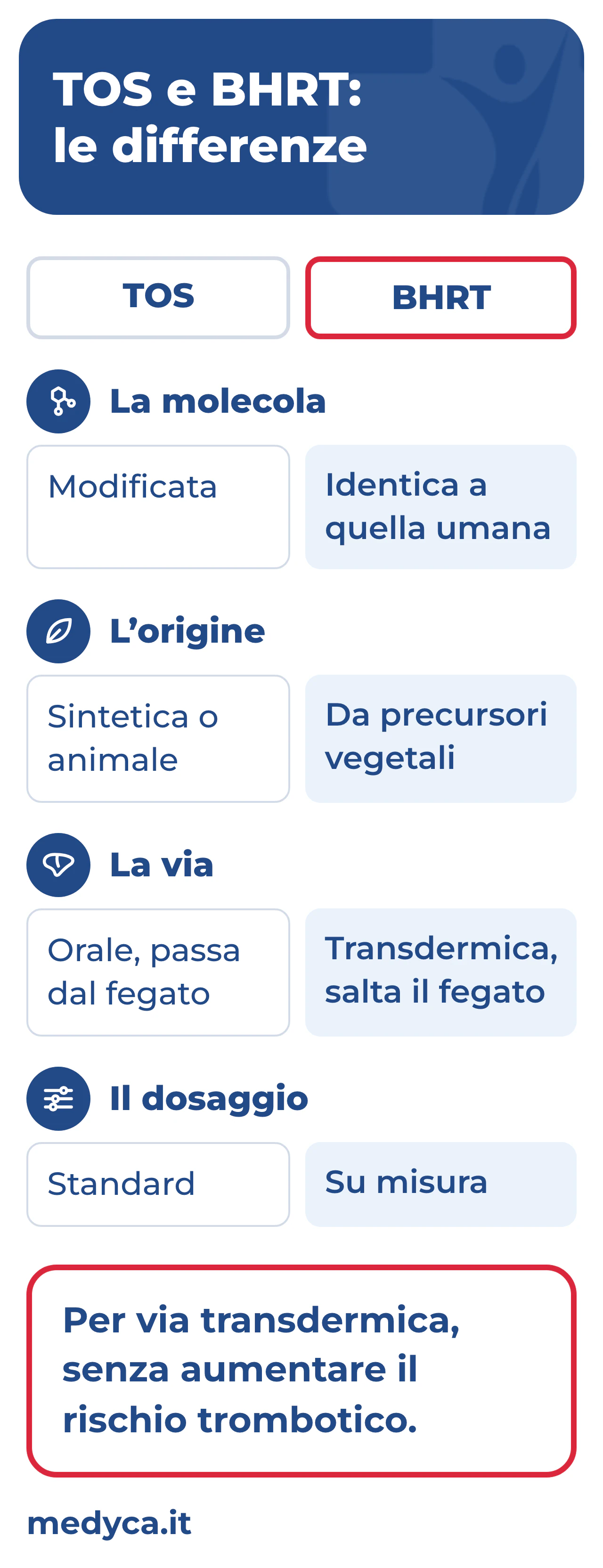
What is the difference between bioidentical and synthetic hormones?
The key difference between the molecules used in replacement therapy lies in how they behave at receptor and metabolic level. Here is a schematic overview of the main differences:
| Characteristic | Bioidentical hormones (BHRT) | Conventional synthetic hormones (HRT) |
|---|---|---|
| Chemical structure | Exactly identical to that of human hormones (estradiol, progesterone, testosterone). | Chemically modified and altered compared with human hormones (e.g. medroxyprogesterone acetate, ethinylestradiol). |
| Origin | Synthesised in the laboratory from plant precursors, such as soya and wild yam. | Synthesised in the laboratory or extracted from non-human animal sources (e.g. equine urine). |
| Main route of administration | Preferably transdermal (gels, creams, patches), vaginal or oral (micronised progesterone only). | Mainly oral (tablets taken by mouth) or standard transdermal patches. |
| Personalisation | Extremely flexible through tailor-made compounded preparations (cBHRT) or available in regulated industrial medicines (rBHRT). | Limited to fixed doses pre-packaged by the pharmaceutical industry (“one-size-fits-all”). |
| When to choose it | It is the approach of choice for personalising the therapy, when there are intolerances, for using testosterone in women or for reducing cardiovascular risk. | Indicated for contraception, in specific conditions such as severe endometriosis, or for reasons of cost and established experience. |
The molecule makes the difference: a matter of “lock and key”
In our body, hormone receptors work on a model of perfect stereochemical complementarity, similar to a lock and its key. Bioidentical hormones are “perfectly duplicated keys”, able to open the receptor lock in an entirely natural way.
Synthetic hormones, on the other hand, have chemical alterations that, while allowing them to open the main lock (the desired hormonal effect), can lead them to interact wrongly with other receptors (androgen, glucocorticoid or mineralocorticoid). This explains why natural bioidentical progesterone is considerably better tolerated by patients and free of the typical side effects of synthetic progestins (such as fluid retention, headache, mood swings, weight gain and abdominal bloating).
In practice, the cells of our body recognise bioidentical hormones as if they were the ones that have always been produced naturally. These hormones interact with our cells in an entirely natural way, without any abnormal reaction, because our cells are already used to interacting with them.
The transdermal route of administration, to protect the liver
Another decisive difference between traditional replacement therapy and the BHRT method is the route of choice by which hormones enter the body. The bioidentical method tends to favour the transdermal route (gels or creams applied to the skin) or the transmucosal route over the oral route.
When a hormone is taken by mouth (oral route), it necessarily has to pass through the liver before entering the general circulation (hepatic first-pass effect). This sudden influx leads the liver cells to increase, in a non-physiological way, the synthesis of specific proteins, including the clotting factors. As a result, taking hormones orally (especially synthetic ones) brings a significant increase (two- to four-fold) in cardiovascular and thrombotic risk, including venous thromboembolism (VTE) and stroke.

By contrast, taking hormones by the transdermal route skips the first pass through the liver entirely: it enters the peripheral circulation directly, keeping hormone levels stable. Large epidemiological studies and clinical trials (such as the ESTHER study) confirm that transdermal administration of estradiol at standard therapeutic doses does not alter coagulation parameters and is not associated with any increase in the risk of thrombosis or cardiovascular events compared with non-users.
A word of caution: safety always comes first
Saying that bioidentical hormones are compatible with our body in no way means treating them as risk-free or as something to be used without caution. Bioidentical hormones are, to all intents and purposes, active, powerful and clinically significant medicines.
If given at the wrong or unbalanced doses, they can cause real problems and adverse effects: for example, too much oestrogen can cause transient breast tenderness and abnormal uterine bleeding, while an overload of progesterone can cause daytime sleepiness or tiredness.
For this reason, the therapy must always be calibrated, guided and constantly overseen by an experienced specialist doctor, carefully avoiding non-standardised preparations and “do-it-yourself”. Many doctors prefer to use personalised therapies, made ad personam on each patient's profile, in order to eliminate the side effects due to wrong doses or, more commonly, to the absence on the pharmaceutical market of a standardised product with a dose that exactly matches what each patient needs.
Are HRT and BHRT the same thing?
One area that often confuses patients is terminology. HRT (hormone replacement therapy, known in Italy as TOS) is the umbrella medical term for any treatment aimed at restoring and making up for the decline in sex hormones linked to age or to the exhaustion of ovarian function.
BHRT (Bioidentical Hormone Replacement Therapy) is not an alternative medicine or an unscientific therapy, but simply a form of HRT that uses bioidentical molecules instead of synthetic substances. Both sit within evidence-based medicine and the regulated gynaecological clinical pathway.
Replacement therapy with bioidentical hormones, BHRT, is considered an improvement on traditional HRT, which uses only chemically synthesised hormones, at a high dose and the same for every woman, without aiming for a personalised hormonal rebalancing. With BHRT, every hormone therapy can be developed in a personalised way for each woman who uses it.
When do you need synthetic hormone therapy instead?

Knowing about bioidentical hormones does not mean writing off the synthetic oestrogen-progestin therapy used for so many years. There are a few rare contraindications to bioidentical hormones that may make traditional HRT preferable.
Some patients need “progestins” (that is, synthetic hormones, with excipients) rather than bioidentical progesterone; sometimes certain progestins have an antihypertensive effect, or a longer duration than their bioidentical counterpart, or the patient has a gynaecological condition such as severe endometriosis. In such cases classic synthetic therapy wins, because it is the best one for the patient.
Registered medicines and compounded preparations: two different paths
There are two clearly distinct pharmaceutical ways of taking bioidentical hormones, each with its own regulatory and practical characteristics. Industrial formulations (rBHRT) are standard, with fixed doses for all patients, while compounded formulations (cBHRT) are prepared following the doses and compounds indicated in the prescription, which has to be written ad personam for each patient. So only compounded formulations can be personalised.
The magistral compounded preparation (cBHRT)
Magistral compounded medicines are “tailor-made” preparations made up directly in the laboratories of specialist compounding pharmacies, on the basis of a medical prescription written ad personam for the individual patient. In Italy, these laboratories operate under the strict supervision of the Ministry of Health and must comply rigorously with the Norme di Buona Preparazione (NBP, the Rules of Good Preparation) of the Official Pharmacopoeia.
The main advantage of magistral compounding (cBHRT) is its complete flexibility: a doctor who specialises in BHRT can specify doses personalised to the milligram, vary the vehicles and excipients in the case of documented allergies or intolerances to industrial preservatives (such as the peanut oil found in some commercial capsules), and combine several active ingredients (e.g. estriol, progesterone and testosterone) in a single transdermal or vaginal cream, significantly improving the patient's experience.
The fixed-dose industrial medicine (rBHRT)
Regulated bioidentical hormones (rBHRT), on the other hand, are registered industrial products, standardised and approved by national and international regulatory authorities (such as AIFA, the EMA or the FDA). These medicines guarantee absolute chemical stability and pinpoint consistency of dose, and are backed by large controlled clinical studies and post-marketing surveillance.
Industrial bioidentical hormones are available on the market, such as estradiol gels and patches and micronised progesterone capsules; each product has its own brand name, and some come in packs reimbursed by the Italian National Health Service (SSN).
How do you choose between the two?
International medical guidelines tend to suggest regulated industrial products (rBHRT) first, because of their standardisation and very strict production controls. However, resorting to the magistral compounded preparation (cBHRT) becomes a valuable and irreplaceable resource in specific clinical circumstances:
- Personalised doses that are not available: When the patient's symptoms call for an intermediate dose or balance (such as Bi-Est, a combination of estriol and estradiol) not covered by the industrial range.
- No equivalent industrial medicines: This is the case with testosterone for women, to counter the decline in sexual desire (hypoactive sexual desire) in menopause; in Italy there are no commercial products at a female dose, which makes a compounded prescription for a very low-dose transdermal cream (0.3% to 0.6%) the only viable route.
- Intolerance to specific excipients: Where the patient is intolerant to the binders or colourings found in branded products.
How do you take bioidentical hormones?
Bioidentical hormones come in different forms, and the form decides how the hormone enters the body:
| Form | How it is used | Where it acts |
|---|---|---|
| Gels and creams | Applied to the skin | Throughout the body, through the skin |
| Patches | Applied to the skin | Throughout the body, through the skin |
| Capsules (such as micronised progesterone) | Taken by mouth | Throughout the body, after passing through the liver |
| Very low-dose vaginal creams and gels (such as estriol) | Applied in the vagina | Locally, on the vaginal lining |
For systemic therapy, the kind that acts on the whole body, I prefer the transdermal route. For intimate problems, when needed, very low-dose vaginal oestrogens are used, such as estriol, which act only locally, without affecting general hormone levels.
Are bioidentical hormones safe?
With bioidentical hormones, a great deal depends on the dose, which has to be the right one for you. That is why you start with a low dose and increase it gradually, with check-ups over time, so as never to reach an excessive dose.
In general, oestrogens taken by mouth have been associated with an increased risk of thrombosis; by the transdermal route, at standard therapeutic doses, this increase is not seen. That is why scientific societies recommend the transdermal route as the first choice, particularly when there are risk factors.
For decades hormone therapy was feared above all for the risk of breast cancer, and many women, together with their doctors, grew up with the idea that oestrogen means cancer. It is the legacy of an American study from 2002: it used hormones different from those of the body, taken by mouth, yet its results were extended for years to every hormone therapy. The most recent evidence, however, does not associate oestrogen therapy with an increased risk of breast cancer, and combined therapy with natural micronised progesterone has not been associated with an increased risk either.
Although bioidentical hormones offer a decidedly more favourable tolerability and safety profile than synthetic hormones, they share some general systemic contraindications, which include undiagnosed vaginal bleeding, serious active liver disease or known hereditary thrombophilia.
Based on your personal history, your doctor assesses the contraindications and effects of the therapy.
The duration of treatment is not set by rigid rules, but is assessed and discussed again every year between doctor and patient, based on the improvement achieved in quality of life and in the protection of the organs.
What do you need before bioidentical hormones are prescribed?
Bioidentical hormones can be obtained only with a medical prescription, and by law any doctor can prescribe them. What makes the difference is how much the doctor has trained to understand the effect of hormones on a woman's whole body: in Italy, doctors who specialise in bioidentical hormone therapy are still few.
BHRT is an innovative therapy that makes it possible to treat the symptoms of menopause using bioidentical hormones, without side effects for our body. The only side effect seen in practice is the one caused by an unsuitable dose, and it is corrected by calibrating the dose: this is why the therapy should be prescribed by an experienced doctor who is aware of the clinical and personal specifics of every woman.
At the Medyca centre run by Dr Cristina Lenzi, women's health is managed to high standards of clinical safety. Bioidentical hormone therapy cannot and must never be prescribed lightly or without preliminary investigations.
Before drawing up any personalised treatment plan, hormone levels are requested: a blood test that also includes vitamin D. Computerised bone mineral densitometry (MOC) and a gynaecological examination are added later, depending on the patient's age and history. These tests allow the doctor to understand the patient's real state of health, to diagnose hormone deficiencies and any risk of osteoporosis, and to personalise the treatment in complete safety, then setting a tolerability check 3 months after the start and monitoring tests once a year.
Blood tests may also include an assessment of thyroid function: in menopause the drop in sex hormones slows down the metabolism even when thyroid values stay within normal limits. Rebalancing oestrogen, progesterone and testosterone can therefore improve thyroid function.
During the first visit, before the therapy is prescribed, a full 360-degree medical history of the patient is then taken, assessing the state of endocrine senescence and carefully reviewing the blood test results, and any instrumental tests already done, in order to prescribe a personalised therapy that restores the correct hormonal balance in complete safety.
Do you want to find out whether the therapy is right for you?

Dr Cristina Lenzi
Dr Cristina Lenzi is an internal medicine physician and the Medical Director of Medyca, where she looks after women's health in perimenopause and menopause with bioidentical hormone therapy.

Medyca is a medical service founded by Dr Cristina Lenzi, one of the few doctors in Italy specialising in bioidentical hormone therapy. A specialist in Internal Medicine, cum laude, from the Università di Siena, she holds a PhD in osteometabolic diseases and Level I and Level II Master's degrees in bioidentical hormones from the Marion Gluck Clinic in London.
The first introductory consultation is free and without obligation: it is the way to find out more and understand whether the pathway is right for you. We look after patients from anywhere in Italy by video call, and in person at our practice in Siena.
Find out more: