Menopause and thyroid: why your metabolism slows down

Written by Dr Cristina Lenzi
Do you find yourself putting on weight even though you eat little? Do you feel more tired, with a mood that goes up and down, disturbed sleep and a struggle to “find yourself again”, ever since your periods changed or stopped?
In many women between 40 and 60, these symptoms are attributed to menopause alone. In reality, behind them there is often thyroid involvement too: a small gland at the base of the neck that nevertheless plays an enormous role in metabolism and overall wellbeing.

In this article we look, in a simple but scientifically accurate way, at:
- what the thyroid does in a woman's body
- how fluctuations in sex hormones in perimenopause and menopause affect the thyroid
- why you can have test results “within range” but a metabolism that is still blocked
- why, when we talk about hormones and menopause, thyroid function cannot be ignored
Would you like to talk it through with a doctor?
The first consultation is free, also by video call.
Book a free consultationThe thyroid: the engine of women's metabolism
The thyroid gland produces hormones that:
- regulate the metabolism (how quickly you burn energy)
- influence the immune system
- act on bone turnover
- help to stabilise mood
- support heart, muscle and brain function
When the thyroid works well, you have:
- steady energy throughout the day
- a clear mind
- a relatively stable weight for the same diet and level of activity
- regular bowels and good-quality sleep
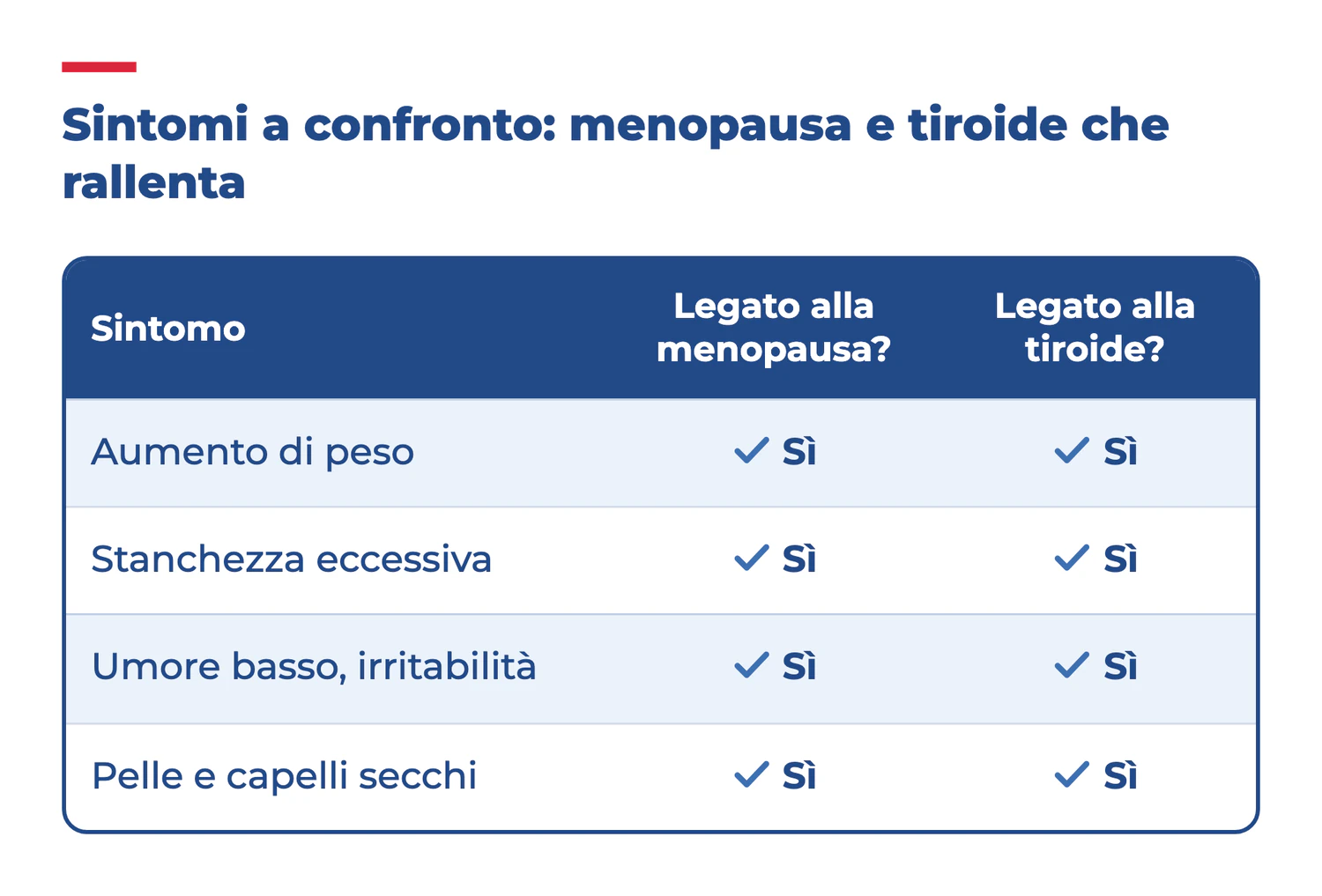
When the thyroid slows down (even if only in a “functional” way, that is, not yet evident on standard tests), the following may appear:
- weight gain or difficulty losing weight
- a feeling of excessive tiredness
- dry skin, more brittle hair
- lower mood or irritability
- bowel problems (constipation, bloating)
These symptoms overlap with those of menopause, often creating confusion: “Is it the menopause or the thyroid?” The answer, very often, is: both.
Hypothyroidism, hyperthyroidism and Hashimoto's thyroiditis: the symptoms in menopause
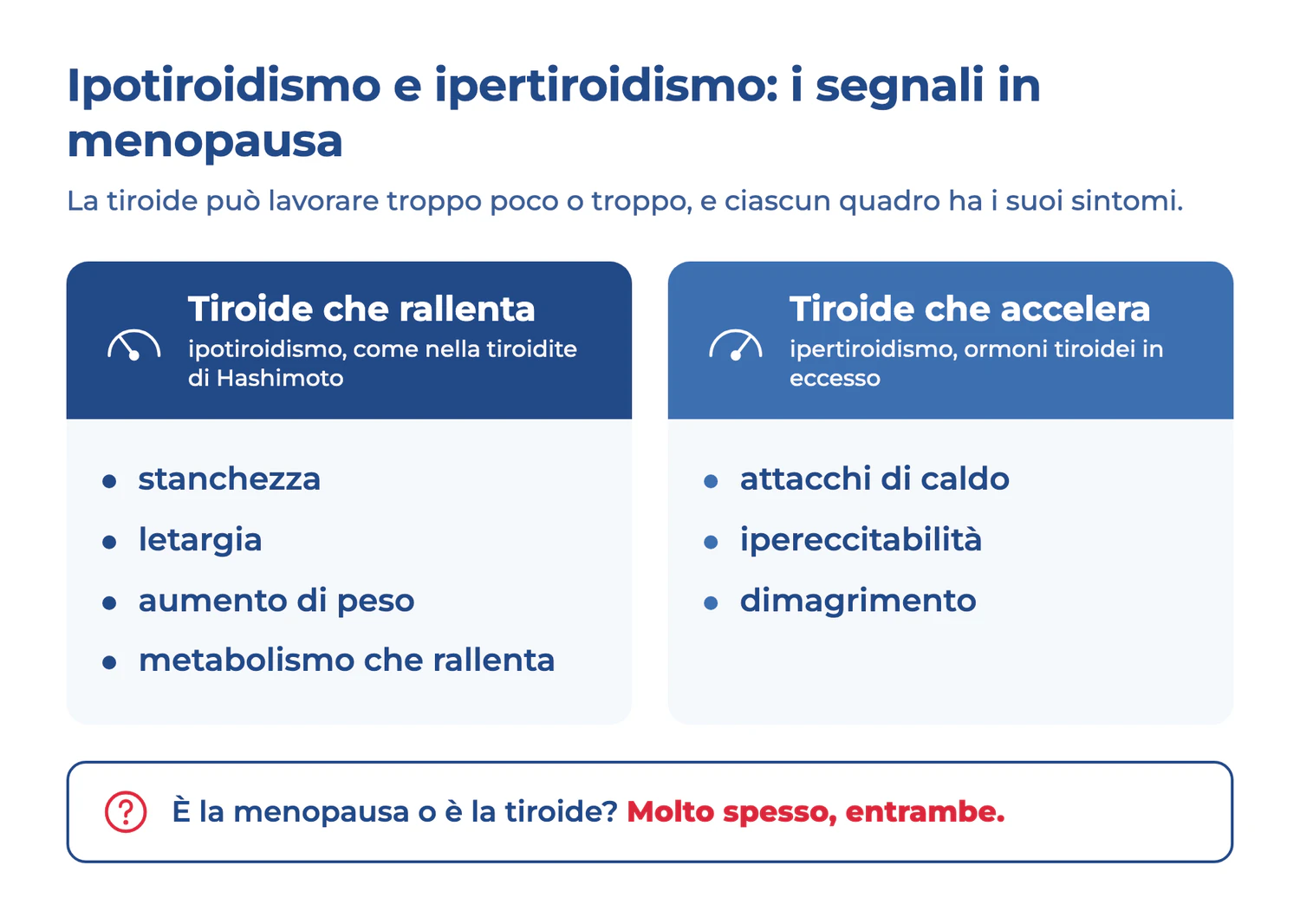
The thyroid and menopause are closely linked. Some thyroid diseases make it work too much, others too little: thyroid hormones in the blood rise or fall, and each situation has its own symptoms.
- Too much thyroid hormone (hyperthyroidism): surges of heat, hyperexcitability, weight loss.
- Too little thyroid hormone (hypothyroidism, as in Hashimoto's thyroiditis): tiredness, lethargy, weight gain, a metabolism that slows down.
These are the same signs that many women put down to menopause alone. And the lack of sex hormones weighs on the thyroid: it reduces its function and hinders the conversion between FT4 and FT3, the two forms of thyroid hormone that we have in the blood.
If you recognise yourself in these symptoms, you can talk to Dr Lenzi about it: the first consultation is free and with no obligation, also by video call.
Menopause, hormone fluctuations and the thyroid: what really happens

When a woman approaches menopause, the levels of sex hormones, in particular oestrogen, begin to fluctuate markedly. They can rise and fall rapidly, causing:
- hot flushes
- insomnia
- irritability
- irregular periods
- water retention
- changes in weight
But these fluctuations do not affect only these “classic” symptoms: they also touch the way the thyroid works.
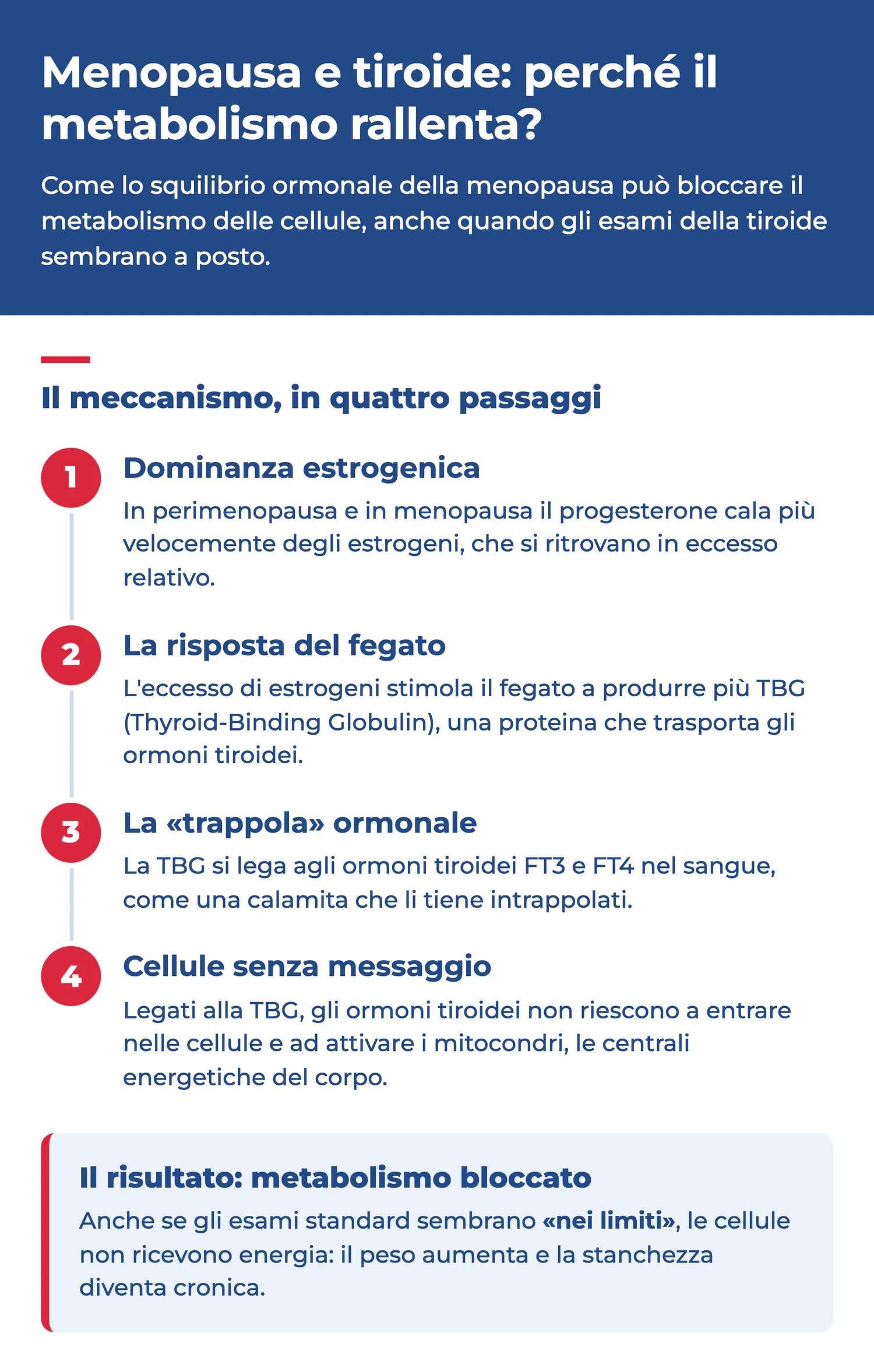
Oestrogen dominance: when oestrogen “puts the brakes on” the thyroid
When oestrogen is in excess relative to progesterone, we speak of oestrogen dominance. In this condition a protein produced by the liver, TBG (thyroxine-binding globulin), increases, and it plays a key role:
- TBG binds to thyroid hormones (in particular FT3 and FT4) in the blood
- when they are bound to TBG, thyroid hormones cannot enter the cells and exert their action
- Result: blood tests of thyroid function can come back “within range”, but the cells receive little of the thyroid message
In practice:
- On the lab report everything looks “fine”, but at tissue level the metabolism is slowed.
- Visible consequence: THE METABOLISM GETS BLOCKED AND WEIGHT GOES UP.
This is a typical situation for many women in perimenopause and menopause: standard tests that look normal, but clear symptoms of a slowed metabolism and tiredness.
FT3, FT4 and rT3: thyroid hormones explained simply
To understand the link between menopause and the thyroid, it helps to know the three main thyroid hormones:
- FT3 (free triiodothyronine)
- FT4 (free thyroxine)
- rT3 (reverse T3)
FT3: the “active” hormone of metabolism
FT3 is the active form of the thyroid hormones. It regulates the activity of the mitochondria, the “powerhouses” of the cells. Much of the functioning of the following depends on it:
- brain (attention, memory, concentration)
- muscles (strength, endurance)
- heart
- digestive system
From what we have seen, it is clear that:
- menopause and the thyroid are closely related
- any treatment pathway based on sex hormones (including bioidentical hormones) must give thyroid function great consideration
In practice, before setting up (or changing) a hormone therapy for menopause, it is essential to:
- assess not only TSH, FT3 and FT4, but also the overall hormonal picture
- interpret the results in light of the woman's symptoms
- consider any signs of oestrogen dominance or progesterone deficiency
- check whether the metabolism is really “fed” by thyroid hormones at cell level, not just “on paper” in the tests
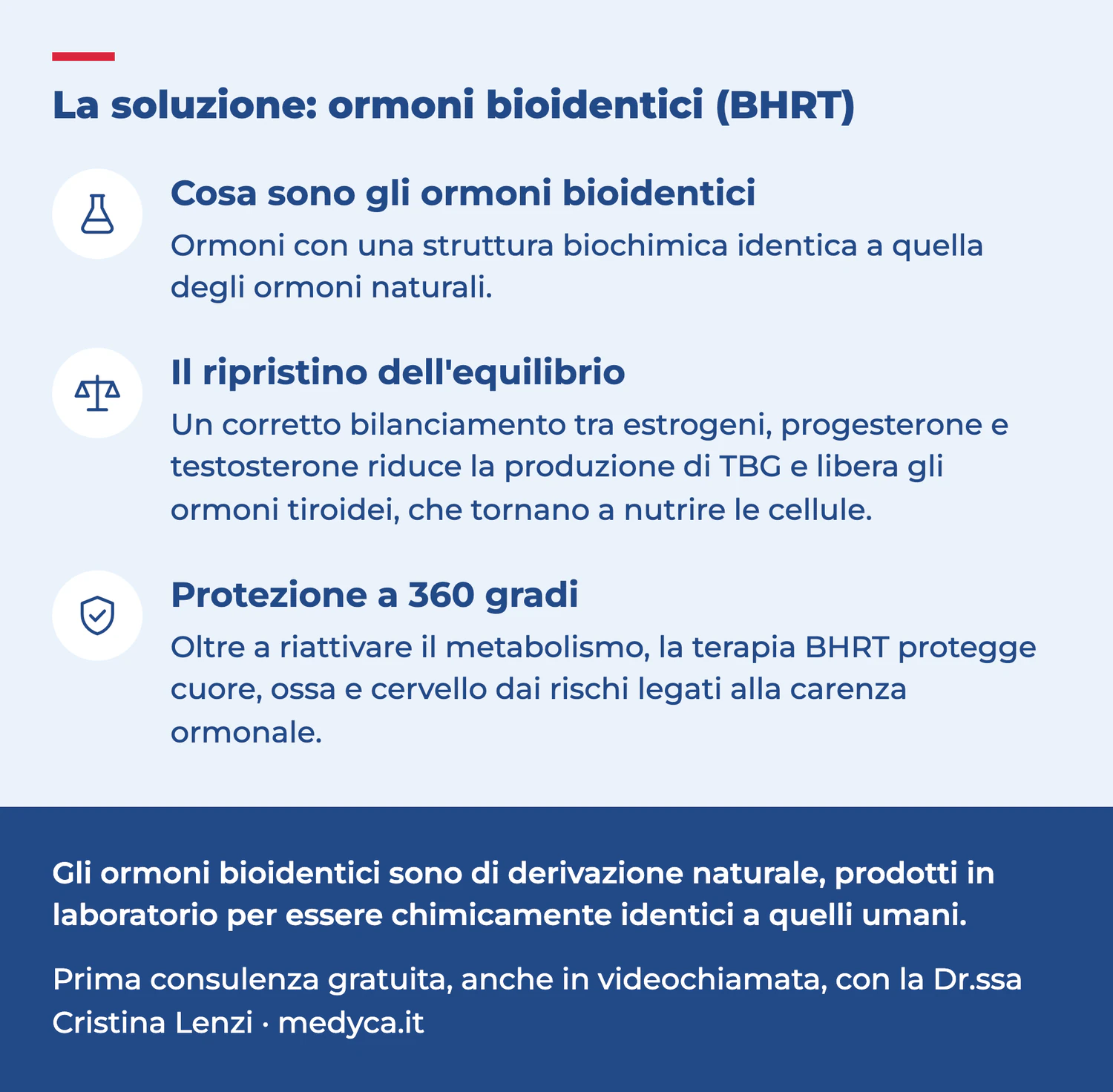
An integrated approach, using well-balanced, personalised bioidentical hormones, can:
- support the thyroid
- improve energy, weight, mood and quality of sleep
- reduce the risk of metabolic disorders (insulin resistance, changes in cholesterol and triglycerides)
Eutirox in menopause: should it be changed or stopped?
The most common treatment for Hashimoto's thyroiditis is Eutirox, that is, thyroxine, FT4. FT4, however, is not the active form: to work it has to be converted into FT3. If the body cannot convert it, taking ever higher doses does little good.
With hormone therapy, this mechanism of conversion from T4 to T3 starts working again. For this reason, paradoxically, some women who take thyroxine may end up taking less of it.
The dose, however, is decided by the doctor who looks after you, on the basis of your tests: Eutirox is not stopped or changed on your own.
Frequently asked questions about the thyroid and menopause

Can I have thyroid problems even if my TSH is normal?
Yes. In some situations (such as oestrogen dominance) thyroid hormones are present in the blood but are too tightly bound to transport proteins and not very available to the cells. This is what is called, in simple terms, a picture of “functional hypothyroidism”.
Is it normal to gain weight in menopause?
A slight change in weight and in the distribution of fat is common. However, when the increase is marked, rapid or resistant to dieting, it is important to assess both the sex hormones and the thyroid, as well as lifestyle.
Can bioidentical hormones help the thyroid too?
If correctly prescribed and balanced (oestrogen, progesterone, testosterone), bioidentical hormones can improve overall hormonal balance and reduce the negative effects of oestrogen dominance on the thyroid. They do not replace any thyroid treatment where it is needed, but they can make it more effective.
How can I tell whether my symptoms are caused by the thyroid or by menopause?
Many symptoms overlap (tiredness, weight gain, mood swings, insomnia). What makes the difference is a complete medical assessment, one that brings together: medical history, examination, hormone tests (sex hormones and thyroid), clinical signs and lifestyle.
A correct assessment of menopause and the thyroid, considering them together and not as two separate worlds, is the first step to regaining energy, balance and wellbeing.
What are the symptoms of hypothyroidism in menopause?
Tiredness, lethargy, weight gain and a metabolism that slows down, as in Hashimoto's thyroiditis; often also dry skin, more brittle hair, lower mood and a sluggish bowel. These are the same signs seen in many women in menopause, which is why the thyroid and sex hormones need to be assessed together.
Is it advisable to stop Eutirox in menopause?
No, not on your own. With hormone therapy some women end up taking less, but it is the doctor who looks after you who decides this, on the basis of your tests.
What TSH values are normal in menopause?
Reference values depend on the laboratory, because each one has its own units of measurement. But even a value within range is not enough to say that the thyroid is working well: it has to be read together with FT3 and FT4, the picture of the sex hormones and the symptoms. If thyroiditis is suspected, anti-thyroid peroxidase and anti-thyroglobulin antibodies are added, and often an ultrasound scan.
Does Hashimoto's thyroiditis change with menopause?
Menopause does not cause Hashimoto's thyroiditis, but it often brings it to light: the symptoms overlap, and the lack of sex hormones weighs on the way the thyroid works, so a problem that had stayed silent can make itself felt at precisely this stage. In early menopause, on the other hand, Hashimoto's thyroiditis is among the autoimmune causes that the doctor goes looking for.
Where to start
Tiredness, extra weight and disturbed sleep can depend on the thyroid, on the sex hormones or on both, and to find out you need tests read together with your symptoms and your history. That is why, at the first visit of the Bioidentical Hormone Pathway, the doctor also assesses the thyroid alongside the hormone profile, because the state of the thyroid can change what the therapy consists of. If you first want to understand whether the pathway is right for you, you can talk about it in a free introductory consultation with a doctor, also by video call.
Do you want to find out whether hormones are behind it?
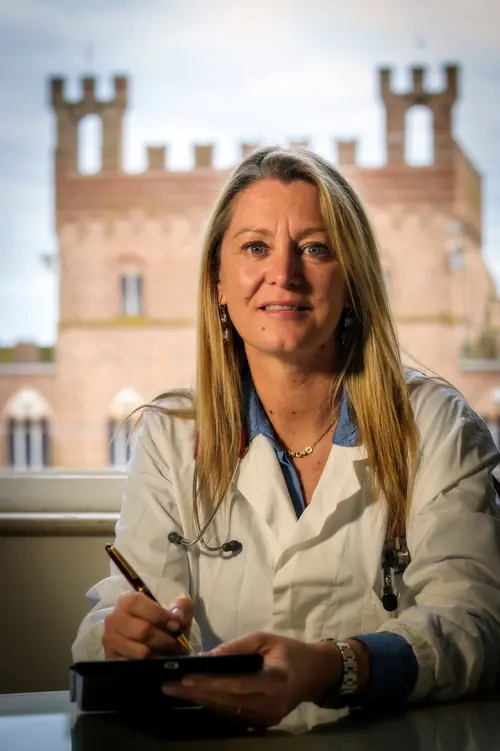
Dr Cristina Lenzi
Dr Cristina Lenzi is an internal medicine physician and the Medical Director of Medyca, where she looks after women's health in perimenopause and menopause with bioidentical hormone therapy.

Medyca is a medical service founded by Dr Cristina Lenzi, one of the few doctors in Italy specialising in bioidentical hormone therapy. A specialist in Internal Medicine, cum laude, from the Università di Siena, she holds a PhD in osteometabolic diseases and Level I and Level II Master's degrees in bioidentical hormones from the Marion Gluck Clinic in London.
The first introductory consultation is free and without obligation: it is the way to find out more and understand whether the pathway is right for you. We look after patients from anywhere in Italy by video call, and in person at our practice in Siena.
Thyroid care is included in the pathway, at no extra cost.
Find out more: