Menopause weight gain: why it happens and what to do

Written by Prof. Riccardo Sarzani & Dr Lucia Stella
In brief
- During the transition to menopause, fat mass tends to increase and to settle more in the abdomen, while muscle mass tends to decrease.
- Every increase in fat mass results from the balance between the energy that comes in and the energy that is used, while where it is distributed in the body depends on several factors, including hormonal ones.
- Visceral fat, the fat found around the organs, carries a health risk and can be present even in people who are only overweight.
- In the same period around menopause, blood levels of cholesterol, triglycerides and glucose also change, and blood pressure rises: conditions that can be measured but cannot be felt (an asymptomatic danger).
- The simplest measurement to take at home to find out whether you have visceral obesity: waist circumference in centimetres divided by height in centimetres. A result above 0.5 indicates visceral obesity.
Would you like to talk it through with a doctor?
The first consultation is free, also by video call.
Book a free consultationWhy is your weight changing right now?
The menopausal transition is the period before and after menopause (menopause is established when periods have been absent for 12 months), when ovarian function gradually declines and oestrogen levels fall. It is one of the most critical times in a woman's life for weight gain.
It is not your imagination: a woman around the time of menopause has a higher risk of becoming overweight or obese, even though many women are already overweight or obese before the transition begins, and in them the transition makes the weight problem worse.
One thing needs to be said straight away, because it is the most important and also the least talked about. Behind every increase in fat mass (before, during or after menopause) there is always an imbalance in the energy balance: you take in more energy from food and drink than you use through basal metabolism and physical activity. And the excess is stored as fat in the adipose tissues. Menopause does not suspend this rule. It changes the conditions in which it applies, and those changes are covered in the rest of this article.
What changes in the body?
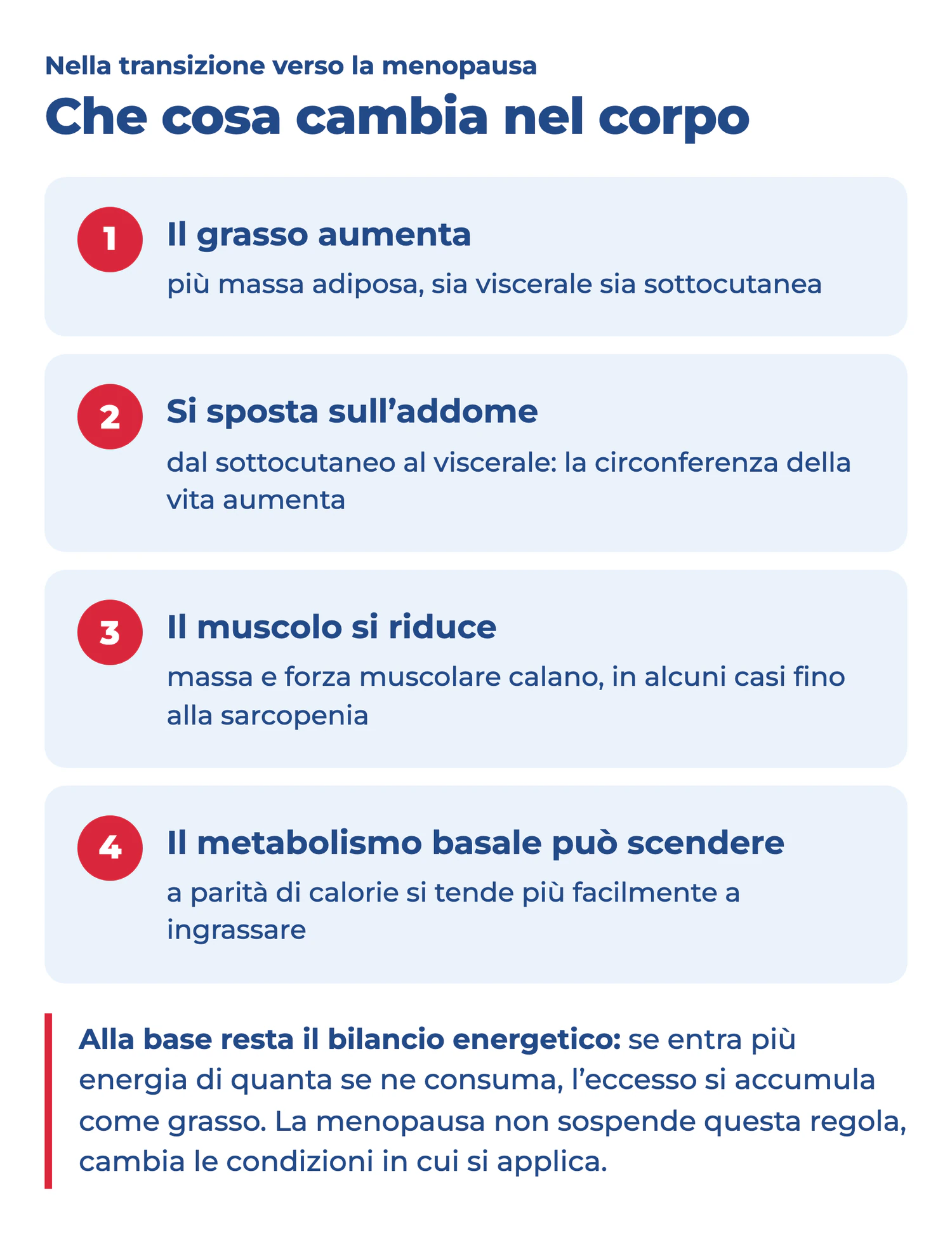
The amount of fat increases. Compared with a woman of childbearing age, a woman in menopause tends to have a higher percentage of fat mass, both visceral and subcutaneous, partly because of the drop in oestrogen.
And above all, where it is stored changes. Fat tends to shift from the subcutaneous compartment to the visceral-abdominal one, and waist circumference increases. This is a change that matters more than the scales suggest, because visceral fat is the most dangerous form of adiposity: it is associated with high blood pressure, prediabetes and diabetes, abnormal blood lipids and, over the years, heart attack, stroke and kidney failure. And you do not have to reach obesity: it can be present even in plain overweight.
Muscle decreases. Muscle mass and strength tend to decrease, in some cases to the point of sarcopenia, because of the decline in oestrogen, which has a trophic effect on muscle and bone, in some cases also because of the reduction in androgens, and also because of reduced secretion of growth hormone (GH) and of IGF-1. If on top of this there is little physical activity, and in particular a lack of resistance exercise, the stimulus that keeps muscle in place is missing; a diet with inadequate protein intake makes the picture worse still. The risk is sarcopenic obesity: more fat mass, more visceral obesity and less muscle mass, all at once.
Basal metabolism may fall. During the transition there can also be a reduction in basal metabolism, so that, with truly and measurably the same calorie intake as before, you tend to gain weight more easily. The main factor is precisely the loss of muscle mass; oestrogens may also play a role through direct actions on adipocytes. This is why resistance exercise is not a cosmetic detail: it is the part of the programme that protects the metabolism.
How do you measure it without special equipment?
The diagnosis of overweight and obesity is still based on the body mass index (BMI), which is calculated by dividing weight in kilograms by the square of height in metres: overweight from 25 to 29.9 kg/m², obesity from 30 upwards. So all we need is an accurate measurement of “naked” weight and of height in metres.
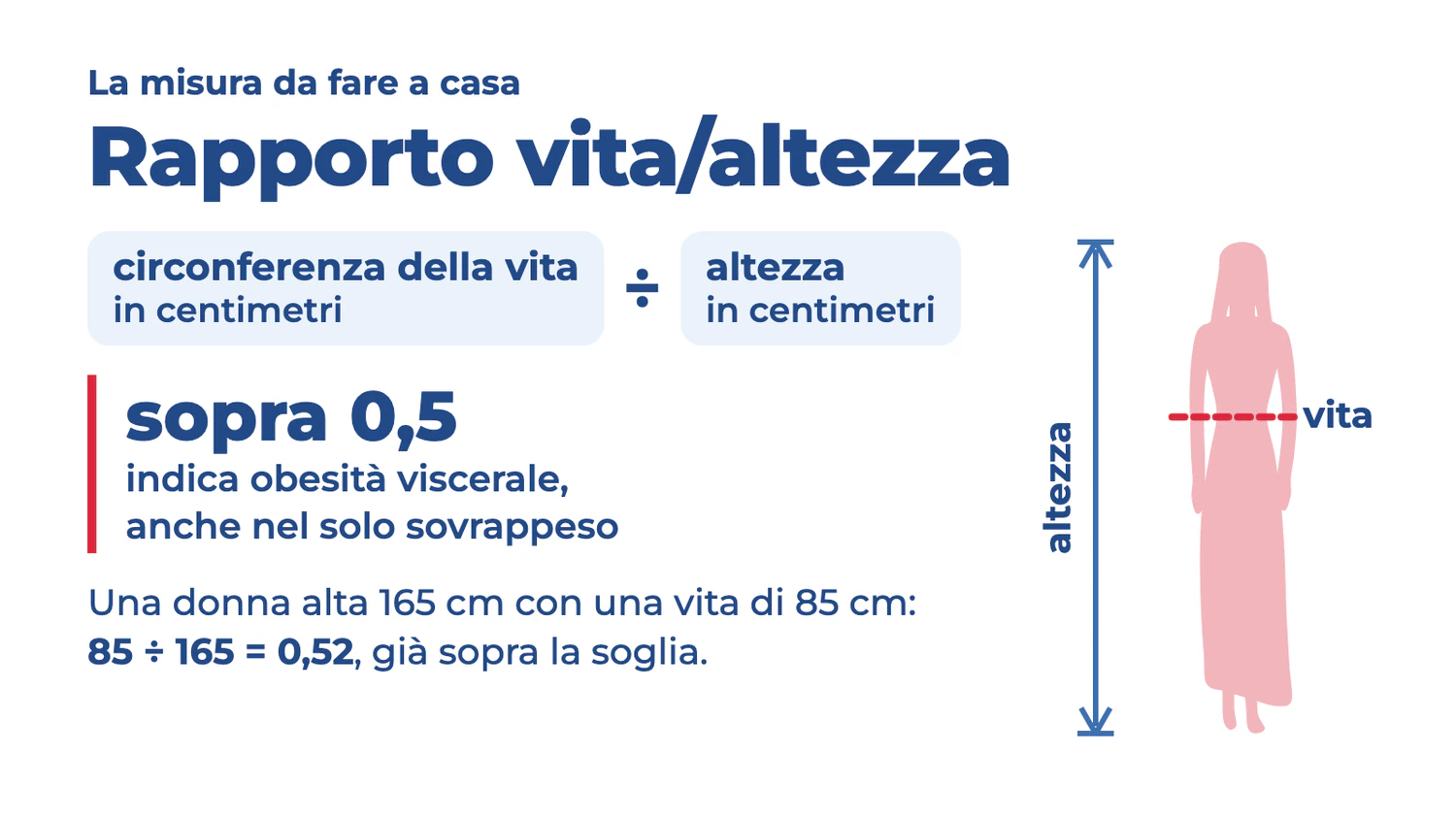
But body mass index does not tell you where the fat is, and at this stage that is exactly what matters. The most useful measurement to take at home is a different one: take your waist circumference in centimetres and divide it by your height in centimetres. If the number is above 0.5, it indicates visceral obesity, even in people who are only overweight. A woman who is 165 cm tall with an 85 cm waist is already over the threshold.
This index does not replace a medical assessment, and it is not a diagnosis. It is a way to become aware of the problem and talk about it with a doctor who works in this field.
What should you get checked?
In the same phase in which weight changes, three “metabolic” profiles also change, and they cause no symptoms. You can only see them with blood tests, and that is why it is worth doing the tests early.
Blood lipids. With menopause the lipid profile worsens: LDL cholesterol, triglycerides and apolipoprotein B go up, while HDL cholesterol goes down. A recent study of 2,582 middle-aged women reconstructed the trajectories of lipids during the transition: total cholesterol, LDL and apolipoprotein B begin to rise already about five years before the last period, reach a peak and then tend to level off in the following years. The practical consequence is that the lipid profile should be checked early and repeated over time during the transition, not just once. This study and earlier ones also stress that the problems linked to menopause begin years before periods stop.
A warning that spares a lot of disappointment: high LDL cholesterol, and also its rise in perimenopause, depend largely on inherited polygenic genetic factors. Diet makes only a small difference, generally just 10–15%, to blood cholesterol levels. Lifestyle should therefore always be corrected; but to reach the target that an individual's cardiovascular risk requires, medicines are almost always needed as well. What that target is depends on overall risk: European guidelines call for keeping LDL cholesterol below 100 mg/dL in moderate risk, below 70 in high risk and below 55 in very high risk. In the last two cases you also need to reduce LDL cholesterol by 50% from the starting values, which are often in what is defined as the “normal” laboratory range.
Blood sugar. The fall in oestrogen and the change in body composition reduce the sensitivity of tissues to insulin (insulin resistance), above all because of the increase in visceral fat and the reduction in muscle mass. A woman in perimenopause is therefore at risk of insulin resistance and prediabetes and then, with an additional family genetic predisposition, of type 2 diabetes as well. Overweight and visceral obesity are the rule in both prediabetes and diabetes in adults and the elderly, which is precisely type 2 diabetes. To identify whether there is resistance to the action of insulin, besides the HOMA index, which requires measuring blood glucose and insulin, simpler indices are emerging: the waist-to-height ratio for visceral obesity and an index (TyG) calculated with a formula based on triglyceride and blood glucose values.
Blood pressure. Hypertension (blood pressure of 140 and/or 90 mmHg or above) often develops precisely in perimenopause, and is more common in postmenopausal women than in premenopausal ones. Even though there is a polygenic predisposition to so-called “essential” hypertension, oestrogens contribute to the elasticity of the vessels (they act on vascular tone and endothelial function), and their decline can favour a rise in blood pressure. But it is often weight gain associated with a diet too rich in salty and sweet foods that leads to the rise in blood pressure. Postmenopausal women have, on average, higher blood pressure than premenopausal ones: some studies indicate an increase of about 4 mmHg in both systolic and diastolic pressure.
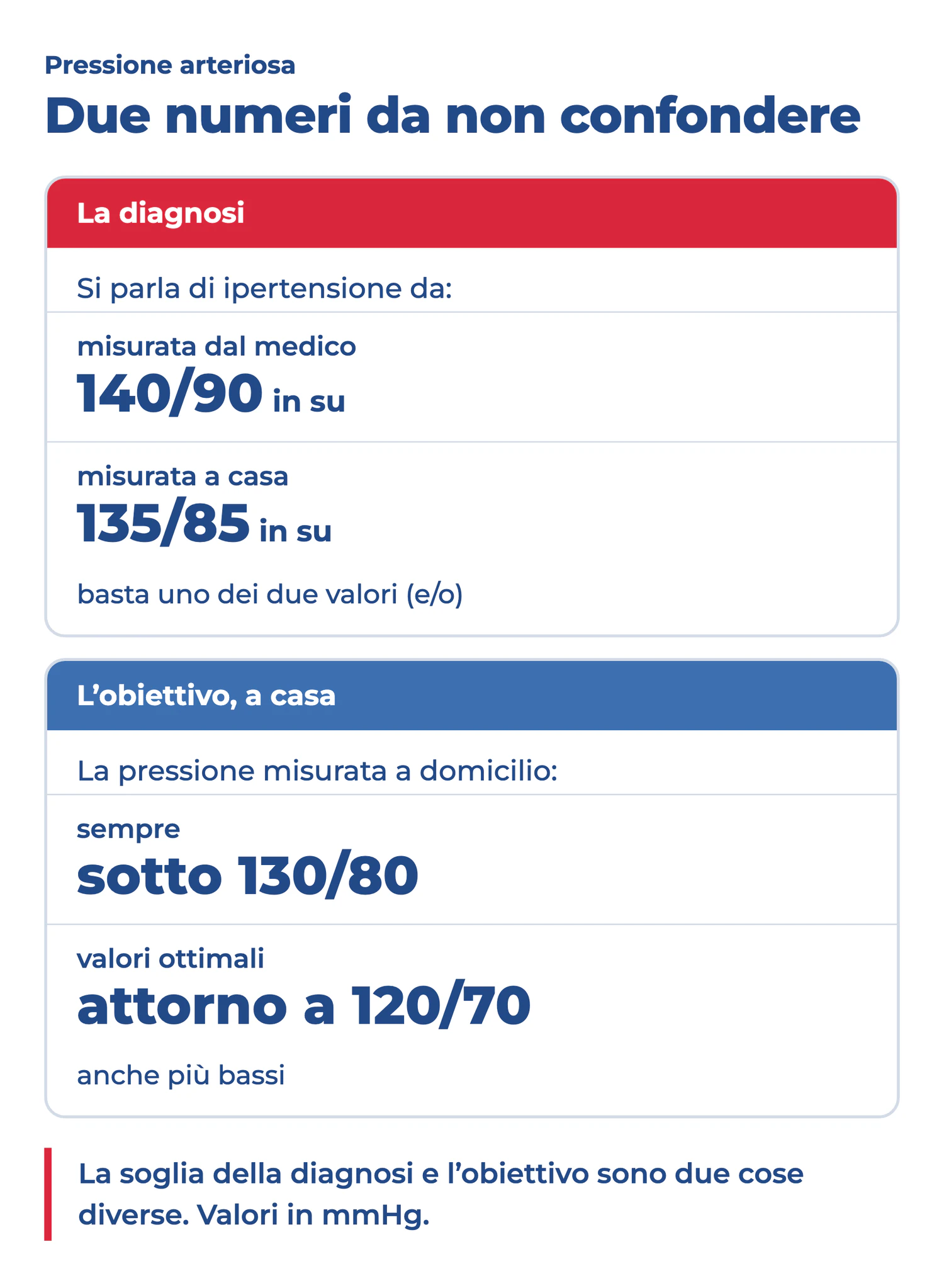
Here two sets of numbers are needed, which are easy to confuse. We speak of hypertension from 140 and/or 90 mmHg upwards when blood pressure is measured by the doctor, and from 135 and/or 85 upwards when it is measured at home: these are the thresholds for diagnosis. The target is something else: blood pressure measured at home should stay always below 130/80, with optimal values lower still, around 120/70.
Overall cardiovascular risk. None of the values, such as cholesterol or blood pressure, should be considered on its own. The menopausal transition, with the increase in visceral fat mass, LDL cholesterol and blood pressure, translates into an increase in overall cardiovascular risk — that is, the probability of suffering a heart attack or stroke or even chronic kidney damage. It is particularly marked in people who were already overweight or obese before perimenopause. For this reason a woman in transition, especially if already overweight, should be taken on early by an experienced doctor, with an assessment of her anthropometry (body measurements, with attention to waist circumference), of her lipid and glucose profile, of her creatinine and blood pressure, and also of other parameters, including blood levels of Lp(a), a particular lipoprotein that can be genetically elevated and cause damage to the arteries and heart valves.
What can you do about it?
Metabolic and cardiovascular prevention starts with lifestyle:

- reaching and maintaining an appropriate body weight;
- following a healthy, mostly plant-based diet on the Mediterranean model;
- doing regular physical activity, both aerobic and resistance exercise;
- keeping blood glucose under adequate control;
- keeping cholesterol under adequate control;
- keeping blood pressure under adequate control;
- avoiding smoking, including passive smoking;
- ensuring adequate duration and quality of sleep;
- promoting psychological wellbeing.
On the Mediterranean model there is no shortage of data: it is one of the dietary patterns best supported by evidence for reducing cardiovascular risk, including in peri- and postmenopausal women. Prospective data from the Women's Health Initiative and the Study of Women's Health Across the Nation show that a healthy dietary pattern is associated with better cardiometabolic parameters and may help limit the weight gain associated with menopause. A word of warning: in the “Mediterranean diet”, contrary to what you might think, pizza is not part of it, and is in fact strongly discouraged.
On smoking, a figure worth knowing: in postmenopausal women, active smoking is associated, compared with never-smokers, with about three times the risk of ischaemic heart disease and almost three times the risk of stroke. Stopping is associated with a reduction of about a third in the risk of ischaemic stroke within three years, compared with those who continue to smoke. The recommendation also applies to passive smoking.
When lifestyle is not enough, and this does happen, it is not a personal failure: for LDL cholesterol medicines are almost always needed, for blood pressure in most cases a combination therapy is needed, especially in the presence of overweight, and for overweight there are now drug treatments that have successfully changed the picture. In all these cases the treatment is decided by the doctor, on the basis of the individual profile. These are not decisions to make on your own, and they are not decisions to make by reading an article or watching a video on social media: you often need doctors with specific expertise in these matters.
Obesity is a disease, and in Italy the law says so
A 2025 Lancet Commission distinguishes preclinical obesity (excess adipose tissue with tissue and organ function still preserved, and variable risk) from clinical obesity, a state of chronic, systemic disease with impaired tissue and organ function.
Italy has recognised in law that obesity, which is linked to other diseases of social importance, is a progressive and relapsing disease: law no. 149 of 3 October 2025, in force since 24 October 2025. The same law provides that people with obesity have access to the services included in the essential levels of care provided by the Italian National Health Service (SSN). It must be said that the law has yet to be implemented, and that resources are needed to do so.
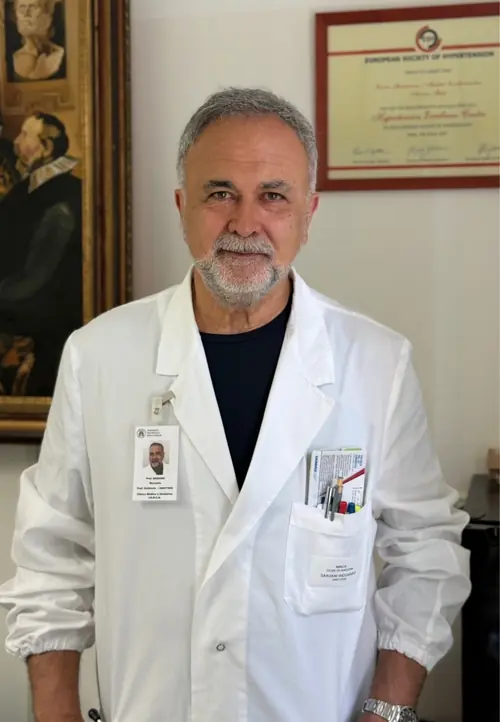
Prof. Riccardo Sarzani
Full Professor of Internal Medicine at the Università Politecnica delle Marche — the scientific advice behind Medyca's cardiometabolic assessment. He supports Medyca as scientific adviser in building the cardiometabolic assessment and fitting it into the Bioidentical Hormone Pathway: what is measured, how the results are read, when it makes sense to offer it. It is the contribution that extends Medyca's 360° approach to menopause to the heart, blood pressure and metabolism.

Dr Lucia Stella
Physician, specialist in Nutrition Science — the cardiometabolic assessment of Medyca's patients.
She is the specialist who carries out the cardiometabolic visits for patients on the Bioidentical Hormone Pathway: weight and waist circumference, blood pressure, lipid and glucose profile, in coordination with the doctor who looks after them.
Medyca is a medical service founded by Dr Cristina Lenzi, one of the few doctors in Italy specialising in bioidentical hormone therapy. A specialist in Internal Medicine, cum laude, from the Università di Siena, she holds a PhD in osteometabolic diseases and Level I and Level II Master's degrees in bioidentical hormones from the Marion Gluck Clinic in London.
The first introductory consultation is free and without obligation: it is the way to find out more and understand whether the pathway is right for you. We look after patients from anywhere in Italy by video call, and in person at our practice in Siena.
Find out more:
- Weight-loss medication in menopause: what GLP-1 analogues are and who they are suitable for
- What are bioidentical hormones, and how do they differ from synthetic hormones?
- How bioidentical hormone therapy (BHRT) works: effects, contraindications and the role of your doctor
Sources
- Nappi RE, Chedraui P, Lambrinoudaki I, Simoncini T. Menopause: a cardiometabolic transition. Lancet Diabetes Endocrinol. 2022;10(6):442-456. PMID: 35525259.
- Sarzani R, Spannella F, Falcioni P, Ortensi B, Massacesi A, Di Pentima C, Giulietti F. L'adipocentricità dei comuni problemi metabolici, cardiovascolari e renali nei pazienti obesi (parts I and II). Giornale Italiano dell'Arteriosclerosi 2023;14(4):11-30 and 31-58.
- Sarzani R, Landolfo M, Di Pentima C, et al. Adipocentric origin of the common cardiometabolic complications of obesity in the young up to the very old. Front Med (Lausanne). 2024;11:1365183. PMID: 38654832.
- Lumsden MA, Dekkers OM, Faubion SS, et al. European Society of Endocrinology clinical practice guideline for evaluation and management of menopause and the perimenopause. Eur J Endocrinol. 2025;193(4):G49-G81. PMID: 41082911.
- Wu B, Fan B, Qu Y, et al. Trajectories of Blood Lipids Profile in Midlife Women: Does Menopause Matter? J Am Heart Assoc. 2023;12(22):e030388. PMID: 37947109.
- Mach F, Baigent C, Catapano AL, et al. 2019 ESC/EAS Guidelines for the management of dyslipidaemias: lipid modification to reduce cardiovascular risk. Eur Heart J. 2020;41(1):111-188. PMID: 31504418. Update: Mach F, Koskinas KC, Roeters van Lennep JE, et al. 2025 Focused Update of the 2019 ESC/EAS Guidelines for the management of dyslipidaemias. Eur Heart J. 2025;46(42):4359-4378. DOI: 10.1093/eurheartj/ehaf190.
- Cano A, Marshall S, Zolfaroli I, et al. The Mediterranean diet and menopausal health: an EMAS position statement. Maturitas. 2020;139:90-97. PMID: 32682573.
- Dinh PC, Schrader LA, Svensson CJ, Margolis KL, Silver B, Luo J. Smoking cessation, weight gain, and risk of stroke among postmenopausal women. Prev Med. 2019;118:184-190. PMID: 30359645.
- Rubino F, Cummings DE, Eckel RH, et al. Definition and diagnostic criteria of clinical obesity. Lancet Diabetes Endocrinol. 2025;13(3):221-262. PMID: 39824205.
- Legge 3 ottobre 2025, n. 149, Disposizioni per la prevenzione e la cura dell'obesità (GU n. 235 del 09/10/2025), art. 1 c. 2 and art. 2.