Weight-loss medication in menopause: what GLP-1 analogues are and who they are suitable for


Written by Prof. Riccardo Sarzani & Dr Lucia Stella
In brief
- GLP-1 analogues, also called GLP-1 receptor agonists, are the “copy” of a peptide hormone that the small intestine normally produces.
- Their action is predominantly at the level of the stomach, relaxing its muscles and slowing its emptying. Above all for this reason they reduce appetite, by communicating with the central nervous system: the result is that you take in less food without great mental effort over your diet and you achieve a negative energy balance, the only real mechanism that leads to a reduction in body weight.
- They are not an “over-the-counter” product, let alone a “supplement”, and they are not for everyone: only a doctor can prescribe them, after a clinical assessment, and they are collected from a pharmacy (reimbursed by the Italian National Health Service (SSN) if you have type 2 diabetes mellitus).
- In menopause, this GLP-1-based therapy can be prescribed just as it is for patients who are not in menopause, and likewise for men and for adolescents from the age of 12, because the drugs work and are very safe, without the side effects of the therapies of the past that are no longer prescribed (amphetamines and similar drugs, or drugs such as rimonabant).
Would you like to talk it through with a doctor?
The first consultation is free, also by video call.
Book a free consultationWhat they are
GLP-1, or glucagon-like peptide 1, is a peptide hormone that our small intestine normally produces. The drugs of this family (semaglutide is the best known) are essentially a copy of it, but with a duration of action that, in the weekly subcutaneous injectable version, allows a single administration per week. Others, such as tirzepatide, are also agonists or antagonists of other receptors for other intestinal peptides or for hormones such as glucagon, but always and in any case what matters is the similarity to GLP-1 and the activation of the GLP-1 receptor. For semaglutide, by the end of 2026 there will also be an oral version (one tablet a day) for patients with overweight or obesity.
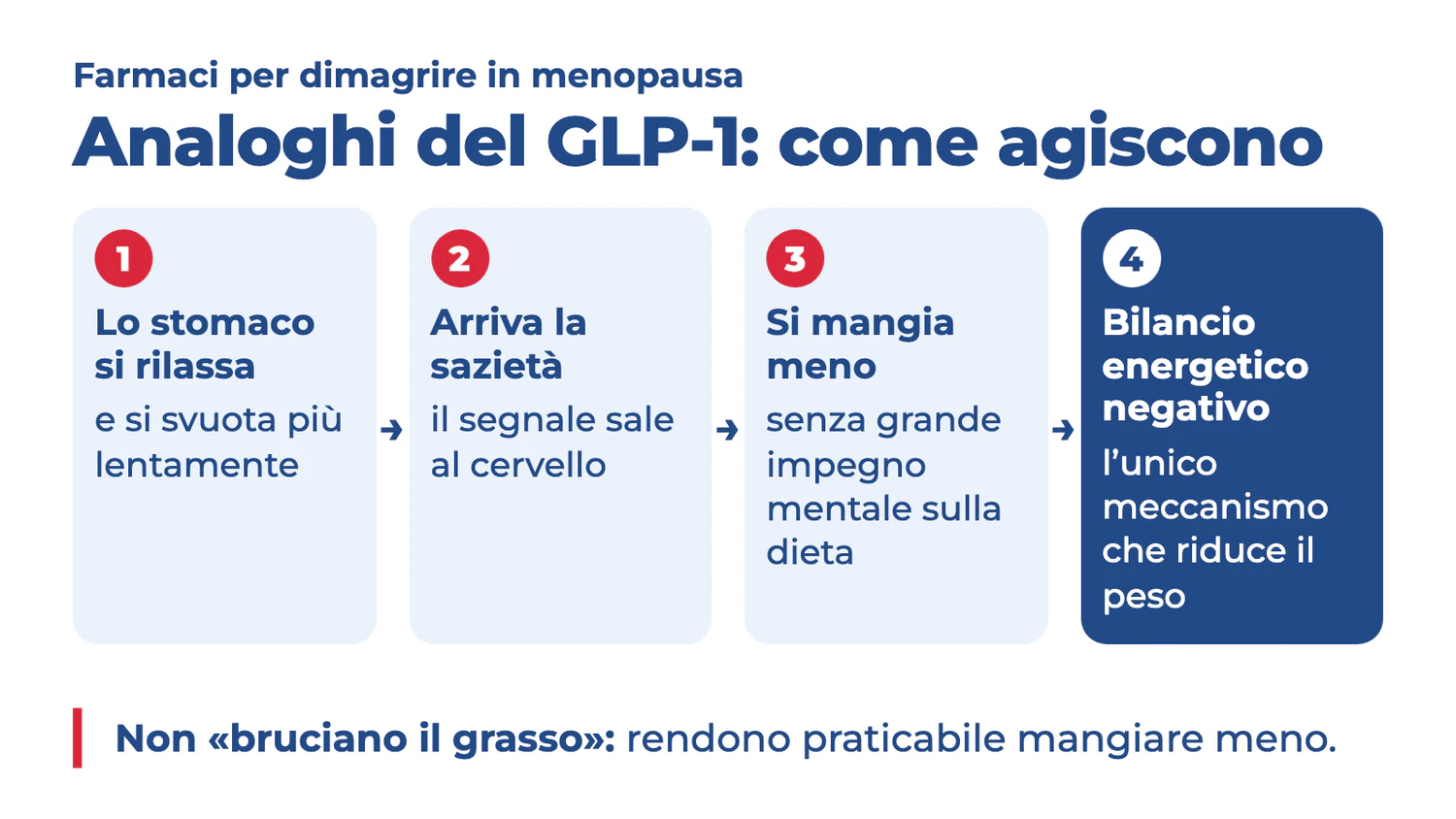
As to how they work, the most widely held explanation is that they act on the GLP-1 receptors in the central nervous system, stimulating the satiety circuit at the level of the hypothalamus and reducing hunger. However, this has been shown mainly in experimental studies in rodents and, on the contrary, patients with a genetic defect in this very circuit respond equally to semaglutide or to other agonists (liraglutide, tirzepatide) that stimulate the GLP-1 receptor. In the light of new studies, these GLP-1 analogues are believed to act on receptors located on particular intestinal neurons, which in turn stimulate other neurons of the sympathetic system, causing the muscles of the stomach to relax. Then another gastro-spinal nerve pathway, even without involving the vagus nerve, communicates to the nerve centres of the brain the sense of satiety due to the slowed gastric emptying.
Setting aside any ancillary benefits mediated by the GLP-1 receptor in various tissues, the fundamental effect is therefore the consequence of “eating less” and hence of a negative energy balance, the only known mechanism capable of reducing body weight by reducing fat mass. Put another way: these drugs do not “burn fat”, as is wrongly claimed for other products in misleading advertising. GLP-1 analogues make it feasible to eat less, even for those who have tried dieting many times but have then failed.
Who they are suitable for
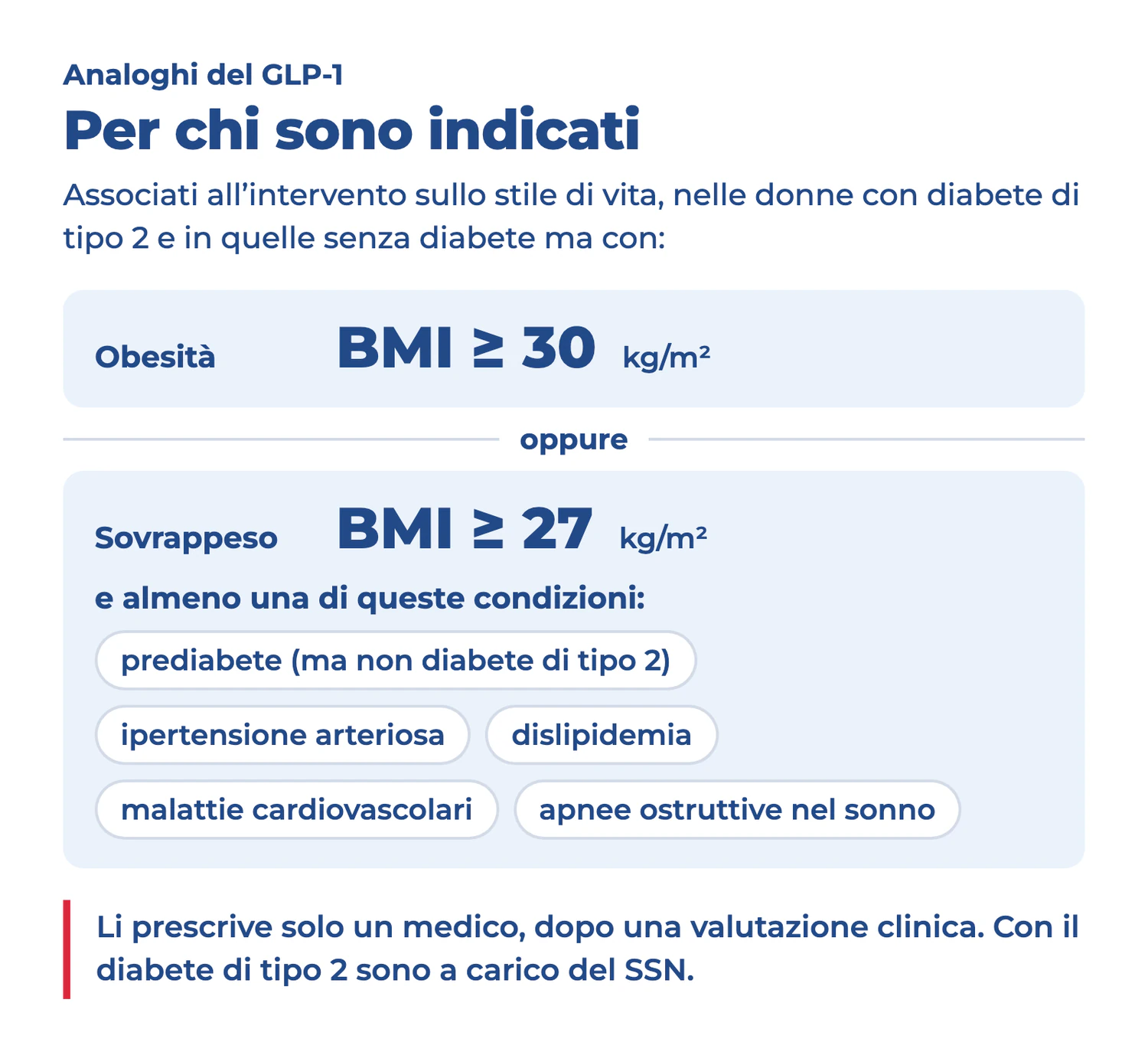
GLP-1 analogues, combined with lifestyle intervention, have shown efficacy in reducing weight in women both with type 2 diabetes mellitus and in those without diabetes but with:
- obesity, that is, a body mass index of 30 kg/m² or above; or
- overweight, with a body mass index of 27 kg/m² or above, if at least one condition associated with obesity is present: prediabetes (but not type 2 diabetes), arterial hypertension, dyslipidaemia, cardiovascular disease, obstructive sleep apnoea.
These drugs are therefore prescribed by the doctor when these conditions are present and, if type 2 diabetes mellitus is present, they are reimbursed by the Italian National Health Service (SSN).
What the studies show
In non-diabetic patients treated with semaglutide 2.4 mg, a large study found an average reduction in body weight of 9.4 kg, a reduction in waist circumference of 7.6 cm and a reduction in systolic blood pressure of about 3.8 mmHg, against 0.5 mmHg in the placebo group. The lipid profile also improved: total cholesterol −4.6%, LDL −5.2%, triglycerides −18.3% and HDL +4.9%; in the placebo group, over the same period, −1.9%, −3.1%, −3.2% and +0.6% respectively.
With this class of drugs as a whole, it is possible to lose up to 20% of body weight. Even modest losses of 5% are accompanied by a marked improvement in metabolic and cardiovascular parameters, and a great deal depends on the molecule used, the dose, the duration and what you do in the meantime with diet and physical activity.
What has changed the way overweight and obesity are viewed goes beyond weight alone. In the SELECT study — carried out in people aged at least 45, with overweight or obesity (body mass index of 27 or above), established cardiovascular disease and no diabetes — semaglutide reduced major cardiovascular events by 20%, that is cardiovascular death, non-fatal myocardial infarction and non-fatal stroke, regardless of the starting body mass index. This relative reduction in the population studied was a striking result, but it is not a figure specific to women in menopause, although obviously the benefit is generalised and includes women in menopause.
What about menopause?
Treatment of overweight and obesity with semaglutide and other analogues can also be considered in women in menopause, under the same conditions that apply outside menopause, with benefits not only on weight but also on the metabolic profile.
There is also a recent strand of research that bears directly on women who are already on hormone therapy. Two cohort studies, one for each drug, observed greater weight loss in postmenopausal women with overweight or obesity who received both hormone therapy and the obesity drug, compared with those treated with the drug alone: 16% versus 12% at twelve months with semaglutide, and −19.2% versus −14.0% with tirzepatide.
Indeed, on this subject there is also a position statement from a scientific society dedicated specifically to women in perimenopause and postmenopause with obesity. Many other studies are under way to pin down the benefits in precisely this particular segment of the population: women in the menopausal transition as well as those who have been in menopause for some time.
Limitations and unwanted effects
The slowing of gastric emptying, which is part of the mechanism, is also the origin of the most common complaints. The stomach empties more slowly, a feeling of fullness arrives, and in some people this becomes a discomfort (called dyspepsia in medical terms) that can go as far as nausea; and if you keep eating too much in that state, sometimes out of habit without realising it, you can even end up vomiting. This is why doses are increased gradually, so as not to cause these symptoms in the person being treated.
The same slowing has a consequence that needs to be known beforehand, not afterwards: numerous associations of anaesthetists have issued recommendations to avoid aspiration pneumonia during anaesthesia in patients treated with these drugs, and similar warnings come from gastroenterologists who have to perform a gastroscopy. If you are taking a GLP-1 analogue and need to have an operation or an endoscopy, tell whoever is looking after you.

Why you need a doctor
Because the thresholds above are clinical thresholds, because the choice of molecule and dose depends on the overall picture, because there are situations in which these drugs must not be used, and because weight is never the only parameter being treated. An assessment of the metabolic and cardiovascular profile (waist circumference, lipid profile, blood glucose, blood pressure) is the starting point, not a later step.
If you are following the Bioidentical Hormone Pathway with Medyca, the cardiometabolic assessment is its complement, in the same 360° view of your health: it is the weight management and cardiometabolic health service in menopause that we run together with Dr Lenzi.

Prof. Riccardo Sarzani
Full Professor of Internal Medicine at the Università Politecnica delle Marche — the scientific advice behind Medyca's cardiometabolic assessment. He supports Medyca as scientific adviser in building the cardiometabolic assessment and fitting it into the Bioidentical Hormone Pathway: what is measured, how the results are read, when it makes sense to offer it. It is the contribution that extends Medyca's 360° approach to menopause to the heart, blood pressure and metabolism.

Dr Lucia Stella
Physician, specialist in Nutrition Science — the cardiometabolic assessment of Medyca's patients.
She is the specialist who carries out the cardiometabolic visits for patients on the Bioidentical Hormone Pathway: weight and waist circumference, blood pressure, lipid and glucose profile, in coordination with the doctor who looks after them.

Medyca is a medical service founded by Dr Cristina Lenzi, one of the few doctors in Italy specialising in bioidentical hormone therapy. A specialist in Internal Medicine, cum laude, from the Università di Siena, she holds a PhD in osteometabolic diseases and Level I and Level II Master's degrees in bioidentical hormones from the Marion Gluck Clinic in London.
The first introductory consultation is free and without obligation: it is the way to find out more and understand whether the pathway is right for you. We look after patients from anywhere in Italy by video call, and in person at our practice in Siena.
Find out more:
- Menopause weight gain: why it happens and what to do
- Hormone replacement therapy in menopause: what it is, when it is recommended, risks and how to start
- Health in menopause: protecting your heart, bones and brain and slowing the ageing process
Sources
- Stella L, Spannella F, Sarzani R. Adipo-centered Cardiovascular-Renal-Hepatic-Metabolic Syndrome and GLP-1 receptor agonists. Cardiologia ambulatoriale 2025;3:239-260. DOI: 10.17473/1971-6818-2025-3-6.
- Sarzani R, Spannella F, Falcioni P, et al. L'adipocentricità dei comuni problemi metabolici, cardiovascolari e renali nei pazienti obesi, parte II: nuove opportunità terapeutiche. Giornale Italiano dell'Arteriosclerosi 2023;14(4):31-58.
- Lincoff AM, Brown-Frandsen K, Colhoun HM, et al. Semaglutide and Cardiovascular Outcomes in Obesity without Diabetes (SELECT). N Engl J Med. 2023;389(24):2221-2232. PMID: 37952131.
- Hurtado MD, Tama E, Fansa S, Ghusn W, Anazco D, Acosta A, Faubion SS, Shufelt CL. Weight loss response to semaglutide in postmenopausal women with and without hormone therapy use. Menopause. 2024;31(4):266-274. PMID: 38446869.
- Castaneda R, Bechenati D, Tama E, et al. The role of menopause hormone therapy in modulating tirzepatide-associated weight loss in postmenopausal women with overweight or obesity: a retrospective cohort study. Lancet Obstet Gynaecol Womens Health. 2026;2(2):e118-e128. DOI: 10.1016/S3050-5038(25)00145-1.
- Sánchez-Prieto M, et al. Incretin-based therapies in peri- and postmenopausal women with obesity: an expert position statement from the Spanish Menopause Society. Maturitas. 2026;213:109101. PMID: 42664617.