Perimenopause: the early symptoms and what causes them
Written by Dr Cristina Lenzi
Early perimenopause symptoms almost always appear after 40, while you still have periods: a menstrual cycle that gets shorter or longer, waking at two or three in the morning, stiff joints in the morning, mood swings, breast tenderness the week before your period, tiredness, and weight gain with “normal” test results. Hot flushes, which every woman associates with menopause, often come last. There is a precise order behind all this: progesterone falls first, oestrogen fluctuates, and each symptom has its own hormone. Here you will find them all, one by one, with the age at which they appear and the tests to ask for.
“Doctor, I haven't felt like myself for some time.” It's what I hear most often in my practice, and behind it there are very different scenes. Some women wake at three in the morning drenched in sweat, others at two, as alert as if it were morning, only to crash at five. Some feel an exhaustion they have never felt before. Some notice that their clothes are a little tighter around the waist, on the same diet as ever. Some get up stiff and need a quarter of an hour to feel “oiled”. Some cry for no reason and then get irritated over nothing. Some still have their periods, but they are not what they used to be. Your thyroid tests are normal. You are 42, 45 or 48, and each of these complaints has already been given its explanation: stress, work, the children, age.
Taken one by one, they look like separate problems. Taken together, they are often the early symptoms of perimenopause: the years when the ovaries begin to produce hormones irregularly, long before your periods stop. They are not “all in your head”, and they are not signs of the body giving up: they are the physiological response of a body whose hormones are changing. It is not your fault, and you are not alone. I am a specialist in internal medicine and I see these women every day: hardly any of them arrive knowing that the pieces belong to the same picture. In this article I take the ten symptoms we collected for our community, explain them one by one with the hormone behind each, add the ones you won't find on any list, and tell you what to ask your doctor, what to bring to your appointment and when not to wait.
Would you like to talk it through with a doctor?
The first consultation is free, also by video call.
Book a free consultationPremenopause or perimenopause? The difference, and why it matters little to you
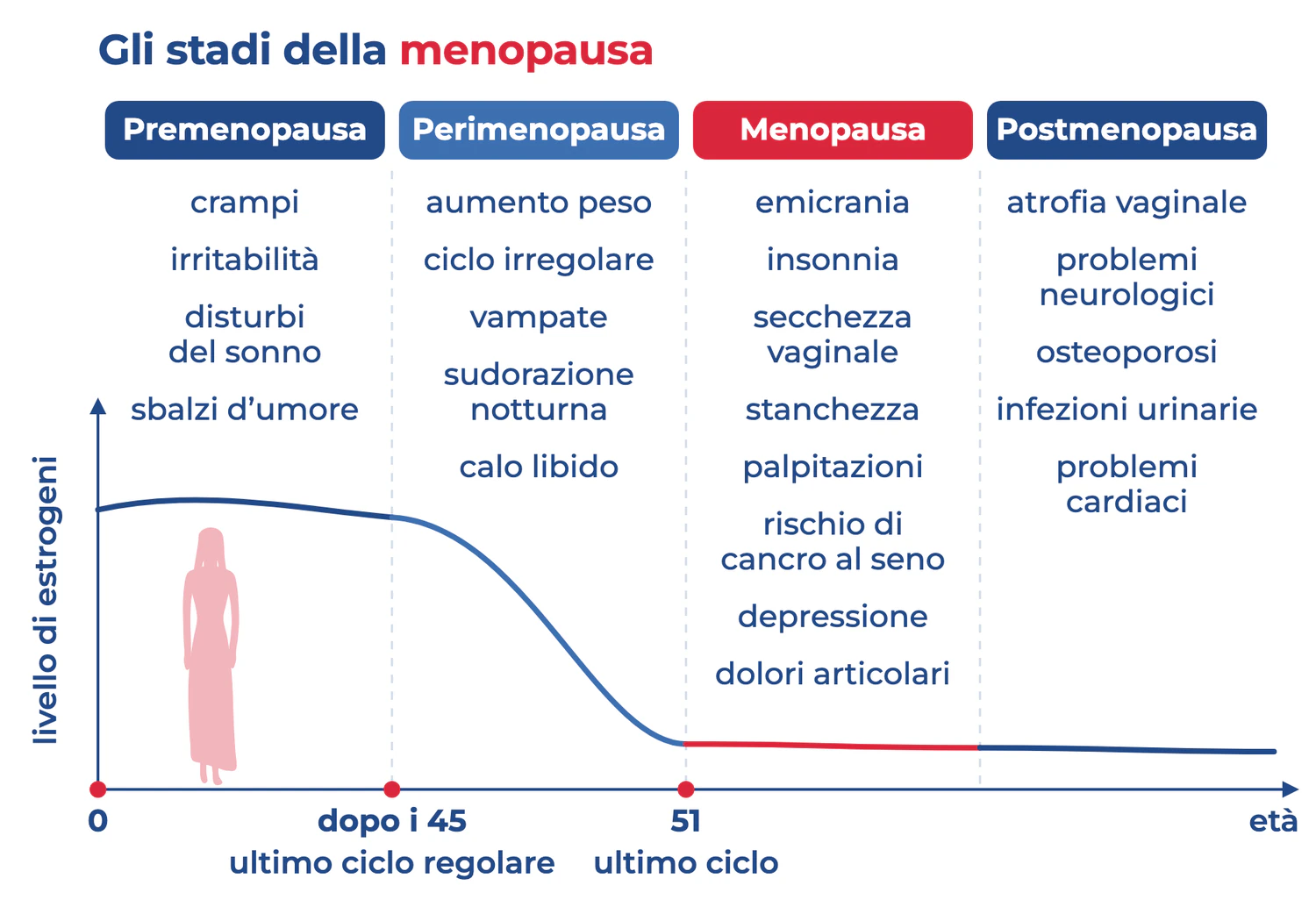
In everyday language, “premenopause” means the years leading up to menopause: you still have periods, but your hormones have started to change. The medical term for this stage is perimenopause, or the menopausal transition. Strictly speaking, in medicine “premenopause” would cover the whole of a woman's reproductive life; but if you searched for “premenopause symptoms”, you are looking for the same thing that we call perimenopause, and that is the word I use in this article.
The transition can be described in four stages. In the first, your periods are still regular, but your hormones begin to fluctuate: this is when the first night wakings, the first aches and the first mood swings appear, and it is the moment when almost nobody thinks of menopause, because you still have periods. In the second, perimenopause proper, your cycle starts to change. Menopause is one precise day, which can only be recognised in hindsight: twelve consecutive months without a period. Everything that comes after is postmenopause. In the diagram beside this text, the first stage is called premenopause and the second perimenopause. In everyday language “premenopause” covers both, and in this article I call both perimenopause.
The international criteria (STRAW+10) tie the start of the transition to one concrete sign: a cycle length that changes persistently by at least seven days from one month to the next; the late stage begins when sixty days or more go by without a period. Everything that happens between that first change and your last period is the perimenopause we are talking about here.
At what age do perimenopause symptoms start, and how long do they last?
For most women, the first signs of perimenopause appear after 40. In the American study that was the first to measure how long it lasts, perimenopause usually begins after 45 and menopause arrives at around 51; in Italy the Istituto Superiore di Sanità (the national institute of health) places it between 45 and 55. On average the transition lasts a few years, with big differences from one woman to another. There is no “right” age: what counts is the overall picture, not the calendar, and at 42 a changing cycle together with two or three of the symptoms below deserves the same attention it would at 48. If you recognise yourself in this picture, you can talk to a doctor about it in a free introductory consultation, with no obligation and even by video call.
A special case is menopause brought on by an operation that removes the ovaries. There the hormone deprivation is abrupt, yet symptoms can appear even months later, when the body realises it has been left without protection: in that case the hormone assessment should be done straight away, without waiting for symptoms. The same goes for a menopause that arrives early, before 45: in an analysis of more than 300,000 women, those who went through menopause before 40 had a 55% higher risk of cardiovascular disease in the following years, and those who did so between 40 and 44 a 30% higher risk, compared with women who reach it at 50 or 51. That is why, when hormone deprivation begins many years earlier, protection matters even more.
What happens to your hormones: progesterone falls first
There is a precise order behind all these symptoms. Ovulation becomes irregular, and since progesterone is produced only after ovulation, it is generally the first hormone to fall as we approach menopause. Oestrogen, on the other hand, does not fall in a straight line: it fluctuates, and in some cycles it is even higher than before, as cycle-by-cycle measurements in women in perimenopause have shown. The result is an imbalance between oestrogen and progesterone, what I call oestrogen dominance: not so much “too few hormones” as hormones in the wrong ratio to one another. Many of the early symptoms come from this wrong ratio, months or even years before the actual deficiency.
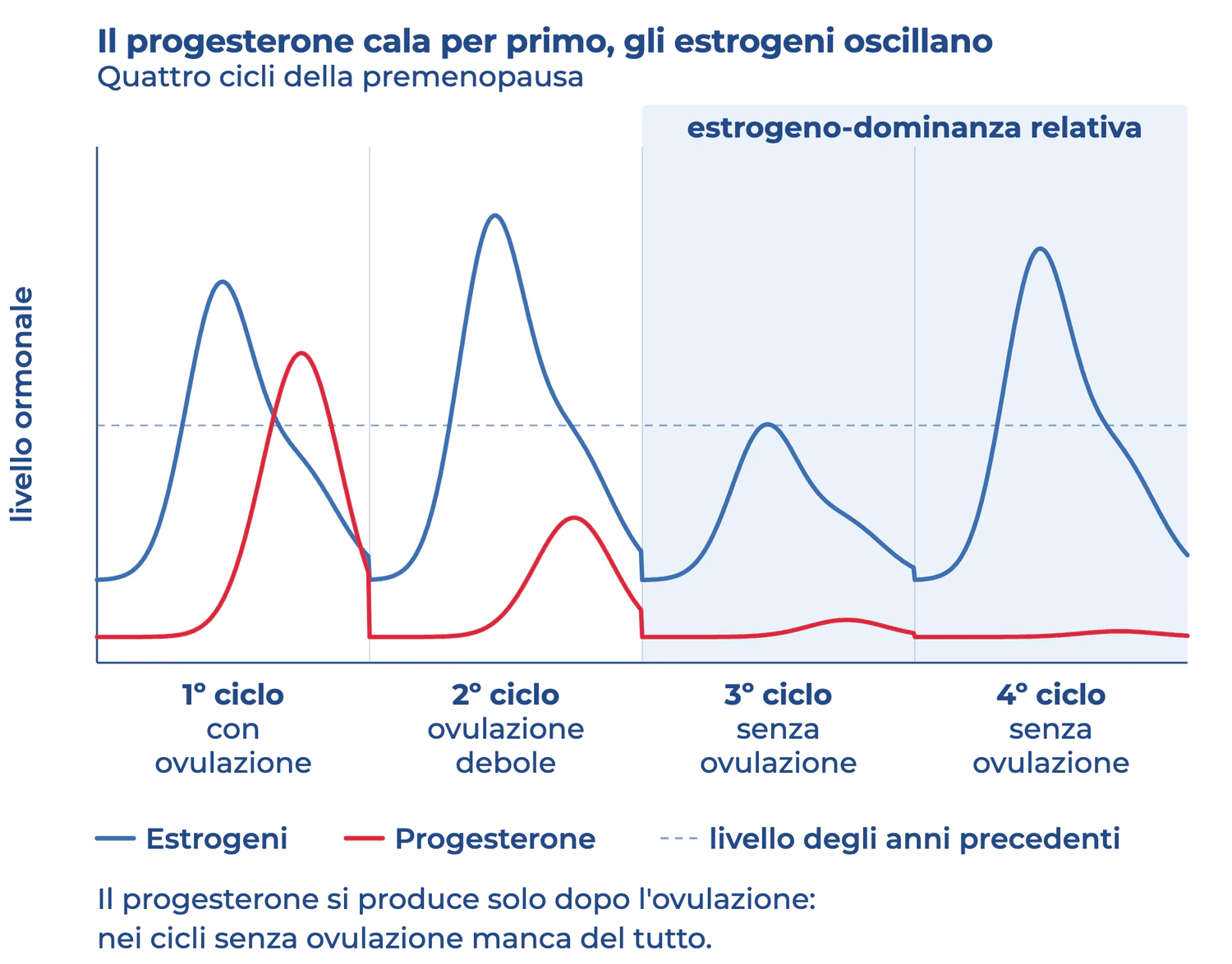
Often the first place you notice it is the week before your period. The breast tenderness, bloating, headache and irritability you have always known in the days before your period arrive earlier, last longer and get stronger: it is the old premenstrual syndrome, amplified by oestrogen that, for a time, predominates without the counterweight of progesterone. More slowly, testosterone and DHEA also fall, and the thyroid is affected by all of this, as we shall see.
The 10 perimenopause symptoms, one by one (and when they appear)
These are the ten symptoms we collected for our community on Facebook. You will find them here in the same order, with two extra things for each: when it usually appears, and which hormone is behind it. Because the order in which you hear them named is not the order in which they arrive: hot flushes, which everyone associates with menopause, are often among the last, and what comes first is quieter. That is exactly why nobody links it to hormones.
| The symptom | When it usually appears | The hormone behind it |
|---|---|---|
| 1. Hot flushes | later on, often among the last; sometimes while you still have periods | the fall in oestrogen acting on the brain's thermostat |
| 2. Night sweats | together with hot flushes | the same thermostat, at night |
| 3. Mood changes and irritability | early on, while your periods are still regular | progesterone (GABA, serotonin) and fluctuating oestrogen |
| 4. Irregular periods | the first sign that really makes you think of hormones | progesterone falling first, oestrogen fluctuating |
| 5. Vaginal dryness | gradually, at first on and off | the fall in oestrogen acting on the mucous membranes |
| 6. Sleep problems (insomnia) | early on: waking at two | progesterone, the first to fall |
| 7. Weight gain and a slower metabolism | gradually, with “normal” test results | oestrogen predominating over progesterone and holding back thyroid hormones |
| 8. Drop in libido | gradually | slowly falling testosterone, plus the dryness |
| 9. Difficulty concentrating (“brain fog”) | early on, and it is frightening | fluctuating oestrogen |
| 10. Breast tenderness or pain | early on: like premenstrual tension that arrives sooner and lasts longer | oestrogen predominating over progesterone |
1: Hot flushes
Hot flushes are the symptom everyone knows, and often they are not the first but one of the last. Most women experience them during or after the transition; they can start while you still have periods, and they last a long time: a median of 7.4 years, and more than 11 when they begin in perimenopause. They are largely the effect of falling oestrogen on the brain's thermostat, the hypothalamus, which loses its zone of tolerance and reacts to the slightest changes in internal temperature as if they were heatstroke.
There is something you are not usually told: hot flushes are not just a nuisance to put up with. In an analysis of six studies that followed women for years, women who had intense hot flushes and night sweats had, in the following years, roughly double the risk of cardiovascular disease compared with those who did not have them, and it was the severity that counted, not the frequency. It is an association, not a foregone conclusion. But it is one more reason to talk to your doctor about it, rather than wait for them to pass on their own.
If you wait for hot flushes before you take the other symptoms seriously, you will be waiting for years.
2: Night sweats
Waking at three completely soaked in sweat, with a wet pillow, is the night-time version of the same thermostat: at night, hot flushes become sweats. They often come with tachycardia or palpitations, a heart that speeds up without any exertion: these are common between perimenopause and the first years after menopause. What I said about hot flushes also holds for night sweats: when they are frequent they are not a minor detail, and in the same analysis women who often had them had a higher cardiovascular risk in the following years.
3: Mood changes and irritability
A short temper alternating with moments of depression and crying spells, for no reason that could justify them. Sudden swings that cause frustration, in you and in the people around you. Many women describe to me a new anxiety, never felt before, with episodes of sudden crying, or a sensitivity to stress that they do not recognise as their own.
As well as acting on sleep, progesterone acts on the GABA system and on the production of serotonin: it ensures what I call mental tranquillity, and when progesterone falls, that tranquillity goes with it. Oestrogen, for its part, fluctuates, and serotonin with it. These symptoms appear early, while your periods are still regular, and they need to be taken seriously: in women who had never suffered from depression, the probability of a high depression score during the transition was found to be more than four times greater than in the preceding years. And this is not an isolated finding: a 2024 review, which pooled studies that followed thousands of women over time, confirms that in perimenopause the risk of depressive symptoms and of a diagnosis of depression is higher than before the transition.
It is not weakness, and it is not just “mood swings” to be played down: in some women it is real depression, which has to be recognised and treated as such. It is a brain receiving inconsistent hormonal signals.
4: Irregular periods
It is the first sign the body sends that really makes you think of hormones, and behind it is the order I was talking about: progesterone falling first, oestrogen fluctuating. Your cycle can get longer or shorter; during the transition, cycles can become shorter, longer, heavier or further apart, until they disappear altogether. Sometimes there is bleeding between periods. The international criteria set the start of the transition at a persistent change of at least seven days in cycle length. Heavy or long periods are more common than you might think: among 1,320 women who kept a menstrual diary for ten years, three in four had at least three cycles with periods lasting ten days or more, and one in three had at least three episodes of very heavy flow lasting three days or more. In most cases these variations are physiological, but a changing cycle should still be mentioned to your doctor, and very heavy or prolonged flow should always be assessed, because fibroids, polyps and other conditions can also change it.
Two practical things to bear in mind. If you take the pill, the cycle you see is induced by the medication and says nothing about your ovaries: according to the NICE guidelines, in women using a combined contraceptive not even FSH is of any use for working out where you are. And as long as you still have periods, even irregular ones, pregnancy remains possible: contraception should be discussed with your doctor, not assumed to be no longer needed.
5: Vaginal dryness
In the vagina, the epithelium of the mucous membrane becomes thinner and the nerve endings, which have always been there, come closer to the surface: hence the burning and the pain during sex, dyspareunia, which in perimenopause may still be only intermittent. With the thinner mucous membrane come recurrent cystitis, with repeated courses of antibiotics, and a more “urgent” bladder: occasional small leaks of urine become more likely already in perimenopause, and even more so in the late stage of the transition. The international scientific societies group dryness, pain during sex and urinary problems together into a single genitourinary syndrome of menopause, defined precisely by the fall in oestrogen. And the dryness does not stop there: further down you will find the eyes, mouth, skin and gut, which almost nobody links to the same cause.
6: Sleep problems (insomnia)
It is not the insomnia of someone who can't fall asleep. It is waking at two or three in the morning, alert, “ready to go to work”, then crashing at five and waking to the alarm already tired. Waking in the night is typical of this stage, and it comes early, often years before hot flushes.
The explanation lies in progesterone, the first hormone to fall. Progesterone acts on the brain's GABA receptor: it promotes sleep and improves its quality. Its metabolite, allopregnanolone, is one of the most powerful natural modulators of the GABA-A receptor, the main brake of the nervous system. When progesterone is lacking, sleep becomes light and fragmented. It looks like work anxiety, but it isn't: studies that followed women through the transition show that difficulty falling asleep and staying asleep increases as the transition progresses and as estradiol falls.
7: Weight gain and a slower metabolism
An exhaustion never felt before, clothes that are tight around the waist, and a thyroid test that comes back normal. Thyroid and menopause are closely linked. Sex hormones also regulate how the thyroid works, and in perimenopause, when oestrogen predominates over progesterone, it binds to the proteins that carry thyroid hormones in the blood and makes them less available to the cells: the values on the report stay within range, but the hormone does not reach where it is needed. The fall in sex hormones also hinders the conversion of FT4 into its active form, FT3. The result is that in menopause the fall in sex hormones slows the metabolism even when thyroid tests come back normal: the swings between oestrogen and progesterone slow down the action of thyroid hormones, your metabolism slows and your weight goes up, and as your metabolism slows, so does your energy.
Your weight goes up on the same diet as ever, and always around the abdomen. Studies that followed women for years show that with menopause fat shifts towards the abdomen regardless of age, and that resting energy expenditure falls. It is not only a question of how much you eat, and cutting calories even further does not fix a metabolism that has slowed down for hormonal reasons. Menopause weight gain is common, but it is not your fault.
8: Drop in libido
A reduction in sexual desire and in physical sensitivity, influenced both by hormonal changes and by vaginal discomfort, and the guilt that follows. Testosterone is considered the male hormone, but that is not so: in women it takes part in bone metabolism and in maintaining muscle mass, and it supports sexual desire. It falls gradually over the years and, added to the dryness and the pain during sex, explains why desire drops precisely at this stage. It is not a relationship problem, and it is not in your head: it is a hormone, and it can be measured.
9: Difficulty concentrating (“brain fog”)
Moments of absent-mindedness, short-term memory lapses, difficulty keeping your attention: the name that won't come, the sentence that trails off halfway. Difficulty concentrating and short-term memory loss are symptoms that many women report already in perimenopause, and they are frightening because they seem like the start of a decline. They are not, and it is not the start of dementia: the study that followed more than 2,300 women through the transition measured a real but temporary decline in the ability to learn and remember, which recovers after menopause. The brain needs oestrogen, feeds on oestrogen, and you can feel the fluctuations of these years.
10: Breast tenderness or pain
A feeling of swelling, tightness or soreness in the breasts, similar to what you feel before your period, but which now comes earlier, lasts longer and does not wait for your period. It is one of the earliest symptoms, and one of those most often mistaken for something else. The cause is the wrong ratio I was talking about: oestrogen that for a time predominates over progesterone, and a relative excess of oestrogen can cause breast tenderness. One thing must be said clearly: diffuse tenderness in both breasts, which comes and goes with your cycle, is hormonal; a lump, a pain that stays in one single spot or a change in the skin must always be checked, and perimenopause is not a reason to put off breast checks.
The symptoms you won't find on any list (and that I see every day)
In the post we asked: “Do you have any that are not in these images?” Yes, almost always. And often they are the first to arrive.
You get up feeling “rusty”: joint pain and morning stiffness
Aching joints, ankles and wrists especially; in the morning you wake up feeling rusty, and it takes a quarter of an hour to “get going”. The pain moves around: one time a shoulder, another time a knee, often at night. It is one of the symptoms for which women most often come to see me, and which nobody ever talks about.
The mechanism is inflammatory: the lack of sex hormones, and in particular the imbalance between oestrogen and progesterone, inflames the points where the tendons attach. More than 70% of women have musculoskeletal symptoms in the transition from perimenopause to postmenopause, and one in four is limited in her activities by them. Many patients come to me with a diagnosis of fibromyalgia made on the strength of the response to a small dose of cortisone, without a test to confirm it. Some really do need further rheumatological investigation, and in that case it should be done. But in many the pain depends on the hormonal imbalance: when balance is restored, the pain recedes, and in my experience often completely.
The dryness that doesn't stop at the vagina: eyes, mouth, skin, gut
One of the key aspects of this stage is dryness of the mucous membranes, and it affects far more than the vagina: the eyes, the mouth, the skin, the gut. The fall in oestrogen can also cause dryness of the eyes, mouth and gut, with constipation and burning eyes. The mouth, too, is affected more than people think: the oral mucosa has oestrogen receptors, and some disorders of the oral cavity become more frequent after menopause, although how much of this depends on hormones is not yet clear.
Women often come to me with a diagnosis of Sjögren's syndrome: when it is present, it is a definite diagnosis, but sometimes it has been made by exclusion, and dryness of the mouth, eyes and skin is very often linked to a deficiency of sex hormones.
Tinnitus: a buzzing that you hear mostly at night
Have you ever noticed that quiet buzzing in your ear, especially at night? Almost nobody links it to menopause. Oestrogen seems to play a role in protecting the cells of the inner ear, where its receptors are present, but in humans the evidence is still limited, and tinnitus is one of the symptoms I see appear as hormones decline.
Headaches that change pattern
A migraine that becomes more frequent, or a new headache, often linked to the days of your period. Fluctuations in oestrogen are a known trigger of migraine, and in women who already suffer from it the attacks become more frequent in perimenopause. This too is usually treated as a problem in its own right.
Drier skin, thinner hair and, sometimes, acne that comes back
Your skin becomes drier and loses firmness, your hair gets thinner. The fall in oestrogen reduces collagen synthesis and, with less oestrogen to balance them, androgens act more freely on the hair follicle: this is the thinning typical of these years. The same imbalance explains something that surprises many women: acne that comes back at 45, on the chin and along the jawline, and that is no longer the “teenage” kind. In the years around menopause the relative rise in androgens shows itself in just this way: acne, a few extra hairs on the face, thinner hair. After menopause the collagen content of the skin keeps declining over the years, and many women notice the first changes already at this stage.
Why does nobody link your symptoms to your hormones?
For four reasons. The first is that they arrive one at a time, months apart, and each has a ready explanation: stress for the sleep, age for the joints, personality for the mood. The second is that they arrive while you still have periods, and “menopause” sounds like a word for fifty-year-olds. The third is that each symptom goes to a different specialist: the rheumatologist for the aches, the neurologist for the headaches, the endocrinologist for a thyroid that tests normal, the psychologist for the anxiety. Nobody sees the whole picture, and the whole picture is hormonal.
The fourth is the deepest: fear. Three generations of women have grown up with the idea that oestrogen means cancer, and so have their doctors. It is the legacy of a 2002 American study, the Women's Health Initiative, conducted with synthetic hormones taken by mouth in more than 16,000 women aged 50 to 79, which led to hormone therapy being abandoned all over the world and, with it, the habit of seeing hormones as the cause of symptoms: what I call psychological terrorism. Those risks were scaled back in the following years, and they concerned mainly synthetic hormones, but twenty years of fear are not erased quickly. Too many doctors, overloaded with shifts, nights and on-call duty, have not had time to catch up on what has changed in the meantime, and a doctor who tells you it is “normal” and that you “have to put up with it” is repeating to you, in good faith, what was said twenty years ago.
Research confirms that it is all one picture: in an analysis of more than 147,000 symptom logs, tiredness is reported by three women in four already in perimenopause, and headache by more than one in two, at frequencies comparable to those of women who do not yet have any change in their cycle; and after menopause tiredness is reported even more often than hot flushes. That is why a specialist in internal medicine like me works on menopause: because it concerns not only the reproductive system but the heart, the bones, the brain and the thyroid.
How can you tell if you're in perimenopause? What to ask your doctor
If you are over 45, your cycle is changing and you have recently developed vasomotor symptoms, such as hot flushes or night sweats, the British NICE guidelines say that perimenopause should be recognised from the clinical picture, without laboratory tests; FSH is considered only between the ages of 40 and 45, or under 40, to confirm the suspicion. The same principle applies to the other symptoms we have talked about: you start from what you describe, not from a number.
Measuring your hormone levels serves a different purpose: to see which hormones are changing and in what ratio to one another, which is the only way to build a therapy tailored to you instead of the same therapy for everyone. A single FSH value tells you little, because at this stage it fluctuates from one cycle to the next; what counts is the complete profile, read together with the symptoms. It is the test I always request: a simple blood sample that shows whether those five or six key hormones are in balance and have the right values. The profile I request includes estradiol and progesterone, FSH, testosterone and DHEA, and the thyroid with TSH, FT3 and FT4, because an underactive thyroid overlaps with the symptoms of perimenopause and has to be told apart.
“Could it be stress?” is the question every woman asks me. Stress can cause tiredness, light sleep and irritability, and at this stage it is often there. But on its own it does not explain a changing cycle, joints that are stiff in the morning, dryness or cystitis that keeps coming back: when these symptoms appear together, the answer is more likely to be hormonal, and the profile will clarify it. And stress is not an alternative to hormones: it is part of the same picture. Under prolonged stress the body diverts its resources into producing cortisol, at the expense of DHEA, the precursor from which testosterone and oestrogen are derived: this is what I call the cortisol steal, and it is one of the reasons why stress weighs more heavily in these years than before. Also ask for the other possible causes of your symptoms to be ruled out, because some really do look alike and can be told apart with simple tests:
| If you mainly have… | It may also be… | The test that clarifies it |
|---|---|---|
| tiredness, weight gain, feeling cold, constipation, dry skin, hair loss, failing memory | an underactive thyroid (hypothyroidism): in perimenopause the two pictures overlap almost point for point, and can coexist | TSH, FT3 and FT4, read together with the hormone profile and the symptoms, not on their own |
| hot flushes, racing heart, agitation, weight loss without dieting | an overactive thyroid (hyperthyroidism) | the same three values |
| tiredness even at rest, shortness of breath without exertion, hair loss, fast heartbeat, tinnitus, especially if your periods are heavy | an iron deficiency | full blood count and ferritin |
| loud snoring, pauses in breathing noticed by whoever sleeps next to you, heavy tiredness during the day | sleep apnoea | a sleep study |
| swollen, warm joints, stiffness that lasts for hours | a rheumatological problem | inflammation markers and a rheumatology appointment |
| weight building up around the abdomen with normal blood sugar | insulin resistance | fasting insulin, alongside blood sugar |
| light sleep, low mood and tiredness, but regular periods, no hot flushes, no dryness and no aches and pains | stress or depression, to be recognised and treated in their own right | a conversation with the doctor; the hormone profile shows whether there is a hormonal component as well |
Hormone therapy does not replace that assessment: it comes after it, and presupposes it.
Before your appointment: the diary that is worth more than a test

Over 45, perimenopause is recognised from the clinical picture, not from a specific value: what you describe is the evidence. That is why, before an appointment, three cycles of notes are worth more than a test done at random. Make a note, even on your phone, of:
- your periods: start and end dates, how heavy they are, any bleeding between periods
- your nights: what time you woke up, whether sweaty or alert, how many times
- each day's symptoms, in one line: hot flushes (how many), mood, aches (where), headaches, breast tenderness, and on which day of your cycle they appear, because the week before your period tells you a lot
- which of the fifteen symptoms in this article you recognise, and for how long
- tests you have already had, with dates: thyroid, full blood count and ferritin, blood sugar, any hormone level tests
- medicines and contraceptives you use, and the family history that matters for this assessment: early menopause, breast cancer, thrombosis, osteoporosis
At your first visit, that diary, together with your full medical history and blood tests, is the starting point for a tailor-made therapy, and it spares you the round of specialists in which each symptom is looked at on its own.
When shouldn't you wait? The signs to get checked straight away
Almost everything you have read so far is physiological and can be dealt with calmly. Some things are not, and I tell you about them precisely because perimenopause must not become the explanation for everything:
- bleeding that appears after twelve months without periods, even just once and even if only a little: it must always be assessed, and the British guidelines on suspected cancer refer it for urgent investigation after 55 and also consider doing so earlier
- a flow so heavy that it leaves you dizzy or short of breath, or bleeding that does not stop between periods
- a lump in the breast, nipple retraction or discharge from one nipple only, a change in the skin of the breast: this is not hormonal tenderness, and it needs to be seen
- a new, sudden and severe headache, or one accompanied by problems with vision, speech or strength
- palpitations with chest pain, breathlessness or fainting
- a mood so low that you think of harming yourself: ask for help straight away, not at your next appointment
None of this rules out perimenopause. It only means that you look there first.
Perimenopause is the best time to intervene
We can no longer say that this is a stage of life you just have to put up with. Menopause can be treated, not just endured: for decades it has been treated as a physiological stage to be accepted, but by restoring hormonal balance a woman can live the years that follow without the symptoms and risks associated with the decline in hormone production. Hormones are to a woman what water is to plants: giving water to a plant we had stopped watering makes it revive.
The best time to start hormone therapy is precisely perimenopause, when you still have periods, perhaps already a little irregular, and the first symptoms have appeared: the ideal is to accompany a woman gently into menopause, with small doses, rather than wait for menopause to arrive and for the symptoms to become established. Bioidentical hormone therapy is a supplementary hormone therapy, a form of hormone replacement therapy (HRT) in which the molecules are identical to those produced by the body: it supplements what the body no longer produces, with the same molecule. Every therapy is personalised, built and tailored from each woman's blood test, at the lowest dose that restores balance, and it is not something to do on your own: you need a doctor who has you do the tests and follows you over time. Restoring hormonal balance helps to eliminate the symptoms of menopause (hot flushes, night sweats, tachycardia, sleep disturbances, changes in mood and in the cycle, tinnitus) or to ease them when they are very severe. As well as acting on symptoms in the short term, the therapy contributes to the prevention and long-term protection of bones, heart and brain: the greatest benefit is obtained when therapy is started within about 10 years of menopause or before the age of 60, and the benefits remain afterwards too.
This is what I mean when I say that women must protect themselves: therapy is not a luxury and not a cosmetic choice, it is protection for the body in the years when it loses the protection that hormones used to give it. And this goes for all hormone therapies: synthetic or bioidentical, what matters is protecting yourself. Bioidentical is my choice because it uses the same molecules that the body produces naturally (which may be better tolerated), and it can be tailor-made, not because other therapies do not exist. It is not the same therapy for everyone: bioidentical hormone therapy is built on each woman's hormone profile and clinical history, is followed over time with regular check-ups, and the decision to start is made only if the personal profile calls for it and justifies it. The Bioidentical Hormone Pathway always begins with a conversation, not a prescription. The right medical support, proper nutrition, suitable physical activity and a personalised therapy together make it possible to live this season of our lives with energy and clarity, not just to put up with it.
If you recognised yourself in three or four of these symptoms, do not wait for your periods to stop before talking about it. You do not have to just put up with it. The first step is a free introductory consultation, even by video call, in which we talk about your symptoms and your history and decide together whether it makes sense to look further into it with a hormone profile.
Do you want to find out whether hormones are behind it?
Dr Cristina Lenzi
Dr Cristina Lenzi is an internal medicine physician and the Medical Director of Medyca, where she looks after women's health in perimenopause and menopause with bioidentical hormone therapy.

Medyca is a medical service founded by Dr Cristina Lenzi, one of the few doctors in Italy specialising in bioidentical hormone therapy. A specialist in Internal Medicine, cum laude, from the Università di Siena, she holds a PhD in osteometabolic diseases and Level I and Level II Master's degrees in bioidentical hormones from the Marion Gluck Clinic in London.
The first introductory consultation is free and without obligation: it is the way to find out more and understand whether the pathway is right for you. We look after patients from anywhere in Italy by video call, and in person at our practice in Siena.
Find out more:
- What are bioidentical hormones, and how do they differ from synthetic hormones?
- Menopause and thyroid: why your metabolism slows down
- Health in menopause: protecting your heart, bones and brain and slowing the ageing process
Sources
- Harlow SD, Gass M, Hall JE, et al. Executive summary of the Stages of Reproductive Aging Workshop + 10. J Clin Endocrinol Metab 2012;97(4):1159-1168. PMID 22344196
- Istituto Superiore di Sanità, ISSalute. Menopausa. issalute.it
- Santoro N, Brown JR, Adel T, Skurnick JH. Characterization of reproductive hormonal dynamics in the perimenopause. J Clin Endocrinol Metab 1996;81(4):1495-1501. PMID 8636357
- Wright VJ, Schwartzman JD, Itinoche R, Wittstein J. The musculoskeletal syndrome of menopause. Climacteric 2024;27(5):466-472. PMID 39077777
- Freeman EW, Sammel MD, Lin H, Nelson DB. Associations of hormones and menopausal status with depressed mood in women with no history of depression. Arch Gen Psychiatry 2006;63(4):375-382. PMID 16585466
- Badawy Y, Spector A, Li Z, Desai R. The risk of depression in the menopausal stages: A systematic review and meta-analysis. J Affect Disord 2024;357:126-133. PMID 38642901
- Greendale GA, Huang MH, Wight RG, et al. Effects of the menopause transition and hormone use on cognitive performance in midlife women (SWAN). Neurology 2009;72(21):1850-1857. PMID 19470968
- Avis NE, Crawford SL, Greendale G, et al. Duration of menopausal vasomotor symptoms over the menopause transition (SWAN). JAMA Intern Med 2015;175(4):531-539. PMID 25686030
- Portman DJ, Gass ML; Vulvovaginal Atrophy Terminology Consensus Conference Panel. Genitourinary syndrome of menopause: new terminology for vulvovaginal atrophy from the ISSWSH and the North American Menopause Society. Maturitas 2014;79(3):349-354. PMID 25179577
- Aras SG, Grant AD, Konhilas JP. Clustering of >145,000 symptom logs reveals distinct pre, peri, and post menopausal phenotypes. Sci Rep 2025;15:1091. PMID 39753725
- NICE. Menopause: identification and management (NG23), recommendations 1.2.3, 1.3.1, 1.3.5 and 1.3.6, updated version 2026. nice.org.uk/guidance/ng23
- Zhu D, Chung HF, Dobson AJ, et al. Age at natural menopause and risk of incident cardiovascular disease: a pooled analysis of individual patient data. Lancet Public Health 2019;4(11):e553-e564. PMID 31588031
- Zhu D, Chung HF, Dobson AJ, et al. Vasomotor menopausal symptoms and risk of cardiovascular disease: a pooled analysis of six prospective studies. Am J Obstet Gynecol 2020;223(6):898.e1-898.e16. PMID 32585222
- Paramsothy P, Harlow SD, Greendale GA, et al. Bleeding patterns during the menopausal transition in the multi-ethnic Study of Women's Health Across the Nation (SWAN): a prospective cohort study. BJOG 2014;121(12):1564-1573. PMID 24735184
- Rossouw JE, Anderson GL, Prentice RL, et al.; Writing Group for the Women's Health Initiative Investigators. Risks and benefits of estrogen plus progestin in healthy postmenopausal women: principal results from the WHI randomized controlled trial. JAMA 2002;288(3):321-333. PMID 12117397
- NICE. Suspected cancer: recognition and referral (NG12), recommendations 1.4.1, 1.4.2, 1.5.12 and 1.5.14, version current as of 15/04/2026. nice.org.uk/guidance/ng12
- Istituto Superiore di Sanità, ISSalute. Fact sheets Ipotiroidismo, Anemia da carenza di ferro and Apnea notturna ostruttiva (symptoms). ipotiroidismo · anemia da carenza di ferro · apnea notturna ostruttiva