Bioidentical hormones: brand names, molecule by molecule

Written by Dr Cristina Lenzi
In Italy, bioidentical hormones reach patients by two routes: registered medicines with a brand name, manufactured industrially and sold in standard doses, and compounded preparations, made up in the pharmacy for the individual patient on a doctor's prescription, which for this reason have no brand name. Below we explain, molecule by molecule, what exists and under which brand names.
Bioidentical means that the molecule has the same chemical structure as the one produced by the body. It is a characteristic of the molecule, not of the way the product is manufactured: it applies to registered medicines and compounded preparations alike. It is this identity of structure that sets bioidentical hormones apart from other hormone therapies.
Bioidentical does not mean natural. The raw material comes from plants — Dioscorea (wild yam), sweet potato, soya — but the molecule is finalised in the laboratory, and it is this step that makes it identical to the one produced by the body. The diosgenin contained in these plants is not converted into progesterone inside the body: it becomes a usable active ingredient only after a controlled chemical conversion in the laboratory. This is why taking the plant is not the same as taking the hormone.
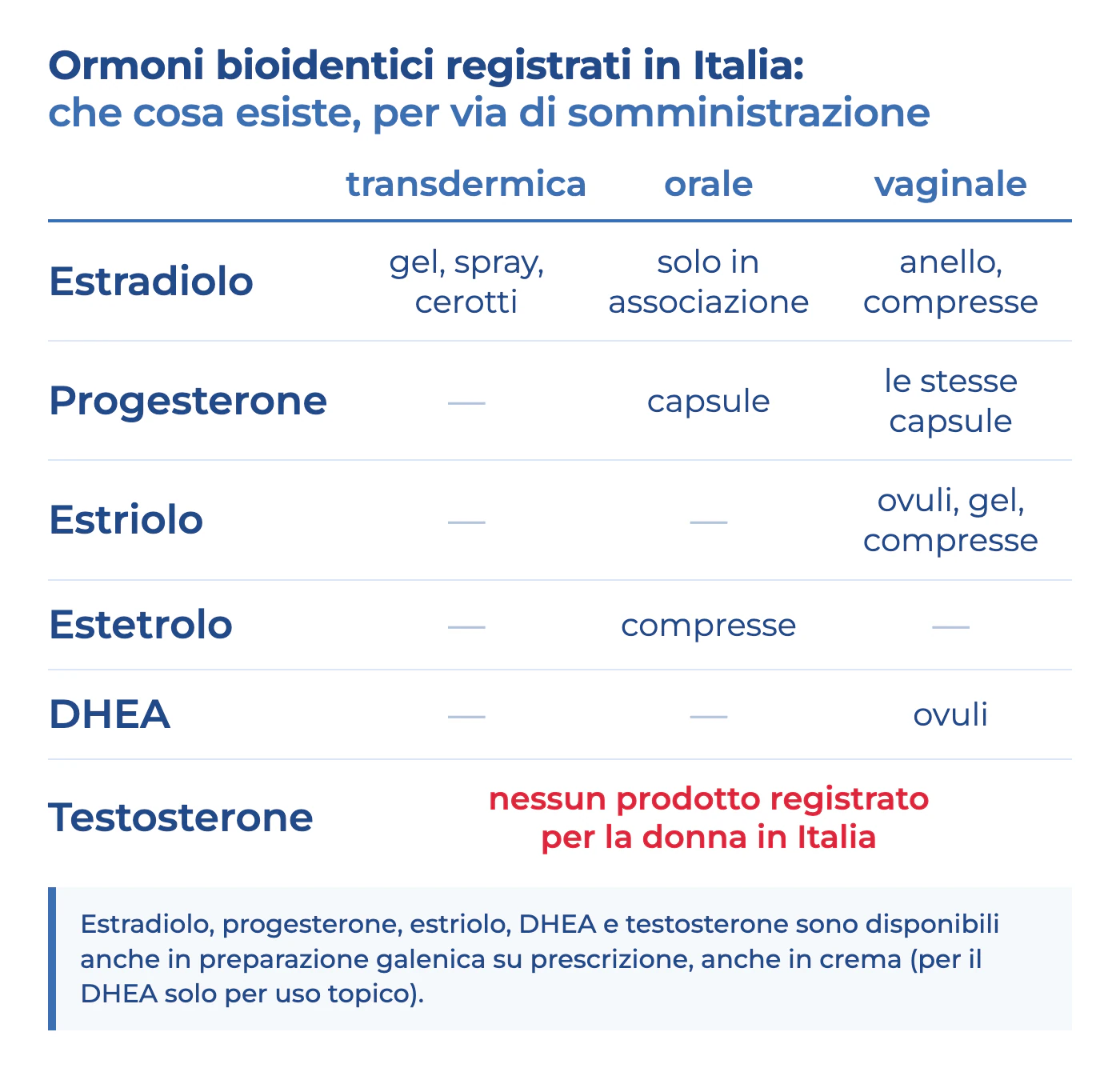
There is a precise reason why the same molecule exists both as a registered medicine and as a compounded preparation: since it is identical to the one produced by the body, it cannot be patented. No company can have exclusive rights to it, and it can be made by pharmaceutical companies and by pharmacies with a compounding laboratory alike. This is why both routes exist.
In this list you will not find hormone therapies that combine estradiol with a synthetic progestin, those based on conjugated oestrogens, or those based on tibolone: they are registered hormone therapies, but their molecules are not bioidentical.
This page lists what exists in terms of bioidentical hormones. Which therapy is right for an individual woman is decided together with her doctor, and the choice between synthetic and bioidentical, between oral and transdermal, comes after that decision. A bioidentical hormone therapy in menopause starts with hormone blood tests and is built on each woman's results and clinical history.
How to read the tables.
- The use column distinguishes systemic therapy, which acts on the whole body, from the local treatment of vaginal atrophy.
- The class column gives the classification of AIFA, the Italian Medicines Agency: A means reimbursed by the Italian National Health Service (SSN), C means paid for by the patient. The class is assigned to each medicinal product. The same medicinal product, however, can have packs in class A and packs in class C, depending on the dose and the number of patches, pessaries or capsules. Where the packs on the market of the same product do not all have the same class, the table says “A or C depending on the pack”; for the exact pack, the always up-to-date reference is the AIFA medicines database (Banca Dati Farmaci).
- The data on this page were verified on 27 October 2026.

Would you like to talk it through with a doctor?
The first consultation is free, also by video call.
Book a free consultationEstradiol
Estradiol is the main oestrogen produced by the ovary, and it is the molecule most represented among the bioidentical medicines registered in Italy. The systemic forms — gels, sprays and patches — release the hormone through the skin. The vaginal forms act locally and do not replace systemic therapy.
It is no accident that the registered systemic forms are almost all transdermal. A hormone taken by mouth passes through the liver before entering the circulation, and that passage increases the release of clotting factors; the route through the skin avoids it. This is why the English school of Marion Gluck, which I follow, favours transdermal administration, particularly in patients with genetic clotting abnormalities.
This is not just a preference of one school of thought. The ESTHER study and other large epidemiological studies have shown that transdermal administration of estradiol, at standard therapeutic doses, does not alter clotting parameters and is not associated with any increase in the risk of thrombosis compared with non-users, whereas the oral route roughly doubles that risk. The most recent data come from a Swedish study of national registers published in 2024, which followed more than 919,000 women: transdermal therapy is not associated with an increase in cardiovascular risk, whereas the increase in the risk of venous thromboembolism is seen with oral therapies. Of course, the individual baseline risk does not disappear: a known thrombophilia is a contraindication and must be assessed before starting.
| Brand name | Form and route | Use | Class (by pack) |
|---|---|---|---|
| Sandrena | gel in sachets, transdermal | systemic | C |
| Estreva | gel in a bottle, transdermal | systemic | C |
| Lenzetto | transdermal spray | systemic | C |
| Dermestril | transdermal patch | systemic | A or C depending on the pack |
| Estraderm MX | transdermal patch | systemic | A |
| Femseven | transdermal patch | systemic | A |
| Estring | vaginal ring | local | A |
| Vagifem | vaginal tablets | local | C |
| Vagirux | vaginal tablets | local | C |
Lenzetto has been on AIFA's list of medicines in short supply since 1 September 2026, because of high demand and production problems, with an expected end date of 31 March 2027. AIFA has also announced two upcoming shortages: Estreva gel from 31 October 2026 to 15 January 2027, in pharmacies only, and Estraderm MX 25 micrograms from 1 December 2026 to 31 March 2027.
As a compounded preparation, estradiol is prepared mainly as a cream or gel, at a concentration set by the doctor for the individual patient.
Which pills contain bioidentical hormones?
In Italy no medicine containing estradiol alone to be taken by mouth is authorised: the only oral estradiol is estradiol valerate, which is an ester — once absorbed, the body converts it into estradiol. There is, however, a bioidentical oestrogen that is taken by mouth, and that is estetrol. The oral forms in this list are therefore estetrol tablets, micronised progesterone capsules and the one capsule that combines estradiol and progesterone (that is, Bijuva).
Bioidentical hormones can be taken by mouth, as tablets or as lozenges to dissolve under the tongue, or applied to the skin as a cream or gel. By the oral route there are registered products — estetrol tablets, progesterone capsules and the combination of estradiol and progesterone in a capsule — while personalised tablets and lozenges are compounded preparations. In my practice the transdermal route remains the first choice when there are no particular contraindications, precisely to avoid the hormone passing through the liver.
Natural micronised progesterone
Progesterone is generally the first hormone to fall as menopause approaches, which is why in a combined therapy it is not an add-on to the oestrogen but one of the two halves.
Micronised progesterone is the same molecule that the body produces, and this identity of structure is not a chemical detail: a bioidentical hormone binds to its own receptor like a key in its lock, whereas a synthetic molecule, chemically modified, can also bind to other receptors. This is why natural micronised progesterone does not generally cause the typical side effects of synthetic progestins — fluid retention, headache, mood swings, weight gain — and it is the reason why this molecule is chosen in a bioidentical therapy. It should be taken in the evening, because it acts on GABA receptors and promotes sleep.
In women who still have a uterus, progesterone is not an add-on to the oestrogen: it is what balances its effect on the endometrium, which thickens in its absence. This is why, in the table below, both capsules are listed for use in combination with oestrogens.
What is bioidentical progesterone called?
In Italy, bioidentical progesterone is sold as micronised progesterone, in soft capsules that are taken by mouth or vaginally. There are two brand names indicated for menopause.
| Brand name | Form and route | Use | Class (by pack) |
|---|---|---|---|
| Prometrium | soft capsules, oral or vaginal | systemic, in combination with oestrogens | A |
| Progeffik | soft capsules, oral or vaginal | systemic, in combination with oestrogens | A |
Both have other authorised indications besides menopause therapy.
As a compounded preparation, progesterone is prepared as capsules or as a cream.
What is estriol used for?
Estriol is a weaker oestrogen than estradiol. In Italy all the registered products that contain it are vaginal: they treat atrophy of the mucosa and do not replace systemic therapy.
Vaginal dryness does not stay a local nuisance: when it worsens it impairs the entire genitourinary system, and the most common consequence is recurrent cystitis, with repeated courses of antibiotics. That is why I have patients over seventy who are starting therapy right now. Very small amounts of hormone applied locally are enough, and in many cases those courses of antibiotics are no longer needed.
It is worth adding that in menopause dryness does not affect only the vaginal mucosa: it also affects the eyes, the mouth and the gut. Almost nobody makes this connection, and restoring hormonal balance can improve the dryness across the board.
| Brand name | Form and route | Use | Class (by pack) |
|---|---|---|---|
| Colpogyn | vaginal pessaries | local | A or C depending on the pack |
| Atrocom | vaginal pessaries | local | C |
| Gelistrol | vaginal gel | local | C |
| Donaflor | vaginal tablets | local | C |
Donaflor combines estriol with Lactobacillus acidophilus and also has non-hormonal indications, concerning the balance of the vaginal flora.
The amounts of oestrogen that enter the circulation with vaginal application are negligible: this is the position expressed by the International Menopause Society, which on this basis distinguishes local therapies from systemic ones. A systematic review of 46 controlled studies published in Annals of Internal Medicine in 2024 concluded that vaginal oestrogens improve dryness and pain during intercourse, while pointing out at the same time that long-term data on efficacy and safety are still limited.
As a compounded preparation, estriol is prepared as a cream, also in combination with estradiol. In my practice I very often prescribe it combined with DHEA, to be applied vaginally.
Estetrol
Estetrol is the newest arrival among the bioidentical oestrogens. It is the same molecule that the foetal liver produces during pregnancy, and it is the only bioidentical oestrogen registered in Italy that is taken by mouth on its own.
| Brand name | Form and route | Use | Class (by pack) |
|---|---|---|---|
| Fylrevy | coated tablets, oral | systemic | C |
Fylrevy is authorised by AIFA but, as of 27 October 2026, does not appear to be on the market in Italy.
In women who still have a uterus it should be taken together with progesterone, for the same reason that applies to estradiol: it is progesterone that balances the effect of the oestrogen on the endometrium.
DHEA
DHEA sits upstream of the other sex hormones: it is the precursor that the body converts, as needed, into the one it requires. In Italy only one registered product contains it, under the name prasterone, which is the name under which DHEA is registered.
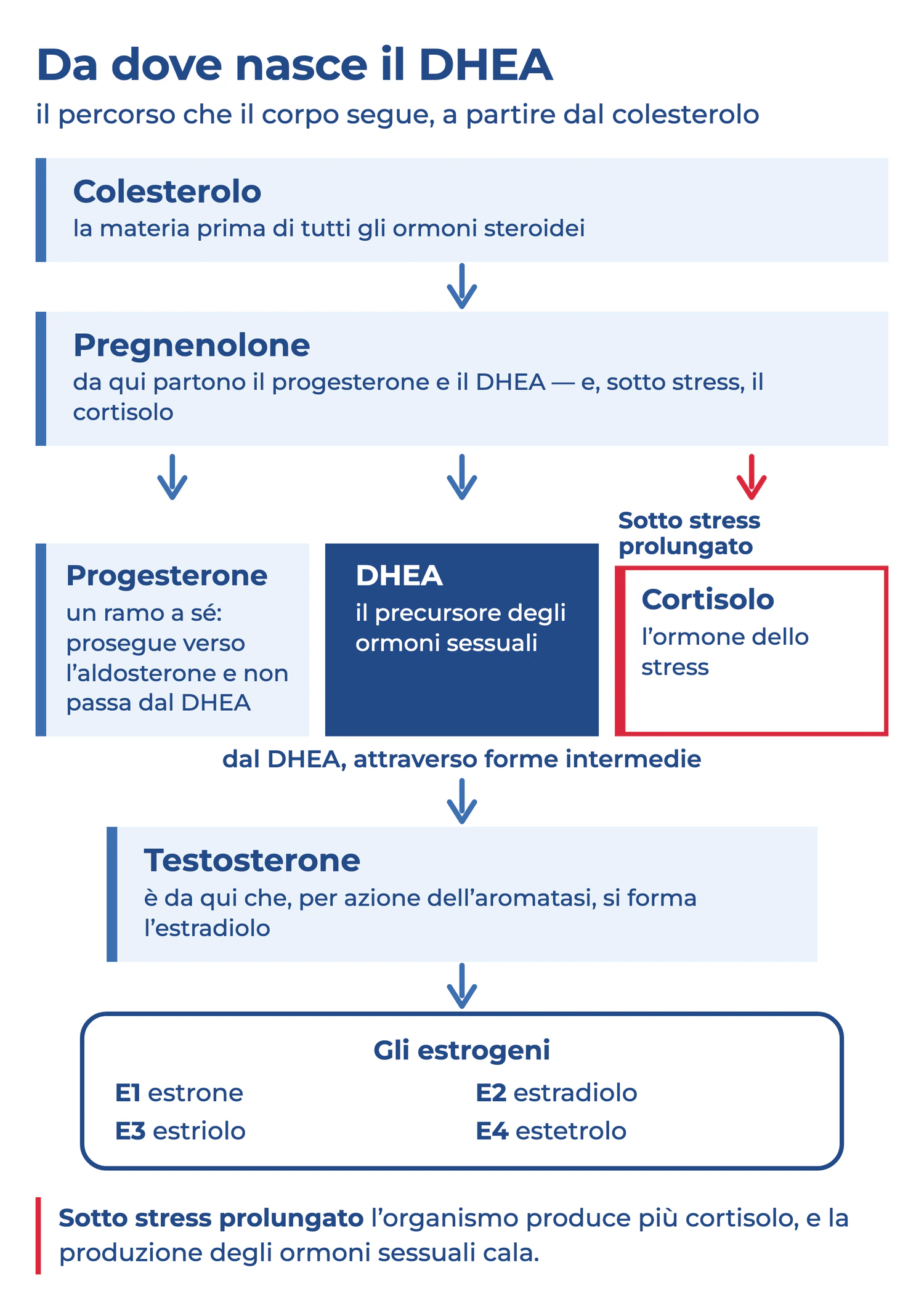
The pathway starts from cholesterol. The body converts it into pregnenolone, and from there different routes open up. One leads to progesterone, which is formed in the mitochondrion and then continues towards aldosterone: it is a branch of its own and does not pass through DHEA. Another, through an intermediate form, leads to DHEA. And from DHEA, again through an intermediate form, you reach testosterone and the oestrogens. This is what I mean when I say that DHEA sits upstream: it stands at the head of testosterone and of all the oestrogens.
And there is not just one oestrogen: in test reports you find them numbered. E1 is estrone, the one that is stored as a reserve in abdominal fat tissue. E2 is estradiol, the strong one: it forms from testosterone thanks to aromatase, an enzyme that works mainly in fat tissue. E3 is estriol, the good one, which works on the mucous membranes. E4 is estetrol, the same oestrogen that the foetal liver produces in pregnancy: it is the most recent, has a long half-life and does not recirculate.
Finally, there is the cortisol route, and it is the one that explains why stress weighs on hormonal balance. Under stress what is known as cortisol steal occurs: instead of passing from pregnenolone to DHEA, the body diverts everything to the production of cortisol. Nothing passes on any more to DHEA (and therefore to neither testosterone nor the oestrogens), or to progesterone.
DHEA is called the hormone of youth, and in my experience patients with a good level of DHEA report more energy and a better mood. It is a hormone I always assess when I study a complete hormone profile.
| Brand name | Form and route | Use | Class (by pack) |
|---|---|---|---|
| Intrarosa | vaginal pessaries | local — postmenopausal vulvovaginal atrophy | C |
The systematic review published in Annals of Internal Medicine in 2024, cited above for vaginal oestrogens, also reports a benefit for vaginal DHEA on dryness, on pain during intercourse and on the distress that results from it.
In Italy, DHEA can be prepared as a compounded preparation, but only for topical use: the decree of 1 June 2021 prohibits preparations intended for systemic use and makes an express exception for those that are exclusively topical. The one registered medicine, above, also acts locally. In Italy, therefore, systemic DHEA is not prescribed, and this is also the reason why DHEA supplements sold online or bought abroad fall outside any Italian prescription.
Testosterone
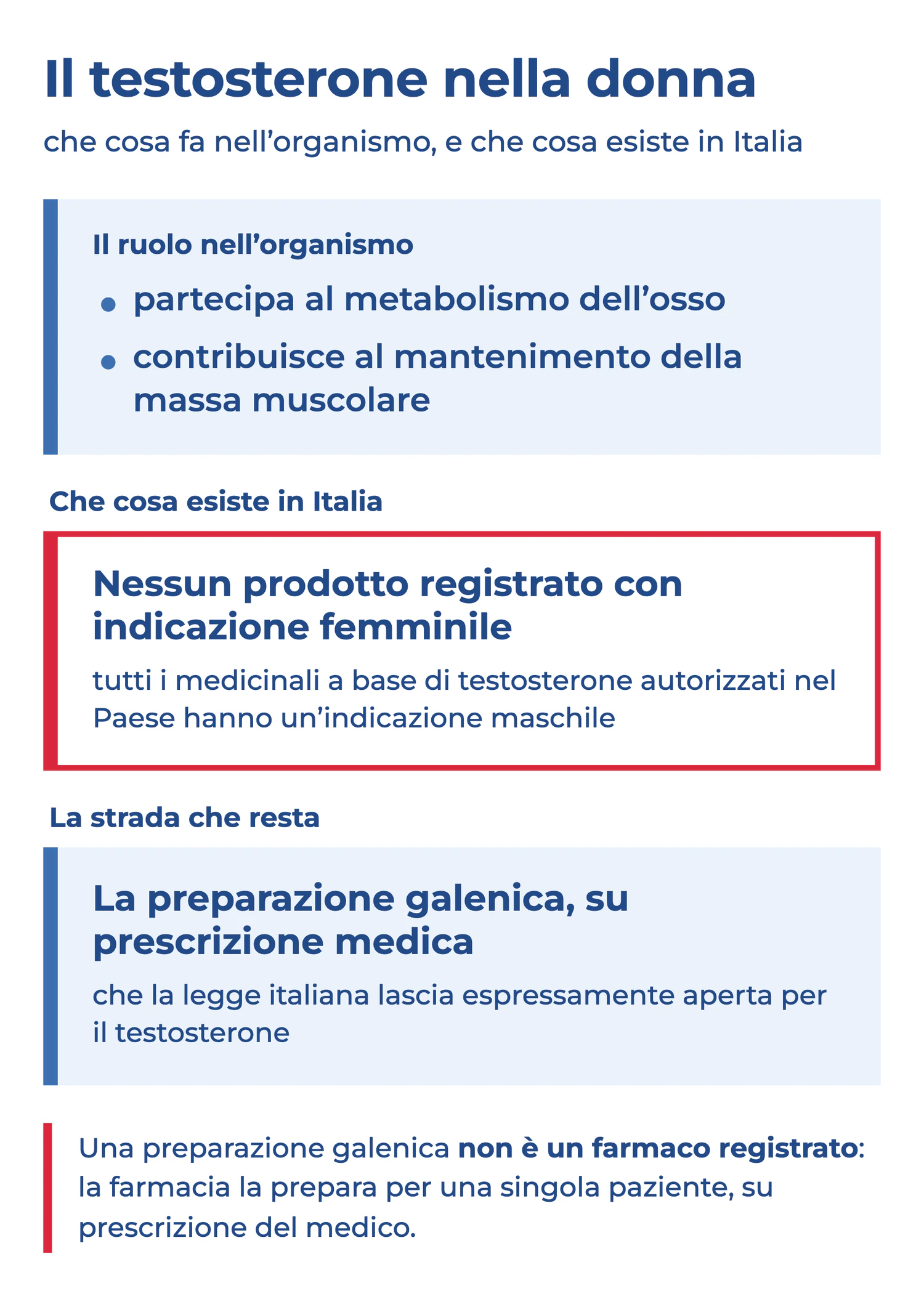
Testosterone is considered a male hormone, and that is not so: in women it takes part in bone metabolism and in maintaining muscle mass, and therapy, when indicated, helps restore sexual desire. In my clinical practice testosterone is an integral part of hormone therapy, on the basis of each patient's complete hormone profile.
For testosterone there is no registered medicine for women in Italy: all the testosterone products authorised in the country have a male indication. The fact that there is no registered product with a female indication does not mean that the molecule has no role in women: it means that, when it is indicated, the route is the compounded preparation on a doctor's prescription.
Bijuva: estradiol and progesterone in a single capsule
Bijuva is the pharmaceutical industry's answer to bioidentical hormones. The logic is the one we saw at the start: because the molecule replicates something that exists in nature, it cannot be patented and remains available to everyone, so pharmaceutical companies manufacture it. Bijuva combines 1 mg of beta-estradiol and 100 mg of progesterone, both bioidentical, in a single capsule to be taken by mouth.
It is the only registered medicine in Italy that combines these two molecules in a single pack. It is an excellent medicine: the intermediate dose takes away the symptoms in many women, and for many it remains a valid therapeutic option.
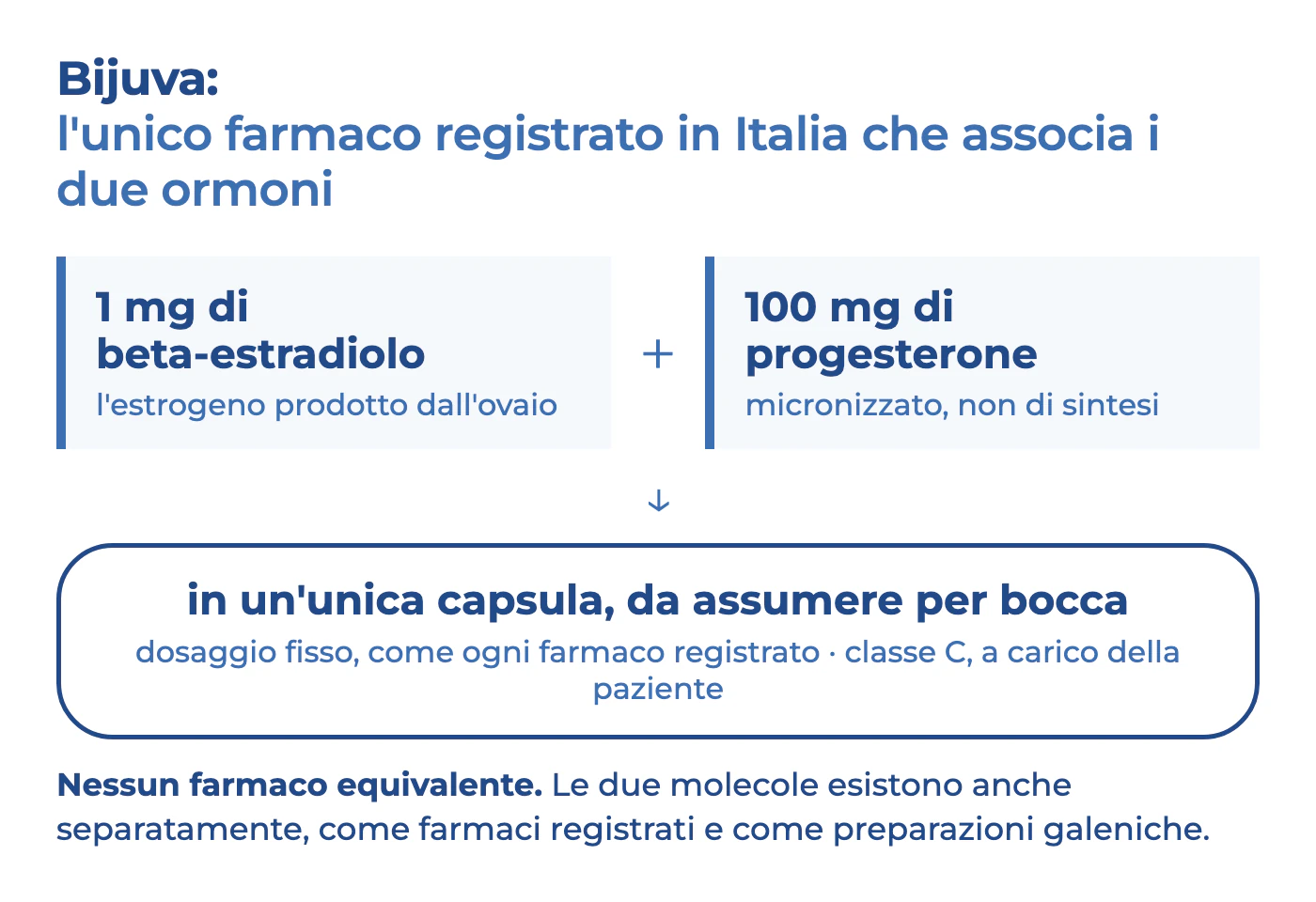
Like every registered medicine, Bijuva has a fixed dose. Unlike tablets, a capsule cannot be divided, because it is made of two halves that fit into each other. Bijuva, moreover, comes as soft capsules, which differ even from those made of two halves and are all the less divisible, so the single dose can only be 1 mg/100 mg of estradiol/progesterone. For some women who need a very precise dose this may not be the most suitable arrangement, and it is a characteristic of the pharmaceutical form, not a defect of the product.
Is Bijuva a bioidentical hormone?
Yes, in the precise sense that the term has: both molecules it contains — estradiol and progesterone — have the same chemical structure as the hormones produced by the body. This is a fact about the molecules, not a judgement on the medicine, and it applies in the same way to micronised progesterone in capsules and to estradiol in gel, spray or patch.
Is Bijuva reimbursed by the Italian National Health Service (SSN)?
No. Bijuva is in class C in both packs, of 28 and of 84 capsules: the cost is borne entirely by the patient, and the current shortage does not change the class.
The two molecules taken separately do not follow the same rule: among the estradiol patches and the progesterone capsules there are packs in class A, as you can see in the tables above. The same combination of hormones can therefore fall under a different reimbursement regime depending on how it is prescribed. Which route is suitable, however, remains a medical decision, not a question of price.
Why can't you find Bijuva in pharmacies?
Since February 2026, Bijuva has been on AIFA's list of medicines in short supply: the 84-capsule pack since 7 February, the 28-capsule pack since 25 March, and AIFA gives no end date. For the 84-capsule pack, it advises contacting a specialist or a GP for an alternative treatment; for the 28-capsule pack, it has authorised healthcare facilities to import a similar medicine authorised abroad. (AIFA data updated as of 27 October 2026)
Does Bijuva have an equivalent medicine or alternatives?
No. In AIFA's list of medicines in short supply, the “Equivalente” (equivalent) field for Bijuva reads “No”: there is no generic version of the product.
Having no equivalent does not mean having no alternatives. The two molecules that Bijuva contains are also registered separately: estradiol as a gel, spray or patch, micronised progesterone as a capsule — these are the products listed above on this page. A third route is the compounded preparation, prepared in the pharmacy for an individual patient on a doctor's prescription, in which the dose is set case by case. The main advantage of the compounded preparation is that you are not limited to the two molecules in Bijuva alone: the prescribing doctor can also include other molecules, depending on each patient's hormone profile and needs.
Which of the three routes is suitable is a medical decision. AIFA itself, in its notes on the shortage of the product, points to a specialist or a GP. By law, any doctor can prescribe hormone therapy, but it is important to rely on someone who specialises in menopause care and can design a tailor-made therapy, with the molecules and the dose each woman needs, taking a 360° view of the female body.
In my practice, several patients who were taking Bijuva have switched to a compounded preparation with the same two molecules, at the dose that suits them, and where necessary with other molecules they needed.
Discover the Bioidentical Hormone PathwayStandard dose or tailor-made preparation
The two options differ in how the product is made and dosed. A registered medicine comes off the production line in standard doses, the same for all the patients who take it, and is found in the pharmacy under its own name. A compounded preparation is prepared by the pharmacist for an individual patient, on the doctor's prescription, and the dose is set on her profile: this is why it has no brand name, but a compounding label stating its qualitative and quantitative composition, which shows what it contains.
The regulatory framework is Law 94/1998, which in Article 5 allows the doctor to prescribe magistral preparations based on active ingredients described in the pharmacopoeias of European Union countries or contained in medicines already authorised in Italy or in another EU country.
The molecule is the same; what changes is the way it is prepared and dosed, and the choice between the two routes is made by the doctor on the profile of the individual patient.
The criticism levelled at compounded preparations is that, since they cannot be patented, they can be prepared in any pharmacy rather than in a pharmaceutical company. Pharmacies with a compounding laboratory are, however, subject to periodic inspections by the NAS (the Carabinieri's health protection unit) and the local health authority (USL), and if anything is found that does not comply with the Rules of Good Preparation (Norme di Buona Preparazione), the pharmacy is closed, with responsibility resting on the pharmacy's director.
Tailor-made does not mean a different dose every week. The compounded formulation makes it possible to set precise proportions and ratios between the molecules, and the aim is to find the lowest amount that rebalances the patient: a dose that must then be left to work, with checks over time.
Which bioidentical hormones are reimbursed by the Italian National Health Service (SSN), and which do you pay for?
In general, estradiol patches, progesterone capsules, the vaginal ring and some packs of estriol pessaries come in class A; the gels, the spray, the vaginal tablets and the combined capsules are in class C. Because the class follows the pack, before buying it is worth checking the exact one in the AIFA medicines database (Banca Dati Farmaci).
The class says nothing about how suitable a product is for an individual patient: it is a reimbursement decision that AIFA takes pack by pack, and that can change over time.
It should be added that “class A” does not mean free: the regional co-payment (the “ticket”) still applies where it is in force, and if the pack costs more than the reference price, the difference is paid by the patient.
Compounded preparations have no SSN class: the cost is set by the pharmacy that prepares them, but always according to the national tariff (Tariffario Nazionale). Like all the medicines in this list, they can only be obtained with a doctor's prescription.
The choice is not made from a list
Knowing what exists and what it is called helps you form an idea; it does not help you choose a therapy. Which molecule, by which route and at which dose cannot be read from a table: it depends on the individual woman's hormone levels, her clinical history and how she responds over time. This is why two women with the same symptoms may follow different therapies, and why a product that is missing is not replaced by whichever name in a list looks most similar.
The registered products in this list have one thing in common: they contain a single molecule, or two at most, in fixed doses, the same for all the patients who take them. For many women that is enough. For others it is not: when the hormone profile calls for several molecules together, or for an amount that falls between two registered doses, that therapy does not exist as an industrial product. This is where more and more women turn to the compounded preparation, prepared in the pharmacy for an individual patient on the doctor's prescription. In my practice it is what allows me to build the therapy around the woman's profile, instead of forcing the woman onto a standard dose that is not necessarily the optimal one for her.
Hormone therapy should be chosen together with your own trusted doctor. It can be synthetic or bioidentical, industrial or compounded, oral or transdermal: what matters is not which, but that a woman who has an indication for it is not left without hormone therapy.
Hormone therapy is not a do-it-yourself job: you need a doctor who orders the blood tests and builds the therapy on those results.

Dr Cristina Lenzi
Dr Cristina Lenzi is an internal medicine physician and the Medical Director of Medyca, where she looks after women's health in perimenopause and menopause with bioidentical hormone therapy.

Medyca is a medical service founded by Dr Cristina Lenzi, one of the few doctors in Italy specialising in bioidentical hormone therapy. A specialist in Internal Medicine, cum laude, from the Università di Siena, she holds a PhD in osteometabolic diseases and Level I and Level II Master's degrees in bioidentical hormones from the Marion Gluck Clinic in London.
The first introductory consultation is free and without obligation: it is the way to find out more and understand whether the pathway is right for you. We look after patients from anywhere in Italy by video call, and in person at our practice in Siena.
Find out more: