Compounded bioidentical hormone preparations: how they are made and who checks their quality
Written by Medyca
The compounding pharmacist's point of view
Therapies based on bioidentical hormones are personalised treatments, tailor-made for each patient: the doctor prescribes them after reviewing the blood tests and measuring hormone levels. This approach is an innovation compared with traditional treatments at standard doses and can be described as being at the forefront of what is known as “precision medicine”, the direction in which the world of healthcare wants to move in the near future: more precise, tailor-made therapies for each patient, and therefore characterised by fewer adverse effects and better clinical efficacy.
On this blog we have already discussed what bioidentical hormones are and when one route or the other is chosen, how the therapy works and how it is monitored. Bioidentical hormones can reach you in two forms: as registered industrial medicines at a fixed dose (rBHRT), or as magistral compounded preparations (cBHRT), prepared in the pharmacy on your doctor's personalised prescription. This article is about the second.
But what happens after the doctor's prescription? Who actually prepares the cream with bioidentical hormones and, above all, who guarantees its quality? As a compounding pharmacist, this is the ground I know best, and it is also the one around which most myths circulate: “compounded medicines are not controlled”, “they are not tested”, “they come with no guarantees”. In this article I answer these questions from the point of view of someone who prepares these creams in the laboratory every day: how a transdermal cream with bioidentical hormones is made, which hormones it contains, who checks its quality and with what inspections, and why a compounded preparation is no less controlled than an industrial medicine. Then the practical questions: how to store the Topi-Click, which is the question patients ask me most often, how long a bottle lasts, and how much the therapy costs.
Would you like to talk it through with a doctor?
The first consultation is free, also by video call.
Book a free consultationWhat is a compounded preparation? And why is it called “magistral”?
A compounded preparation is a medicine made directly by the pharmacist in the pharmacy's laboratory, starting from raw materials and chemical substances. Naturally, a large pharmaceutical company cannot manufacture on a large scale a medicine aimed at a single person, with a personalised dose: the compounded medicine was born precisely out of this need.
Creams based on bioidentical hormones prescribed for menopausal complaints are classed among the compounded medicines of the magistral type, that is, those that require a prescription from your doctor, written individually (ad personam) for you. For this reason, and also so that patient and doctor can keep each other updated on how the therapy is going, the prescription for the compounded cream needs to be renewed periodically. For the same reason you will not find it ready-made on the shelf: with the prescription you go to a pharmacy that prepares magistral compounded preparations, which prepares it specially for you and, if you cannot come in to collect it, can ship it directly to your home. This means you do not necessarily need a compounding pharmacy near you, since shipments cover the whole of Italy, including the islands.
How is a transdermal bioidentical hormone cream made?
Bioidentical hormones are nothing other than the same hormones that our body normally produces. They are made from plant derivatives that undergo successive chemical and biotechnological transformations in the laboratory, until a molecular structure exactly identical to that of human hormones is obtained.
In menopause creams, the most widely used hormones are the oestrogens, that is estradiol and estriol, often combined with each other, and progesterone. When the doctor considers it appropriate, the hormone DHEA is also used, in another type of preparation that we will discuss later. Which hormones to use, in what combination and at what concentration is decided by the doctor in the prescription; we incorporate them into the base from which we then prepare the therapy for the patient.
The prescribed creams are transdermal absorption creams: they allow bioidentical hormones to pass directly into the bloodstream through the skin. This is made possible by the composition of the cream: the vehicle is a completely natural liposomal matrix. Liposomes are small lipid vesicles that carry the active ingredients and, once they reach the skin, literally fuse with it and mediate their release.

This pharmaceutical form brings concrete advantages:
- the bioidentical hormones administered do not undergo the first-pass effect in the liver: they are not metabolised and reach the site of action practically unchanged. This avoids several adverse effects typical of the oral route: gastrointestinal disorders (nausea, excess stomach acid, dyspepsia, with the possible need to add a stomach-protecting medicine, and diarrhoea) and the additional thrombotic risk that oral administration entails;
- the release is continuous, with a plasma concentration, and therefore an effect, that is constant over time.
These two aspects allow the cream to have, on the one hand, a very low dose and, on the other, minimal or often absent adverse effects.
Then there is the practical side: many patients find it easier to apply a cream once or twice a day to the inside of the arms or legs than to take tablets or resort to injections. For this reason, the transdermal cream route supports better adherence to therapy. To help the compounded cream bind together, argan oil is also used, which acts as a true solubilising excipient and gives the cream a very pleasant smell and texture.
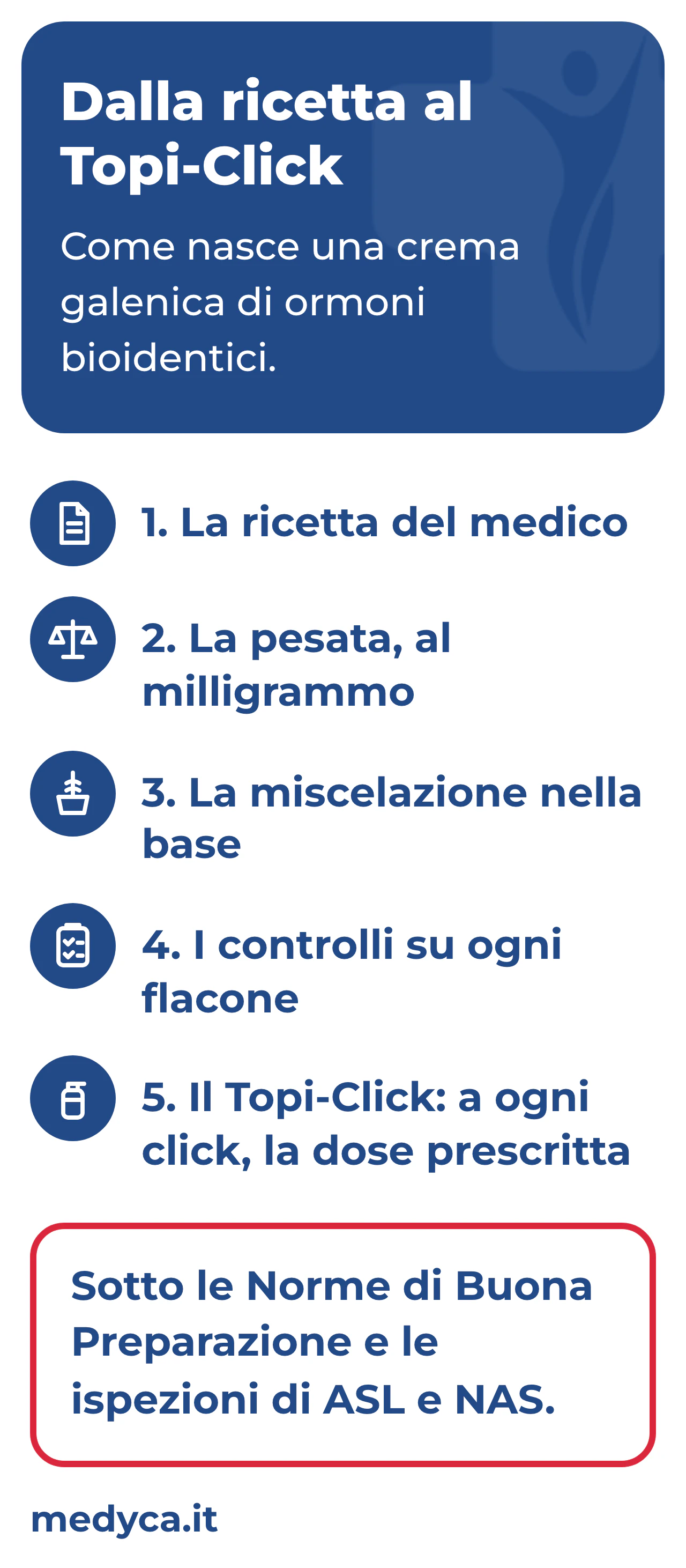
Given the complex liposomal matrix, for the preparation we use a pharmaceutical-grade automatic mixer and a patented liposomal base (Pentravan), supplied by the same company that specialises in raw materials for compounding (Fagron), which is also where the bioidentical hormones come from. The rotating paddle of the mixer incorporates the hormones into the base very efficiently and ensures uniformity of content and concentration: this means that every millilitre of the cream contains exactly the content and concentration prescribed by your doctor. This ensures that every application produces the same action and the same pharmacological activity, avoiding variations and discrepancies.
Which hormones are used in compounded creams?
It depends on where the cream is applied.
In creams for body application, those prescribed for the general symptoms of menopause, we use estradiol, estriol and progesterone in the liposomal base (Pentravan). The prescription usually provides for two applications a day, one in the morning and one in the evening, alternating areas of the body.
For external applications in the genital area, the vestibular ones, we use dehydroepiandrosterone (DHEA) and estriol instead. DHEA is a hormone that already acts in its own right: it binds directly to its receptors and triggers, in a cascade, the mechanisms linked to cellular youth. The body can then convert it into testosterone and oestrogens, which also contribute to the pharmacological action. On other occasions, estriol may be replaced by progesterone within the formulation. All the creams for vaginal application are based on the Versatile vehicle, which is also liposomal but better suited to carrying hormones in this area of the body.
Who checks the quality of compounded preparations?
In Italy, compounding laboratories operate under the supervision of the Ministry of Health and must comply with the Norme di Buona Preparazione (NBP, the Rules of Good Preparation) of the Official Pharmacopoeia of the Italian Republic, now in its 12th edition. This is not a voluntary good practice: it is a protocol laid down by law, and it covers every single step.
For every preparation we therefore carry out preliminary checks on raw materials and balances, checks during the preparation process, and final analyses on the packaged product (to guarantee quality, exact dose and safety in use), as well as cleaning of the premises and work surfaces.
As for the substances used in the compounded cream, the manufacturer supplies us with Certificates of Analysis: documents that always accompany the batches of raw materials and serve to ensure their conformity, traceability and, above all, safety. The substances are stored in dedicated cabinets, in an enclosed space at a controlled temperature, ideal for storage.
In addition, the jars and original packaging of the substances used in compounded preparations are kept for 6 months from the date of their last use. This is essential for traceability: if there were a report about one of the batches of the substances used, through the worksheets we would be able to trace all the preparations in which that batch of substances was used, report it and recall the corresponding preparations.
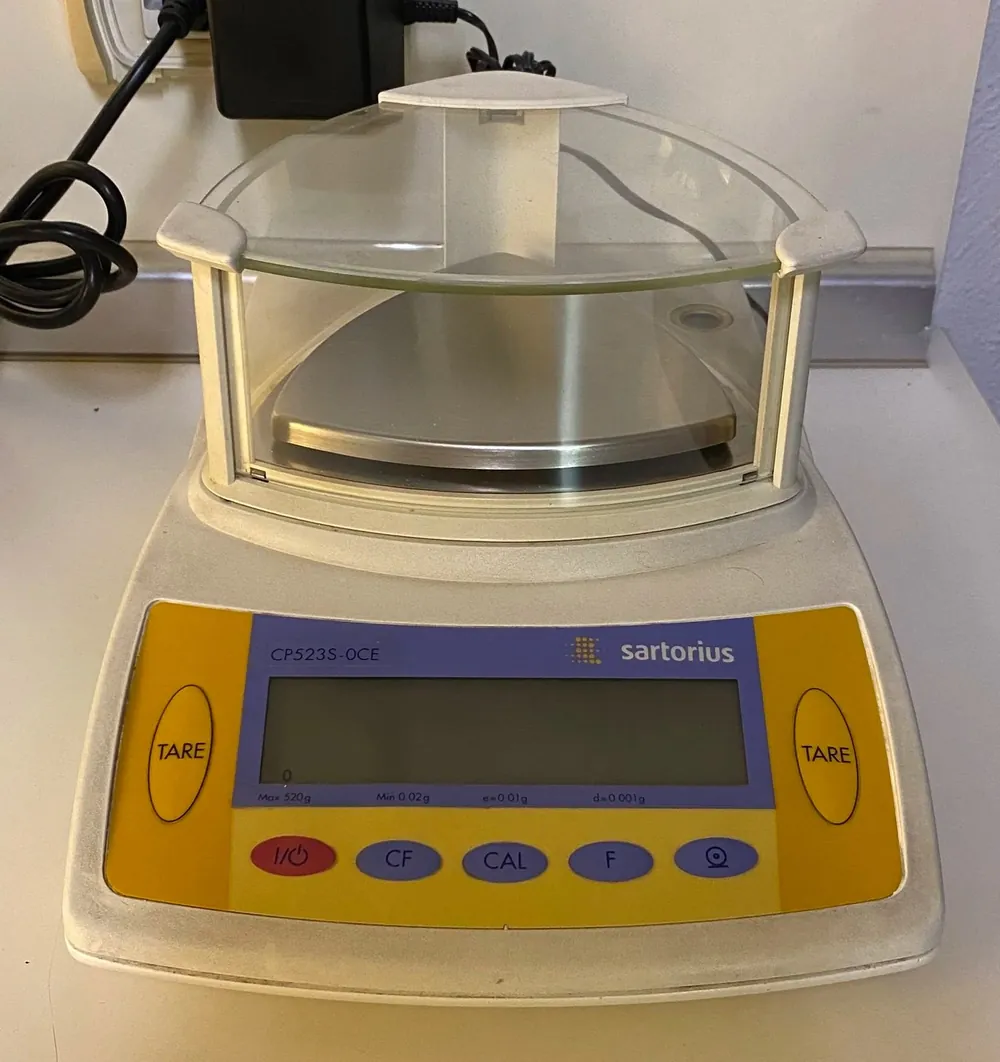
The analytical balances undergo the periodic checks required by law, mandatory every 3 years, and are cleaned and disinfected after each use, to ensure hygiene and the absence of contamination between one preparation and the next. During preparation we follow written procedures and, even before starting, we double-check the qualitative and quantitative calculations for the composition of the cream.
The checks on the finished product include analysis of the organoleptic characteristics (appearance, colour, smell), verification of the actual weight, and the correctness of the sampling and of the sealing of the bottle. If one of these checks fails and a non-conformity occurs, the medicine just prepared is strictly discarded and prepared again from the beginning.
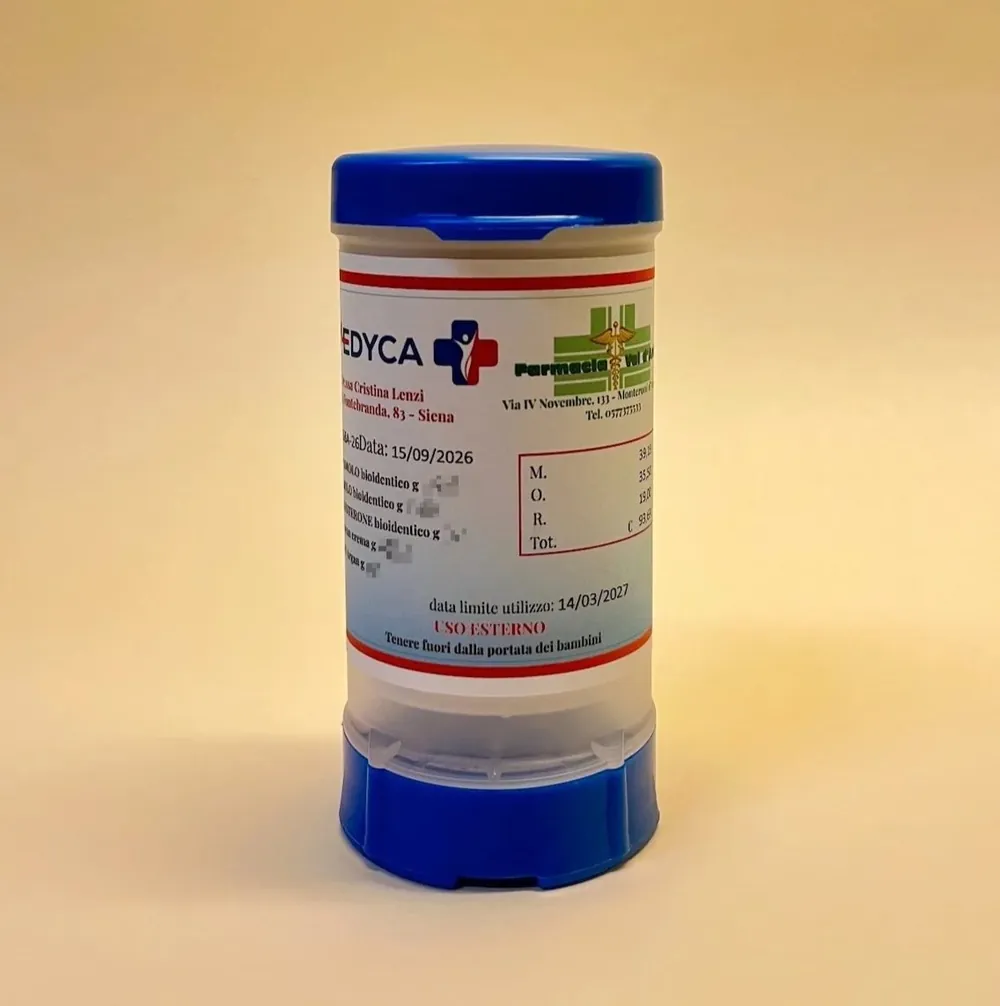
Just as important is the labelling of the medicine: on the label you will find the annual sequential number of the preparation, from the laboratory that prepared it, the date of preparation and the expiry date, the qualitative and quantitative composition of the substances present, and the price table. The quantities shown refer to the total quantity of the substances in the cream.
The minimum equipment is also laid down by law: Table 6 of the Italian Official Pharmacopoeia lists the apparatus that every pharmacy must have, from the balance sensitive to the milligram to the water bath, from the refrigerator for storage to graduated glassware. Personal protective equipment (PPE) is also mandatory: disposable latex gloves, mask, glasses or visor, and a lab coat used only in the laboratory, different from the one we wear in the other areas of the pharmacy.
To these internal checks are added the external inspections. Compounding laboratories are inspected both by the competent local health authority (ASL), with routine checks, and by the NAS (the Carabinieri's health protection unit), with extraordinary checks. In both cases they check that the substances comply with the Italian Official Pharmacopoeia through the certificates of analysis, the periodic verification of the instruments, and the regularity of the documentation of every preparation made up: the worksheets and, for magistral preparations, the attached prescriptions. ASL and NAS inspections are not announced: they can arrive on any day, without notice. For this reason the laboratory must be compliant at all times, not only in view of an inspection.
Are compounded medicines checked in the same way as industrial medicines?
Just as with industrial bioidentical hormones produced by pharmaceutical companies, compounded medicines also have their own procedure of preparation and control to ensure the quality of the medicine. The difference lies in the method: industrial medicines undergo batch-based control procedures, carried out by sampling and as representative as possible of the entire production line.
The compounded preparation, by contrast, is a bespoke therapy: the bioidentical hormone creams that we prepare in the pharmacy, according to the art of the compounding pharmacist, are made one by one and individually subjected to all the checks explained above. In practice: the checks on the finished product are carried out on every single bottle that leaves the laboratory. Not on a representative sample of the batch: on that very bottle that the patient will then receive at home.
The same goes for the dose. We prepare each cream from start to finish, one at a time, starting from the prescription: we weigh each hormone on the analytical balance and put it directly into the cream, with no intermediate steps. If the doctor prescribes 15 mg of estriol, we weigh 15 mg of estriol, and those 15 mg end up in your cream. This way the quantity of hormones is the one the doctor prescribed.
From the point of view of safety and checks, therefore, compounded preparations made ad personam are in no way inferior to industrial medicines produced in series.
It must be said clearly that the authorisation pathway of the medicine is different: the industrial medicine goes through clinical studies and authorisation as a product to be distributed on a large scale, whereas the magistral preparation arises from a medical prescription ad personam and relies on the scientific evidence for the molecules it contains and on the assessment of the prescribing doctor. Two different routes that share the same goal: a safe, good-quality medicine.
How do you use the Topi-Click, how long does it last and how should it be stored?
The transdermal cream is delivered to the patient in a container, the Topi-Click, a dispenser with a built-in dosing device: with each click it releases a precise amount of cream, containing exactly the dose prescribed by your doctor. The container also protects the cream and the hormones in it from light and oxidation: the compounded preparation thus remains stable for 6 months. This is an aspect not to be overlooked, which gives you the right peace of mind throughout the entire course of the therapy.
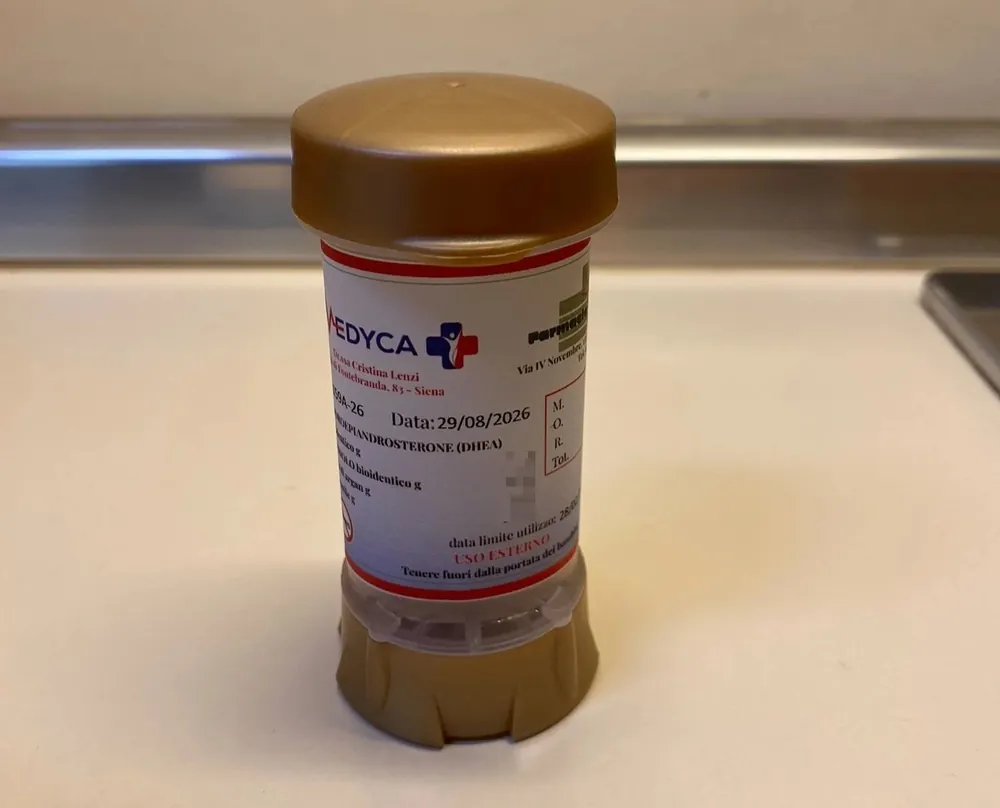
Using the Topi-Click is simple: you turn the base by the number of clicks set for your dose, wait for the cream to appear on the surface at the top of the dispenser and place it directly on the skin, at the spot indicated by your doctor, without touching it with your fingers. Then you massage until it is absorbed, usually a minute is enough, and close the cap firmly, so that the cream does not dry out.
In the most commonly prescribed 120 mL size, the dispenser delivers about 240 doses, which means that the cream lasts roughly three and a half months of therapy, falling comfortably within the 6-month validity of the preparation.
The Topi-Click should be stored at room temperature, around 25-26 °C, away from direct sources of heat (sunlight, radiators, the oven in the kitchen) and never in the fridge. Keep it in a dry place, away from humidity: so not in the bathroom either. It is important to always keep it upright, on its coloured base.
When travelling, no precautions other than these are needed. The only exception is air travel: the 120 mL size exceeds the 100 mL limit for hand luggage, and in that case you can ask your doctor for the smaller 35 mL size.
As for preparation, shipping and delivery times: at our pharmacy near Siena, when we receive the prescription, we usually get back in touch with you within half a day and, from the moment of payment, we prepare and ship the preparation within a day. The courier's time is added to this, so when the bottle is about to run out it is best to act a few days in advance, to receive the next one without interrupting the therapy. There is also a small precaution: we always avoid shipping therapies on a Friday, since the parcel would sit for the whole weekend in the courier's warehouses, where temperature and hygienic conditions are not always assured.
How much does a compounded preparation of bioidentical hormones cost?
Let us turn to cost, one of the most frequent concerns. The cost of the preparation is roughly €90 (price in September 2026) and varies depending on the dose, that is, on the quantity of hormones present. To this price must be added any shipping costs, when the preparation is not collected in person at the pharmacy.
There is, however, one aspect that almost nobody knows, and it is the one that matters most: the price of a magistral preparation is not decided by the individual pharmacy. It is set by the national tariff (Tariffario Nazionale), which lays down how the cost is calculated from the substances used and the preparation work. This means that neither the pharmacist nor the prescribing doctor can make a discretionary margin from the sale of these preparations. If you were offered a preparation at a price very far from the one indicated, you have the right to ask how it was calculated according to the tariff.
The price table is shown on the label of every preparation. The tariff calculates the price on three items: the substances used, the preparation work and the container. When the cost of raw materials rises — which can happen, for reasons ranging from the availability of a single ingredient to the general trend in prices — the price of the preparation adjusts. These are, however, small fluctuations, in the order of a few euros on the total: they do not change the order of magnitude.
With that said, the sum is quickly done. Each click delivers half a millilitre of cream, so a 120 mL bottle contains 240 doses, which cover about three and a half months of therapy: the final cost therefore works out at less than a coffee a day. If your doctor prescribes more daily applications the bottle lasts less time, but usually, instead of increasing the number of doses, the preference is to raise the concentration of the preparation.
One last thing that almost nobody knows: the compounded preparation is a tax-deductible medical expense. A till receipt bearing your tax code (codice fiscale) is always issued with the cream, and that is what you need to claim the deduction in your tax return.
Compounding, an art coming back to life
This type of therapy is also a great way of bringing the world of pharmaceutical compounding back to life, which in recent years has lost ground within pharmacies but is one of the cornerstones of the pharmacist's art — and which, in my view, remains professionally stimulating and absolutely fascinating.
This is not simply a nostalgic return. In medicine there is no such thing as an “average patient”: each of us is different from the next and has our own needs. That is why the direction of medicine is towards personalisation, with therapies calibrated to the individual profile. Magistral compounding is the tool that makes that calibration materially possible, because it allows a dose to be prepared that simply does not exist on the industrial market, and to be modified when the doctor, reassessing the therapy, decides that it needs modifying. Treating with precision means reducing therapeutic attempts that lead nowhere, sparing suffering and giving precious time back to patients: it is not only a matter of clinical efficacy, but of quality of life and dignity. It is craft work in the service of a very modern idea.
The preparation of the therapy, however, comes afterwards. First come the hormone tests and the visit, in which the doctor reads your profile and your history and assesses whether the therapy is suitable for you, with which molecules and at what dose. Then the prescription goes to the pharmacy of your choice, and at the follow-up visits the doctor reassesses the therapy and, if needed, changes the dose. That is the Bioidentical Hormone Pathway, step by step.

Medyca is a medical service founded by Dr Cristina Lenzi, one of the few doctors in Italy specialising in bioidentical hormone therapy. A specialist in Internal Medicine, cum laude, from the Università di Siena, she holds a PhD in osteometabolic diseases and Level I and Level II Master's degrees in bioidentical hormones from the Marion Gluck Clinic in London.
The first introductory consultation is free and without obligation: it is the way to find out more and understand whether the pathway is right for you. We look after patients from anywhere in Italy by video call, and in person at our practice in Siena.
Find out more: