How much does bioidentical hormone therapy cost, and who prescribes it?
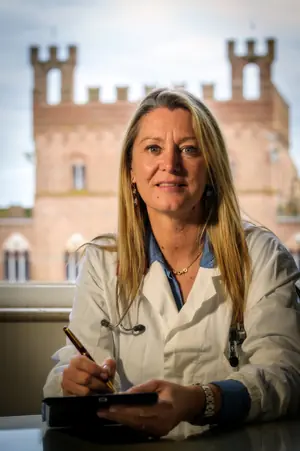
Written by Dr Cristina Lenzi
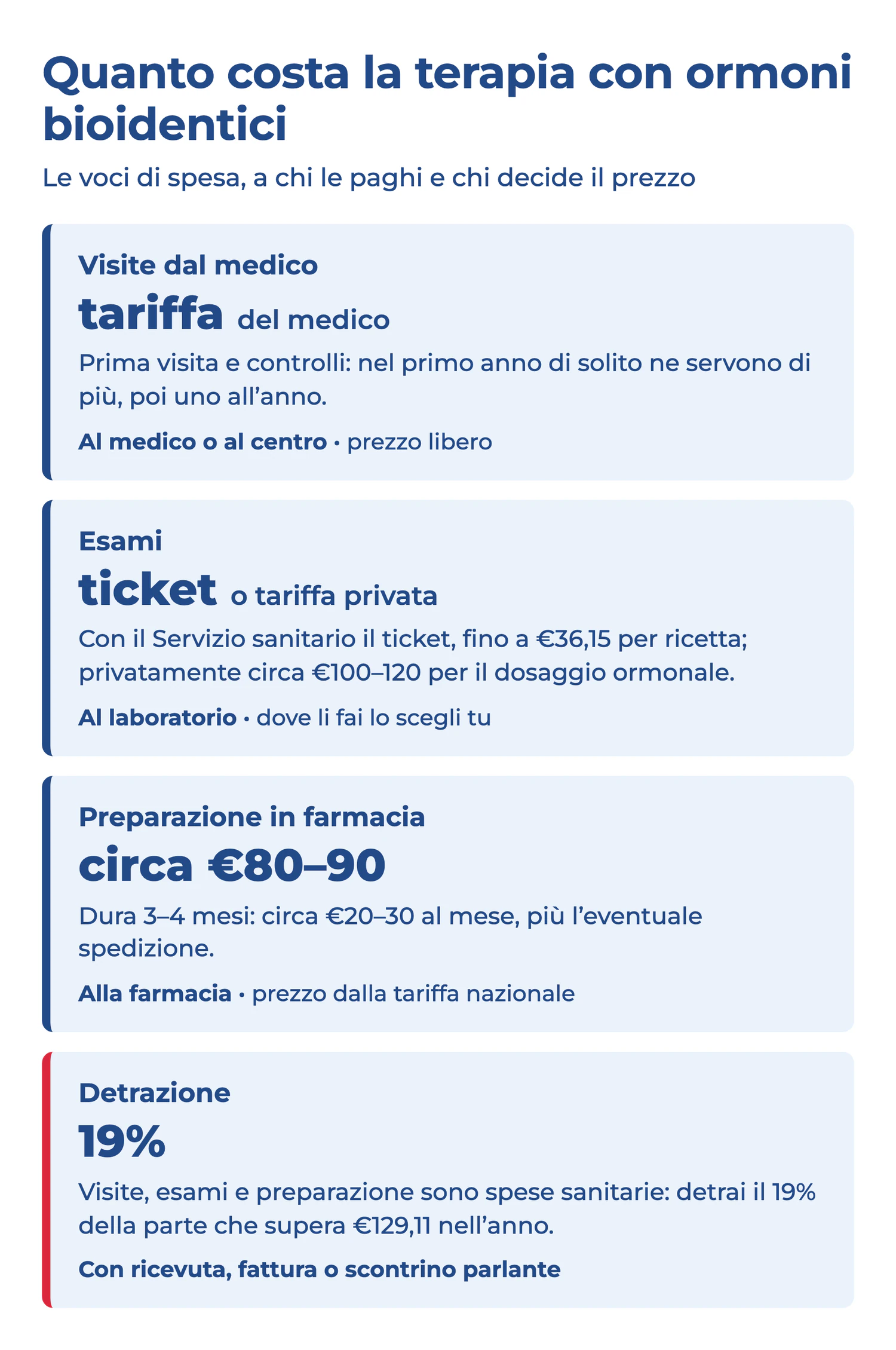
The cost of bioidentical hormone therapy is made up mainly of three items: the visits with the doctor who prescribes and follows the therapy, the tests before you start and over time, and the medicines, which can be registered medicines or a compounded preparation made up in a pharmacy.
The compounded preparation costs about €80–90, a price the pharmacy calculates using the Italian national tariff, and it lasts three to four months. Each doctor sets their own visit fees, and the first year usually costs more, because follow-up visits are needed to find the right dose. Italian law does not require a specialist to prescribe bioidentical hormones: what counts is training in this therapy and follow-up over time.
For most women a compounded preparation of bioidentical hormones costs about €20–30 a month, depending on the dose. Less than a coffee a day. Even counting the visits, in the first year you spend about €50–70 a month, depending on each woman's needs. The first year is often a little more expensive than the following ones, because there are more follow-up visits to identify the perfect dose for bioidentical hormone therapy.
Would you like to talk it through with a doctor?
The first consultation is free, also by video call.
Book a free consultationHow much does bioidentical hormone therapy cost, item by item?
You pay a different person for each item, and a different person decides the price: for the visits, the doctor or centre you choose; for the tests, the Italian National Health Service (SSN) or the laboratory; for the preparation, the pharmacy, using the national tariff.
| Item | How much | Who you pay | When | Who sets the price |
|---|---|---|---|---|
| First introductory conversation | sometimes free | the doctor or the centre, if it is not free | before deciding, if you want it | the doctor or the centre |
| Initial blood tests | through the Italian National Health Service (SSN), the co-payment (“ticket”), up to €36.15 per prescription, plus vitamin D, where applicable; privately, about €100–120 | the centre that carries them out | before the first visit | the SSN tariff, with a cap per prescription; privately, the centre |
| First visit | depends on the doctor | the doctor or the centre | at the start, with the tests already done | the doctor or the centre |
| Follow-up visits | depends on the doctor, for each follow-up visit | the doctor or the centre | in the first year, as many as are needed to find the right dose, then usually one a year | the doctor or the centre |
| MOC and gynaecological examination | if the doctor requests them; privately, the MOC about €55–80 and the ultrasound about €60–90 | the centre that carries them out | after the first visit, depending on age and medical history | the SSN tariff or the private centre |
| Pharmacy preparation | about €80–90 | at the pharmacy | about every 3–4 months | the pharmacy, using the national tariff |
| Shipping of the preparation | charged separately | at the pharmacy | if you do not collect it in person | the pharmacy |
| Follow-up blood tests | same as the initial blood tests | the centre that carries them out | usually around month 9, then once a year | the SSN tariff or the private centre |
How much do the visits cost?
The visits are the item that depends most on the doctor you choose, because each doctor and each centre sets its own fees. More than the price of a single visit, what counts is how many you need and what they include:
- how many follow-up visits you need in the first year, and what each one costs;
- whether the prescription renewal is paid for separately;
- whether you can contact the doctor between visits, and at what cost;
- whether the visit can also be done by video call.
Some doctors and centres offer a free first conversation, so you can ask questions before deciding whether to start a hormone therapy pathway. At Medyca, for example, the introductory consultation is free, with no obligation and entirely online; the first visit costs €200 and each follow-up visit €150.
At the first visit the doctor reads your test results together with your symptoms and your medical history, assesses whether the therapy is right for you and, if it is, writes the prescription with the dose and instructions for the first three months. The starting dose is then reviewed at the follow-up visits, which are there to find the minimum effective dose, that is, the lowest one that works for you.
How much do the tests before the therapy cost?
Before prescribing the therapy the doctor needs to know your hormone profile and your general health: that is why the tests needed before bioidentical hormones are prescribed come before the visit. Your doctor gives you the list, and you choose where to have them done. For the first visit, all I need is the hormone levels, that is, a blood sample taken in the last 12 months. I might ask for the computerised bone mineral densitometry (MOC) and the gynaecological examination later, depending on the age and history of each woman; if you have already had them, bring them to the first visit.
There are two routes, and the bill depends on the region, on exemptions and on the centre.
With the SSN. If your GP, or an SSN specialist, prescribes the tests on an SSN prescription (“impegnativa”), you pay the “ticket” (the co-payment), unless you have an exemption. The ticket equals the fee for the test, up to a maximum of €36.15 per prescription, and one prescription can contain up to eight services of the same specialty: tests of different kinds may require different prescriptions, each with its own ticket. Many regions have their own tariffs, and exemptions depend on your situation. For example, vitamin D, which I often request along with the hormones, may not be covered by the SSN: in that case it has to be paid for separately.
Privately. You pay the listed price of the centre you choose. As a guide:
- hormone levels, the test you need for the first visit: about €100–120, blood draw included;
- lumbar and femoral MOC, if the doctor requests it: about €55–80;
- transvaginal gynaecological ultrasound, usually during the gynaecological examination: about €60–90.
Tests are not done just once, because the hormone profile changes over time. I usually ask for the blood tests to be repeated once a year.
How much does the pharmacy preparation cost?
Bioidentical hormone therapy can be done with registered medicines or with a compounded preparation, which the pharmacist makes up on the doctor's prescription: only the second is 100% personalised, built on the profile of the individual woman. In my experience most women benefit more from a tailor-made therapy, and that is why I work a lot with compounded preparations. It is usually a single preparation, with all the molecules you need, each at the dose chosen for you; if two are needed, each has its own price.
A preparation costs about €80–90 and lasts three to four months. The price varies only slightly with the dose, that is, with the amount of hormones.
The price of a compounded preparation of bioidentical hormones is calculated by the pharmacy using the national tariff, and it cannot increase it. Neither the pharmacist nor the prescribing doctor can make a margin on it at their own discretion; Medyca, for example, receives no commission on the preparations.
You choose the pharmacy, and if you do not have one you can ask the doctor to suggest one. If you cannot collect the preparation from the pharmacy, it will be sent to your home.
Does a compounded preparation cost more than registered medicines?
Yes, by a few euros a month. Estradiol and progesterone also exist as registered medicines, in fixed doses. At October 2026 prices, a registered estradiol patch, gel or spray costs roughly between €6 and €20 a month, micronised progesterone about €5 a month, and the capsule that combines the two about €24 a month. A combination of registered estradiol and progesterone therefore comes to between about €11 and €25 a month; the compounded preparation between €20 and €30. For industrial bioidentical hormones there is another difference as well: some packs are reimbursed by the Italian National Health Service (SSN), apart from any regional co-payment (“ticket”), if the doctor prescribes them on an SSN prescription; the compounded preparation, on the other hand, you pay for in full.
The point, though, is a different one. A registered medicine has fixed molecules and doses: to build a therapy around the individual woman you often have to combine two or three different products, sometimes together with supplements, and the cost easily reaches that of the compounded preparation. The compounded preparation is the best route to a 100% personalised therapy: usually a single preparation, with all the molecules you need at the doses chosen for you.
So the question to ask yourself is this: would you rather save a few euros a month, or have a 100% personalised therapy, built around you? You make the decision with your doctor. And whichever route you and your doctor choose, compounded or industrial, bioidentical or synthetic, the important thing is to protect yourself.
Does the first year cost more?
Yes. The first year is usually spent finding the right dose, and so may need more frequent follow-up visits. The first follow-up visit is usually at three months, based on your symptoms, to see whether anything needs to be increased or added; the second, six months after that. Once the dose is right and the therapy makes you feel well, you usually move to one follow-up visit a year.
From the second year you spend less: what remains is the cost of the bioidentical hormone therapy, the blood tests and, in general, one follow-up visit a year.
Are the costs tax-deductible in Italy?
Yes: visits, tests and compounded preparation are healthcare expenses. In your Italian tax return you deduct from your tax 19% of the part that exceeds €129.11, calculated on all the year's healthcare expenses. If your income is above €75,000, the cap that limits other deductions does not affect healthcare expenses.
But you need the right documents.
- The preparation: the pharmacy receipt must carry the word “farmaco” or “medicinale” (medicine), the wording “preparazione galenica” (compounded preparation), the quantity and your tax code (codice fiscale). If the pharmacy cannot issue a receipt like that, it gives you an invoice. For medicines you can also pay in cash.
- Private visits and tests: you need the receipt or invoice from the doctor or centre, describing the service, and a traceable payment, by bank transfer or card. Doctors and healthcare facilities send these expenses to the Health Card System (Sistema Tessera Sanitaria), so you will normally find them already in your pre-filled tax return.
Who prescribes bioidentical hormones?
Many women think that only a gynaecologist can prescribe hormone therapy. That is not so: any doctor can prescribe it. Italian law does not require a specialisation: magistral preparations, that is, compounded preparations made to a prescription, are prescribed by the doctor. Hormone replacement therapy with a registered medicine also requires a doctor's prescription. The law does, however, set a limit on the substances: as a rule the active ingredients must be described in the pharmacopoeias of European Union countries, or be contained in medicines authorised in Italy or in another EU country.
What makes the difference is how much the doctor has trained to understand the effect of hormones on a woman's whole body. Before you entrust yourself to a doctor, ask:
- what training they have in bioidentical hormone therapy;
- whether they ask for tests before prescribing, and whether they look at your medical history as well as the values;
- whether they build the therapy around your hormone profile;
- whether they follow you with check-ups over time, aiming for the minimum effective dose.
Can you get bioidentical hormones without a prescription?
No. A compounded preparation starts from the prescription: the pharmacist makes it up for you, with the hormones and the dose the doctor has written, and without a prescription you will not find it on the shelf. Bioidentical hormones are not herbs or supplements: they are hormones with the same structure as those produced by the body, prepared on a doctor's prescription.
Gynaecologist, endocrinologist or internal medicine specialist?
As far as the law is concerned, any of them will do, and so will your GP. But hormone therapy does not act on a single organ: as well as acting on symptoms in the short term, it contributes to prevention and long-term protection of bones, heart and brain. The gynaecologist is the specialist in the female genital system; the internal medicine specialist is trained to look at the whole body.
That is why more and more women turn to a specialist in internal medicine for hormone therapy in menopause: it is what I see in my own work too. With menopause the same thing is happening that has already happened with osteoporosis: until forty years ago it was thought to concern only orthopaedists, whereas today diagnosis and treatment are mostly carried out by internal medicine specialists, endocrinologists and rheumatologists. In the same way, menopause does not concern only gynaecologists: I am a specialist in internal medicine and I look after it precisely because it involves the bones, the cardiovascular system and the brain.

Medyca's vision is menopause care led by the internal medicine specialist, so that the assessment of a woman's health as a whole always stays at the centre. The gynaecologist remains a very important part of this way of treating menopause, together with other specialists, such as the endocrinologist or the dietitian, when they are needed. It is not a competition between specialties: whoever you choose, what counts is their training in hormone therapy and the answers to the four questions above.
Can you do it all from home?
Almost everything, if the doctor you choose also sees patients by video call. You have the tests done at a centre near your home, and the preparation, if the pharmacy ships, is delivered to your home. The doctor may still ask you for an in-person visit or further tests, if your case requires it.
If you want to start with Medyca, the next step is the first visit: you receive the list of tests and, once you have them, you book the visit by video call or in Siena. If you would rather first understand whether the therapy is right for you, the introductory consultation is there for that, with no obligation.
Ready to start?
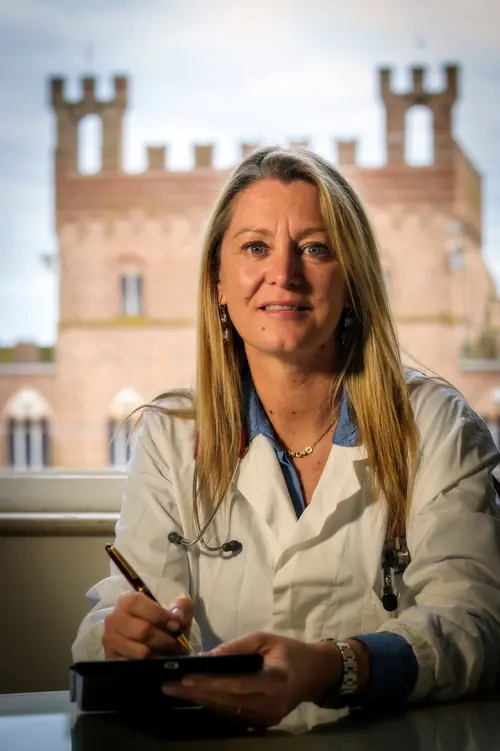
Dr Cristina Lenzi
Dr Cristina Lenzi is an internal medicine physician and the Medical Director of Medyca, where she looks after women's health in perimenopause and menopause with bioidentical hormone therapy.
Medyca is a medical service founded by Dr Cristina Lenzi, one of the few doctors in Italy specialising in bioidentical hormone therapy. A specialist in Internal Medicine, cum laude, from the Università di Siena, she holds a PhD in osteometabolic diseases and Level I and Level II Master's degrees in bioidentical hormones from the Marion Gluck Clinic in London.
The first introductory consultation is free and without obligation: it is the way to find out more and understand whether the pathway is right for you. We look after patients from anywhere in Italy by video call, and in person at our practice in Siena.
Find out more:
- Compounded bioidentical hormone preparations: how they are made and who checks their quality
- Bioidentical hormones: brand names, molecule by molecule
- How bioidentical hormone therapy (BHRT) works: effects, contraindications and the role of your doctor
Sources
- Decreto-legge 17 febbraio 1998, n. 23, art. 5, convertito dalla legge n. 94/1998: prescription of magistral preparations. Normattiva
- Ministero della Salute e Ministero dell'Economia e delle Finanze, circolare del 3 marzo 2022, on the prescription of medicines not reimbursed by the Italian National Health Service (SSN). copy on the AIFA website
- Decreto del Ministero della Salute 22 settembre 2017 (national tariff of medicines), Gazzetta Ufficiale n. 250 del 25 ottobre 2017. Gazzetta Ufficiale
- Ministero della Salute, Ticket ed esenzioni, accessed 07/10/2026. salute.gov.it
- Ministero della Salute, Assistenza specialistica ambulatoriale, accessed 07/10/2026. salute.gov.it
- Agenzia delle Entrate, Spese sanitarie, 2026 tax return guide. agenziaentrate.gov.it
- Legge 27 dicembre 2019, n. 160: traceability of payments for tax-deductible expenses. Normattiva
- Decreto legislativo 21 novembre 2014, n. 175, art. 3: transmission of healthcare expenses to the Sistema Tessera Sanitaria for the pre-filled tax return. Normattiva
- Decreto legislativo 19 giugno 2026, n. 117, Testo unico delle imposte sui redditi: tax deduction for healthcare expenses and limits on deductions. Normattiva
- AIFA, Banca Dati Farmaci: supply regime (“soggetto a prescrizione medica”, subject to medical prescription) and dosage (summary of product characteristics) of medicines based on estradiol and progesterone, accessed 07/10/2026. aifa.gov.it
- Private prices of tests: quotes and public price lists from laboratories and diagnostic centres, from 2024 to 07/10/2026.
- AIFA, lists of class A and H medicines (list by brand name, updated to 31/05/2026): prices of estradiol patches and micronised progesterone. aifa.gov.it
- Prices of class C medicines (estradiol gel and spray, estradiol and progesterone capsule): pharmacy price lists accessed 07/10/2026; for class C medicines the price is set by the company and may vary from pharmacy to pharmacy.