Bioidentical progesterone in menopause: what it is, what it is for and how to use it
Written by Dr Cristina Lenzi
Bioidentical progesterone has the same molecular structure as the progesterone your ovaries produce. In menopause, if you have a uterus, it is given both to protect the endometrium from the effect of oestrogen (without progesterone the endometrium could otherwise thicken, with a higher risk of hyperplasia and endometrial cancer) and for its beneficial effects on sleep, mood, bones and the thyroid. It can be taken as capsules by mouth, as pessaries by the vaginal route, or applied as a cream by the transdermal route, at the dose your doctor indicates.
Progesterone is generally the first hormone to fall as you approach menopause. And in hormone replacement therapy, it is one of the two halves, not an add-on to oestrogen. Here you will find what it does, how it is taken, what effects it can have and what changes if you no longer have a uterus.
Would you like to talk it through with a doctor?
The first consultation is free, also by video call.
Book a free consultationWhat is bioidentical progesterone?
Progesterone is one of the female sex hormones. It is produced mainly by the ovaries, after ovulation, in the second half of the menstrual cycle.
Bioidentical means that the molecule has the same chemical structure as the one produced by the body. Bioidentical progesterone is obtained from substances found in plants such as dioscorea, sweet potato and soya, transformed in the laboratory: it is not “natural” in the sense of being produced by the plant, but it is identical to the progesterone made by the ovaries. This is why it is the progesterone closest to what the body produces physiologically: it is the same molecule. It is also called micronised progesterone, because the substance is reduced to very fine particles, which the body absorbs better.
At the pharmacy it is available as a registered medicine, in fixed-dose capsules, or as a compounded preparation, which the pharmacist prepares on prescription for the individual woman. The brand names of bioidentical hormones, progesterone included, are collected in a separate list.
What is the difference between progesterone and a progestin?
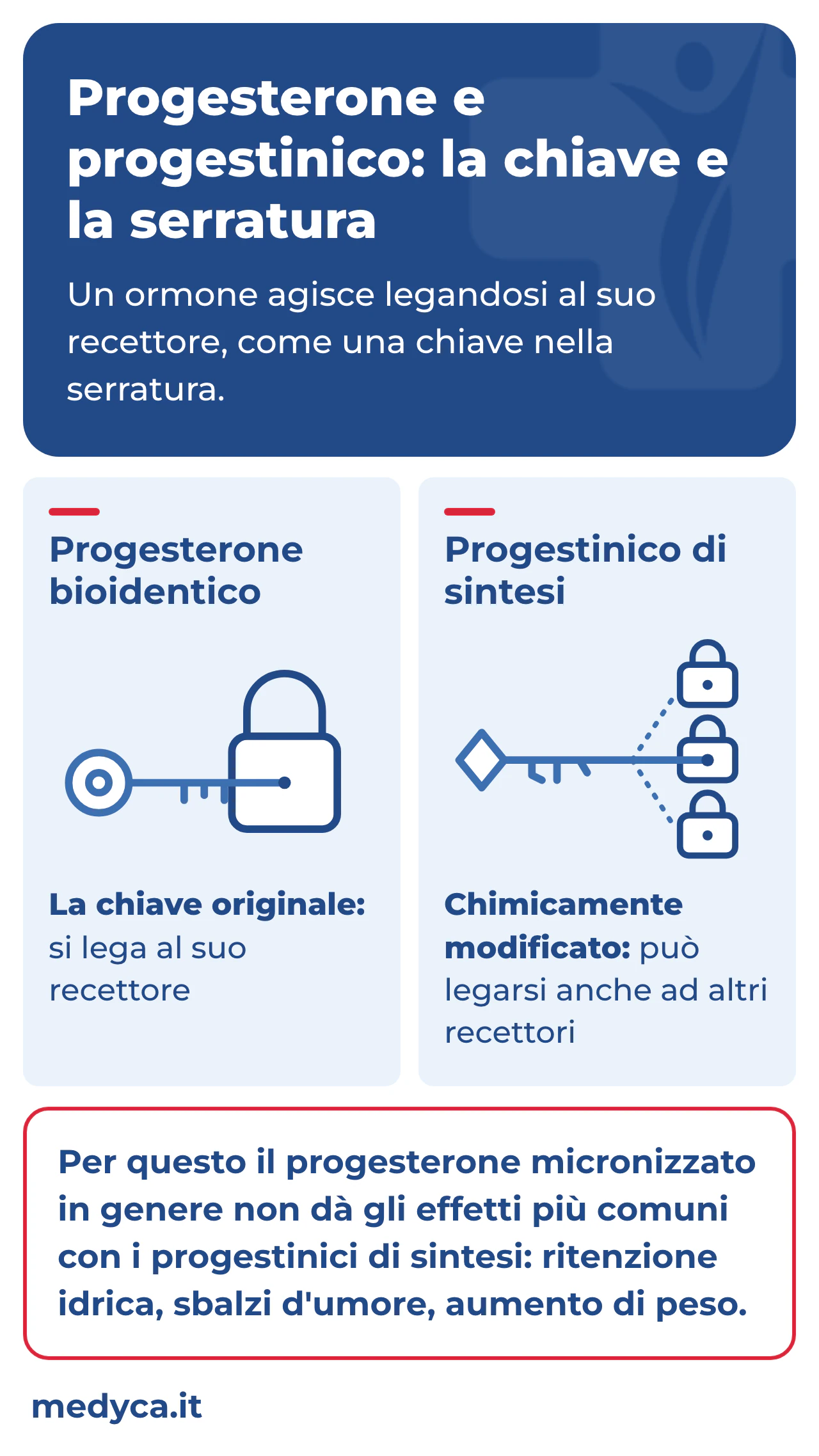
Progestins are synthetic molecules, built to imitate the action of progesterone, but with a different chemical structure. They are found in many traditional hormone therapies and in the contraceptive pill.
The difference matters because a hormone acts by binding to its receptor, like a key in a lock. Bioidentical progesterone is the original key; a progestin, on the other hand, being chemically modified, can also bind to other receptors. This is why micronised progesterone does not generally cause the side effects that are more common with synthetic progestins, such as water retention, mood swings and weight gain.
Whether synthetic or bioidentical, what matters is that the endometrium is protected. In addition, if a molecule is not well tolerated, your doctor can choose another. The difference between synthetic hormone therapy and bioidentical hormones concerns oestrogen too, not just progesterone.
What is the role of progesterone during menopause?
With menopause, the ovaries almost completely stop producing oestrogen and progesterone. Hormone therapy gives them back to the body; progesterone has two tasks.
The first concerns the uterus. Oestrogen stimulates the growth of the endometrium, the inner lining of the uterus; progesterone balances its effect and ensures that it does not thicken too much. That is why, if you still have a uterus, progesterone or a progestin is combined with oestrogen.
The second concerns the rest of the body. Progesterone is not only for the uterus: it acts on sleep, bones and the thyroid, and for this reason it can also be useful for women who no longer have a uterus.
What if you no longer have a uterus?
After a hysterectomy, the operation that removes the uterus, there is no longer an endometrium to protect, and many women are told that progesterone is not needed at that point. After a hysterectomy, the guidelines indicate that it is also possible to have therapy with oestrogen alone. The exception is anyone who has had endometriosis: in this case the doctor can still add a progestin. But let us not forget that progesterone also acts on the brain, sleep, bones and the thyroid, and combining it with oestrogen, even without a uterus, brings benefits in all these respects. I no longer have a uterus myself, but woe betide anyone who takes my dose of progesterone away.
If the ovaries are removed along with the uterus, menopause arrives suddenly: from one day to the next the body finds itself without hormones. Symptoms do not always appear straight away, and sometimes months go by, even a year, before a woman notices.
Why does the endometrium thicken without progesterone?
Oestrogen makes the endometrium grow. If it acts alone, month after month, the endometrium can thicken more than it should: this is what doctors call endometrial hyperplasia, which over time can increase the risk of endometrial cancer. Progesterone balances the effect of oestrogen and keeps the endometrium thin.
For this reason, whatever the hormone therapy and whatever the route, the health of the endometrium is monitored with regular gynaecological check-ups. If the endometrium is found to be thickened at a check-up, it is the gynaecologist who assesses the next step. In addition, any unexpected bleeding should be reported to the gynaecologist.
Can you take progesterone if you have endometriosis?
Endometriosis is the presence of tissue similar to the endometrium outside the uterus, for example on the ovaries or on the peritoneum, the membrane that lines the inside of the abdomen.
It is a purely gynaecological condition, in which you cannot start from the low doses of bioidentical therapy: a young woman of 30 with endometriosis in her childbearing years is treated with specific high-dose hormone therapies, generally synthetic progestins or the combined oestrogen-progestin pill, and often with surgery as well. For many women with a history of endometriosis who enter menopause, personalised bioidentical hormones are a valuable ally in countering symptoms, offering an excellent tolerability profile. In this delicate transition, bioidentical progesterone is often considered for hormonal rebalancing, because, compared with synthetic progestins, it faithfully mimics the action of the body, although, as always, the therapy must be calibrated by the specialist according to the presence of residual foci and the severity of the condition. And if you no longer have a uterus, progesterone is still given, both because any remaining foci of endometriosis could reactivate under the effect of oestrogen alone, and because it also acts on the thyroid, brain and bones.
What is the role of progesterone in perimenopause?
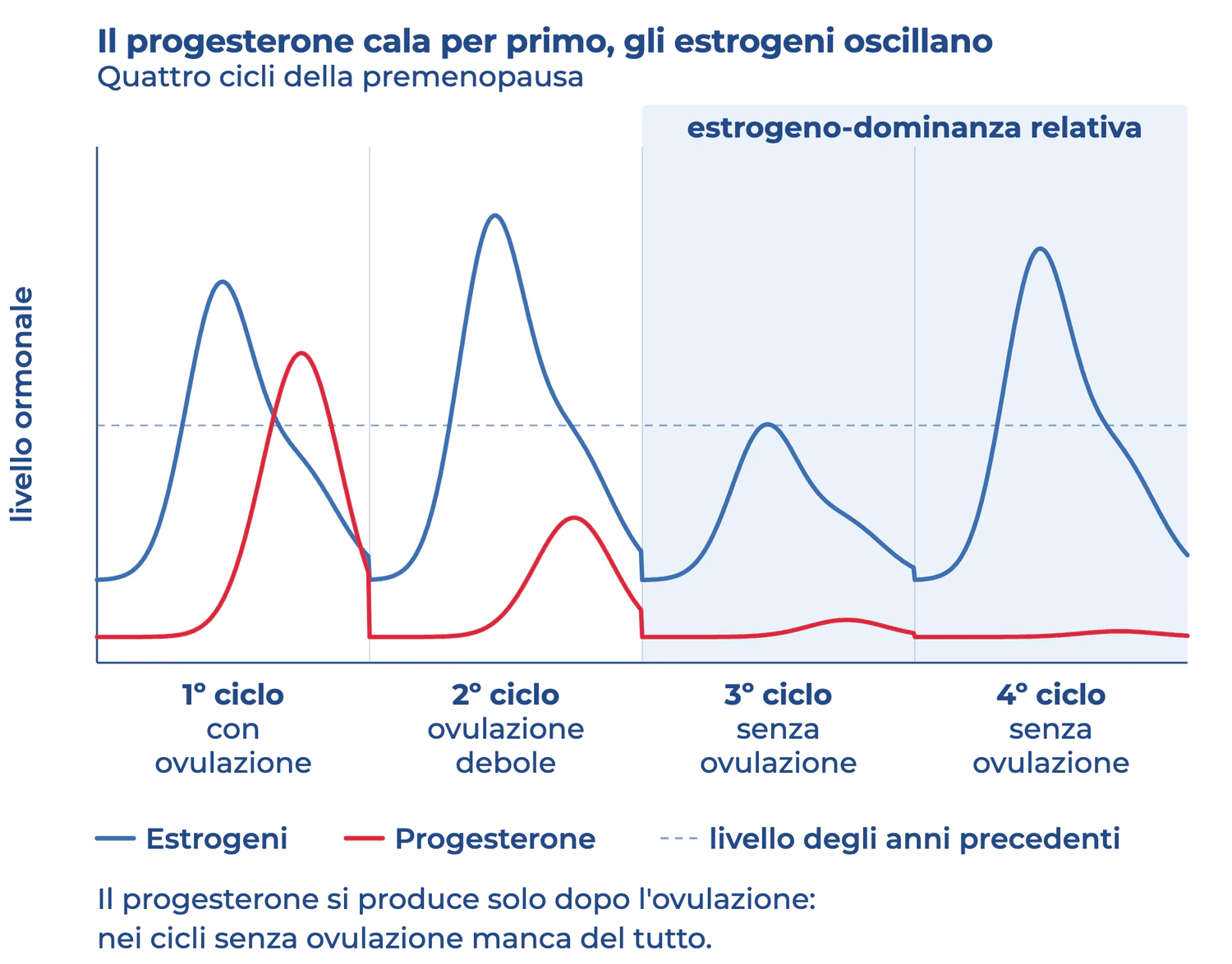
Progesterone is generally the first hormone to fall as you approach menopause. Ovulation becomes less regular and, since progesterone is produced precisely after ovulation, it begins to run short while oestrogen is still fluctuating.
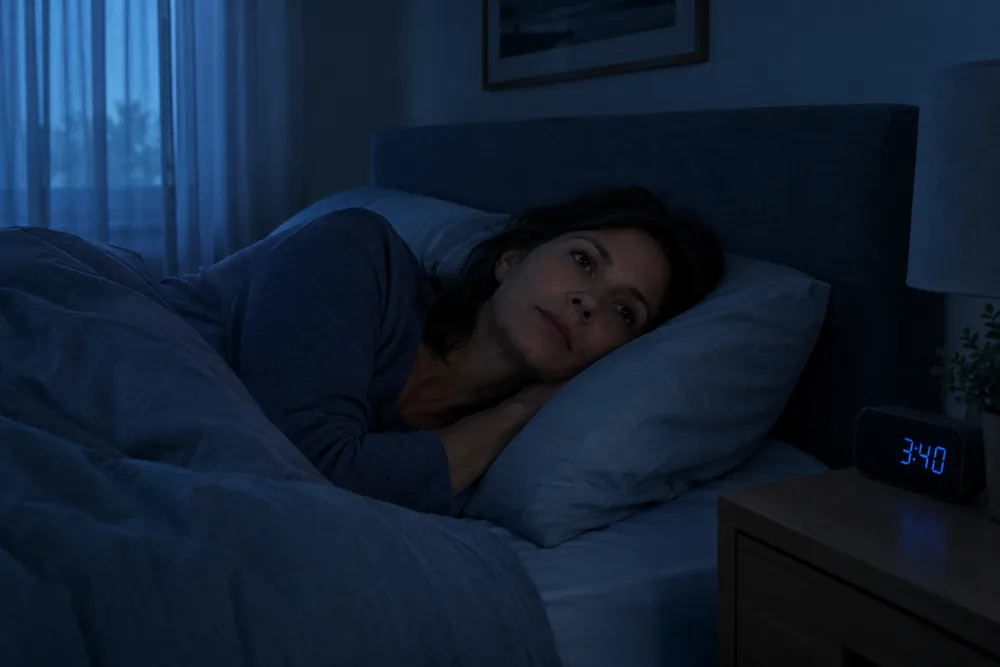
One of the first signs is sleep. For many women it goes like this: at around 3 or 4 in the morning they wake up wide awake, ready to go dancing, fall back asleep at dawn, the alarm goes off at 7am and they spend the day shattered. It is not just a symptom, it is a disorder that deserves attention: the nervous system is greatly affected by the fall in sex hormones, and needs them as a plant needs water.
Along with sleep, the menstrual cycle often changes, getting longer or shorter, and so does mood, with irritability alternating with moments of sadness. These are the first symptoms of perimenopause, and blood tests can help to understand where they come from. Symptoms can appear while you still have periods, perhaps only slightly irregular: there is no need to wait for them to stop before talking to your doctor.
Progesterone is often the first hormone to fall, but in perimenopause the therapy is chosen on the basis of symptoms as well as hormone levels: the doctor can therefore propose progesterone alone or a therapy with oestrogen and progesterone.
What is oestrogen dominance?
When progesterone falls before oestrogen does, oestrogen stays high in proportion: this is known as oestrogen dominance.
In this situation a protein in the blood increases, TBG (thyroxine-binding globulin), which binds thyroid hormones and makes them poorly available to the cells. This is why a woman can have thyroid tests within range and still have a slowed metabolism. Oestrogen dominance is corrected by rebalancing oestrogen and progesterone on the basis of blood tests, and a new balance between the sex hormones can help to improve thyroid function.
What are the benefits of bioidentical progesterone?
In menopause, bioidentical progesterone acts on several fronts:
- Endometrium. If you have a uterus, it balances the effect of oestrogen and keeps the endometrium thin.
- Sleep and mood. It promotes sleep and calm.
- Thyroid. It helps to convert FT4 into FT3, the active form.
- Bones. Together with the other sex hormones, it contributes to bone health; bone is lost silently with menopause, without causing symptoms, which is why it is best not to neglect it.
- Brain. Hormone therapy, started within about 10 years of menopause or before the age of 60, can help to protect the brain, and in this progesterone works together with oestrogen.
Does progesterone help you sleep?
It can help you sleep better. Progesterone acts on the GABA receptors in the brain, which calm the nervous system and promote sleep: this is why the capsules are taken in the evening, before going to bed.
Waking at around 3 or 4 in the morning, so typical around menopause, often stems from the imbalance between oestrogen and progesterone, and bringing them back into balance can help you get your sleep back. Magnesium and melatonin can be a support, but the key is to rebalance the hormones.
Does progesterone help with anxiety?
It can help: progesterone has a calming effect on the nervous system, the same one that promotes sleep, and supports mental calm and mood. In women at the start of perimenopause, estradiol applied to the skin together with micronised progesterone seems to halve the risk of depressive symptoms.
How is bioidentical progesterone taken?
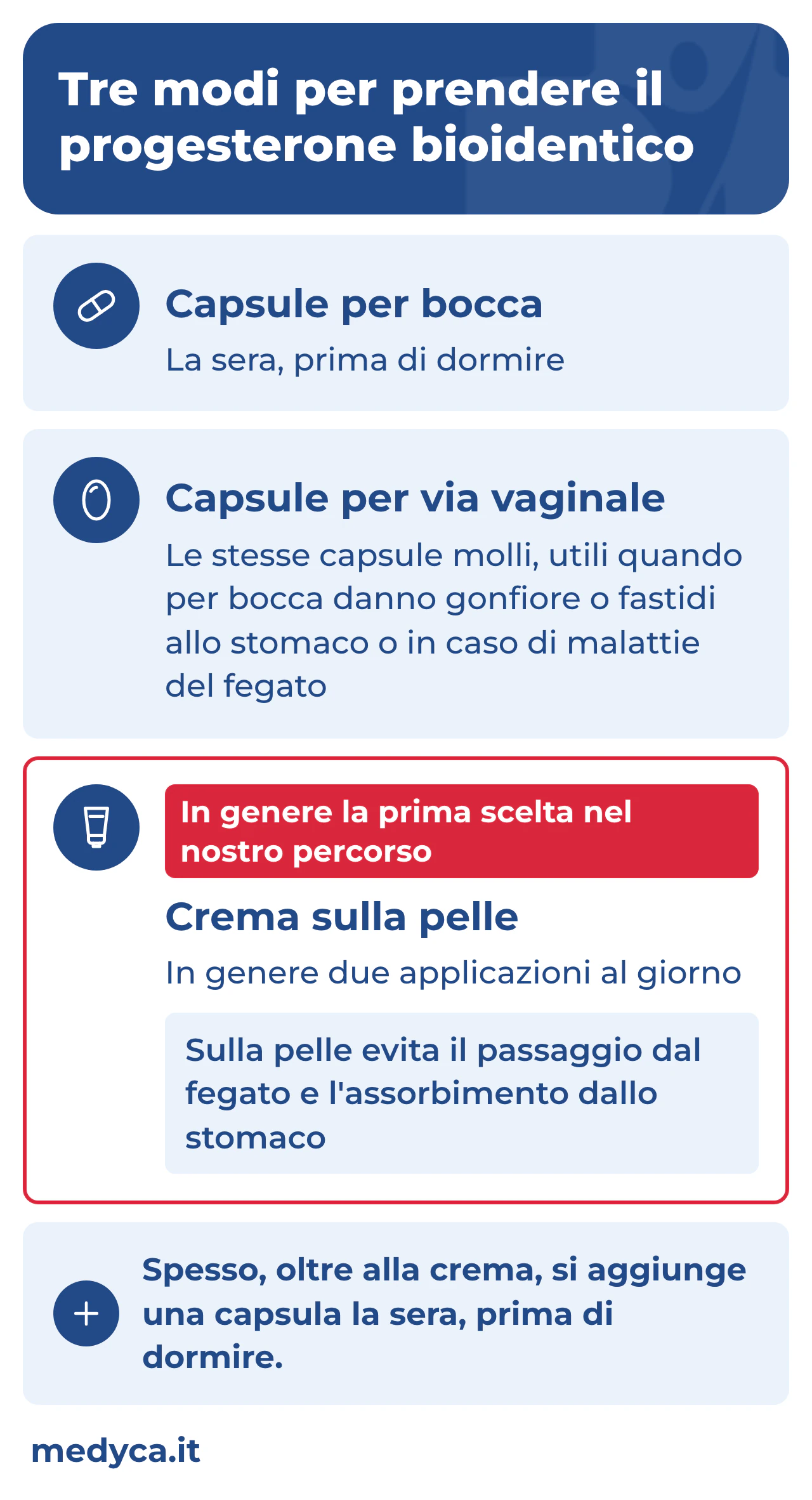
Bioidentical progesterone is used in three ways:
- Capsules by mouth, in the evening, before sleep.
- Capsules by the vaginal route: the same soft capsules, useful when, taken by mouth, they cause bloating or stomach discomfort, or in the case of liver disease.
- Cream on the skin, generally in two applications a day.
In our Bioidentical Hormone Pathway, application to the skin as a cream is generally the first choice: on the skin, progesterone avoids passing through the liver and being absorbed from the stomach, and sometimes it even costs less. Often, as well as the cream, a capsule is added in the evening, before sleep.
The skin is a recognised route of administration, like the oral route. With cream, the absorption of progesterone can vary, and for this reason the scientific societies state that protection of the endometrium is not guaranteed. By mouth too, moreover, absorption varies from woman to woman: for this reason, whatever the route, protection of the endometrium is monitored with regular gynaecological check-ups.
The dose is not the same for everyone: it is set on the basis of blood tests and symptoms. You start with a low dose and increase it gradually, up to the minimum dose that works. If you have a uterus, progesterone is given at a dose that reaches the whole body, always balanced against that of oestrogen: this is how it protects the endometrium, in the same way that hormones protect the other organs. If the symptoms you had go away, it usually means there is enough hormone in the blood, but this alone is not enough to say that the endometrium is protected: for this reason the progesterone dose should not be reduced without your doctor's advice, and regular gynaecological check-ups remain essential.

As a registered medicine, micronised progesterone comes in fixed-dose capsules; as a compounded preparation, it is made up by the pharmacist, in capsules or cream, at the dose the doctor has set for the individual woman. In both cases a doctor's prescription is required.
What are the side effects of bioidentical progesterone?
Micronised progesterone generally does not cause the typical side effects of synthetic progestins, such as water retention and weight gain. It can cause drowsiness, which is also the reason the capsules are taken in the evening.
By mouth, however, in some women it can also cause a bloated belly or stomach discomfort: in that case you can switch to the vaginal route, or change product. Among the soft capsules of micronised progesterone, Prometrium and Progeffik contain the same hormone but a different oil: sunflower seed oil in Prometrium, peanut oil in Progeffik; both contain soya lecithin. If one of the two causes abdominal bloating, you can try the other. If you are allergic to peanuts or soya, tell your doctor before starting therapy.
Sometimes progesterone lowers blood pressure too much and gives a feeling similar to faintness, which is experienced as agitation rather than calm: in this case, talk to your doctor. As with any hormone, the dose matters: bioidentical progesterone is better tolerated when given in physiological amounts, set by the doctor on the basis of symptoms, medical history and blood tests.
If you have a uterus, light bleeding can appear at the start of therapy, and in some women periods return even after years of absence. After so long without hormones, the endometrium responds to their return and then, with progesterone, cleans itself out and becomes thin again: a sort of “cleansing cycle”. If the bleeding lasts more than a week or is very heavy, you need to be seen by a gynaecologist.
Does progesterone make you gain weight?
Micronised progesterone generally does not: weight gain and water retention are effects more typical of synthetic progestins.
Around menopause, however, there is still a tendency to gain weight, especially around the abdomen. Hormone therapy is not a weight-loss therapy.
Is bioidentical progesterone safe for the breast?
Bioidentical progesterone, used at physiological doses, has a molecular structure identical to that of the hormone the female body has produced throughout its fertile life, ensuring perfect recognition by the body. This natural affinity translates into a distinctly superior oncological safety profile: clinical studies show that, unlike synthetic progestins, which can increase the risk of breast cancer after just a few years of therapy, oestrogen therapy combined with micronised progesterone does not show a significant increase in this risk during the first years of treatment, making it the most reassuring and protective choice for the breast.
How can you tell if the progesterone is working?
In general, the first results of bioidentical hormone therapy can arrive as early as 2-3 weeks, and the improvement becomes clear after 4-6 weeks; in more complex cases it takes 2-3 months.
With progesterone, the first benefit is usually sleep: you sleep better, more deeply, and wake up more rested.
How long can you take progesterone for, and what happens if you stop?
There is no set expiry date for bioidentical hormone therapy: its duration is assessed over time, together with your doctor, on the basis of regular check-ups.
When you decide to stop, you can reduce the dose gradually or stop the therapy straight away; a gradual reduction can delay the return of symptoms in the first few months, but after a year the result is the same. It is a decision to take with your doctor: a therapy in progress should not be stopped or changed on your own initiative.
If you stop, partially or completely, the symptoms that had gone away can gradually come back. If you have osteoporosis, be aware that the conventional therapy for osteoporosis, accepted worldwide, is not hormones but bisphosphonates, which can have side effects. Hormones can be integrated perfectly well, and can help to restore a proper mineral content of the bone.
How can you tell if your progesterone is low?
After menopause, progesterone is low by definition, because the ovaries almost completely stop producing it. The question makes sense above all in perimenopause, when you still have periods.
The first signs, when progesterone begins to fall, are usually disturbed sleep and irritability during the day; the rhythm of the menstrual cycle often changes too. To know for sure you need blood tests, which give a snapshot of your hormonal state. The doctor reads the report according to the date of your last period, because progesterone rises only in the second half of the cycle.
How can you increase progesterone naturally?
Dioscorea, sweet potato and soya contain plant precursors, such as diosgenin, from which progesterone is obtained in the laboratory. In the body, however, diosgenin is not converted into progesterone: it becomes an active ingredient only after a controlled chemical transformation in the laboratory. Taking the plant, therefore, is not the same as taking the hormone.
Before taking anything you need blood tests, to measure your hormones and dose what you take properly: supplements bought at random on the internet can throw them even further out of balance.
If you are looking for the therapy closest to what your body used to produce, there is bioidentical progesterone: the same molecule your ovaries used to make. If there is one thing to know about progesterone, it is that it is more or less described as the “hakuna matata” hormone: it acts on the brain like a relaxation hormone, makes everything calmer and can ease symptoms.
Which form, which dose and for how long are not things you can read in an article: they are decided on the basis of your blood tests and your medical history, together with your doctor.
Do you want to find out whether the therapy is right for you?
Dr Cristina Lenzi
Dr Cristina Lenzi is an internal medicine physician and the Medical Director of Medyca, where she looks after women's health in perimenopause and menopause with bioidentical hormone therapy.

Medyca is a medical service founded by Dr Cristina Lenzi, one of the few doctors in Italy specialising in bioidentical hormone therapy. A specialist in Internal Medicine, cum laude, from the Università di Siena, she holds a PhD in osteometabolic diseases and Level I and Level II Master's degrees in bioidentical hormones from the Marion Gluck Clinic in London.
The first introductory consultation is free and without obligation: it is the way to find out more and understand whether the pathway is right for you. We look after patients from anywhere in Italy by video call, and in person at our practice in Siena.
Find out more:
- What are bioidentical hormones, and how do they differ from synthetic hormones?
- How bioidentical hormone therapy (BHRT) works: effects, contraindications and the role of your doctor
- Hormone replacement therapy in menopause: what it is, when it is recommended, risks and how to start
Sources
- Fournier A et al., Breast Cancer Research and Treatment, 2008: E3N cohort. PMID 17333341
- Gordon JL et al., JAMA Psychiatry, 2018: transdermal estradiol and micronised progesterone in preventing depressive symptoms during the menopausal transition. PMID 29322164
- Haimov-Kochman R et al., Menopause, 2006: gradual discontinuation of hormone therapy and return of symptoms, randomised trial. PMID 16735933
- AIFA, package leaflet and summary of product characteristics of Prometrium and Progeffik (Banca dati farmaci), accessed on 26/10/2026.