Compounded or registered bioidentical hormones: are they safe? Pros, cons and the most common objections

Written by Dr Cristina Lenzi
Yes: a compounded preparation of bioidentical hormones, made by an authorised pharmacy on a doctor's prescription, is safe, and it contains the same molecules as registered medicines. The difference lies elsewhere: a compounded preparation is built around the individual woman, with the dose and the combination of hormones she needs, while a registered medicine comes in fixed doses, the same for everyone.
And yet it is easy to be told the opposite: by a doctor, by a video on social media, by a friend. In this article I take the most common objections one by one and tell you what is true, what the rules in Italy say and how I handle them in practice. Not to defend compounding at all costs: it is the best way to personalise the therapy, but it has to be done well.
Would you like to talk it through with a doctor?
The first consultation is free, also by video call.
Book a free consultationWhat is the difference between compounded and registered bioidentical hormones?
They are the same molecules, made in two different ways. A registered medicine is produced by a pharmaceutical company, authorised by AIFA (the Italian Medicines Agency) and sold under its brand name, in fixed-dose packs. A compounded preparation is made by the pharmacist in the pharmacy's laboratory, on the doctor's prescription, with the dose and the combination of hormones written for that woman.
Neither is «natural»: bioidentical hormones have the same chemical structure as those the body produces, are derived from plant precursors and are finished in a laboratory, in the pharmacy as in industry.
| Registered medicine | Compounded preparation | |
|---|---|---|
| Who makes it | A pharmaceutical company, in large batches | The pharmacist, one cream at a time |
| Dose | Fixed, the same for everyone | The one your doctor wrote for you |
| Combination of hormones | In Italy, at most oestradiol and progesterone together | The hormones you need, in the same cream |
| Package leaflet | Yes | No: the information comes from your doctor and your pharmacist |
| Checks | By sampling, on batches | On every single bottle, with simpler checks |
| Price | Varies; some packs are paid for by the Italian National Health Service (SSN), apart from the prescription charge | You pay the full price; usually less than the cost of a coffee a day |
| Shelf life | Until the expiry date on the pack | About six months |
Are compounded bioidentical hormones safe?
«Bioidentical» says how the molecule is made, not how safe it is: bioidentical hormones are active medicines in every sense, in the pharmacy as in industry. The side effect seen in practice is that of a dose that is too high, and it is corrected by lowering it: this is why you start with a low dose and increase it slowly, with check-ups over time, as in the Bioidentical Hormone Pathway.
There are four common objections about safety. Here they are, one by one.
«A pharmacy preparation is not as safe as a registered medicine»
Many doctors recommend only registered medicines because their training in hormone therapy is not up to date: in an American survey, fewer than 7% of young doctors felt prepared to care for a woman in menopause. A compounded preparation made by an authorised pharmacy, on a doctor's prescription, is safe: safety comes from the certified pharmacy and from the right dose.
Pharmacies with a compounding laboratory are inspected by the NAS (the Carabinieri health-protection unit) and by the local health authority (ASL), also without notice, and if something does not comply with the rules the pharmacy is closed.
A compounding laboratory is not a factory, and does not claim to be one. The pharmaceutical industry produces in large batches, with quality-control systems and manufacturing standards designed for that scale, and is usually inspected more often. The pharmacy laboratory prepares creams one at a time: it starts one, finishes it, and only then moves on to the next. The checks are simpler, but they are done on every single bottle (not by sampling whole batches), and the best-organised pharmacies follow the full Good Preparation Practice of the Italian Pharmacopoeia, not the simplified procedures. It is this way of working, one cream for each woman, that allows a different dose for each one: today no pharmaceutical company could do it.
A cream is not a sterile product: sterile products, such as eye drops or vials, need equipment that almost no pharmacy in Italy has, and for this reason they are mainly made by industry. But there are still good practices that protect the cream from contamination. The best-equipped pharmacies prepare it under a laminar-flow hood: a continuous, turbulence-free flow of air forms a barrier in front of the work surface and keeps dust and particles away, and every step in which the cream or the powders are uncovered (that is, before the cap goes on) is done under the hood. Every tool, from the spatula to the balance, is cleaned and disinfected after each use. And once the cream has been handed to the patient, the click dispenser (the Topi-Click) releases it without the fingers touching the inside of the bottle. If the cream were in an ordinary jar instead, it would be contaminated at every use, even with washed hands. And in laboratory tests these creams resist micro-organisms for the full six months.

«You cannot know whether the dose in the cream is the one prescribed»
The pharmacist weighs each hormone and puts it straight into the cream: if the doctor prescribes 15 mg of oestriol, those 15 mg end up in your cream. Before starting, the pharmacist rechecks the prescription's calculations, and a mixer spreads the hormones evenly, so that every millilitre of cream contains the prescribed concentration.
«If something goes wrong, nobody records it»
In my clinical experience, a compounded preparation causes side effects only if it is wrongly dosed: with the right dose it has never happened to me. There can be an intolerance to an excipient: Progeffik, a registered bioidentical progesterone, contains peanut oil, so for a patient allergic to peanuts I prescribe something else.
A compounded preparation has no package leaflet because it is not made by a pharmaceutical company: a leaflet would have to be written for every preparation. What the leaflet would tell you, that is the indications, contraindications and side effects, is explained by the doctor who prescribes and the pharmacist who prepares the cream. And the molecules are the same: registered micronised progesterone, Progeffik or Prometrium, has its own leaflet, and you need only look at that.
If you notice a side effect, your part is to tell your doctor or your pharmacist. They report it to the national pharmacovigilance system, on dedicated forms: pharmacovigilance is the monitoring that continues once a medicine is in use, and reporting applies to compounded preparations as it does to registered medicines.
«Scientific societies advise against them: there are no studies»
It is true: the main scientific societies recommend registered medicines first, and have said so for years. The American college of gynaecologists first took a position on compounded bioidentical hormones in 2005, and in 2023 it still writes that data are lacking.
But it is worth reading carefully what they say. They do not cite a study comparing compounded and registered products on women's health outcomes: that study does not exist, because nobody has ever done it. What they say is that evidence in favour is lacking.
And why, in all these years, has nobody looked for it? The large studies needed to register a medicine are paid for by the company that wants to sell it. A compounded preparation cannot be patented: any pharmacy with a compounding laboratory can make it, on a doctor's prescription, and no company has an interest in funding those studies. So the recommendations, which are based on the studies available, end up always favouring registered products.
One fact can be checked: in the recommendations published in 2026 by several European medical societies, which advise against compounded preparations, the authors declare fees or consultancies for companies that make registered menopause therapies.
These societies accept compounding for testosterone, which has no registered product for women in Italy. Other scientific societies, including the American ones, also accept it when the dose or form a woman needs is not available commercially. And that is exactly the point: a compounded preparation is the best way to personalise the therapy 100%.
Does a cream with several hormones really work?
Yes, if it is dosed correctly. Some claim that, at the same dose, a cream gives lower hormone levels in the blood than a patch: in my view it does not, because absorption through the skin is always transdermal, and creams contain excipients that help it. But a cream cannot hold too many hormones: each base, such as Pentravan creams, allows a set amount to be absorbed. This is why the dose is calculated on the base and found step by step, starting low.

Hormones in the same cream do not interfere with each other: oestradiol, oestriol and progesterone cannot react with one another chemically. As a result, the only change that can happen over time is the oxidation of the cream's base, and this is why it is usually kept for a limited time, about six months.
What really matters is the base. Liposomal bases, such as Pentravan, are made of liposomes, that is tiny bubbles formed by a double phospholipid layer, similar to cell membranes. These liposomes take up the various hormones and keep them stable, and they play a key role in transdermal absorption: by merging with the cells of our body, they cross the skin exceptionally well and let the hormone go straight into the circulation, from the cream, to the skin, to the bloodstream. This is why the pharmacist must respect the proportions between the liposomal base and the other excipients, to make sure the cream is well balanced. One example is argan oil, which helps the hormones enter the liposomes: if a cream contains too much of it, the share of liposomal base goes down, and the cream is absorbed less through the skin.
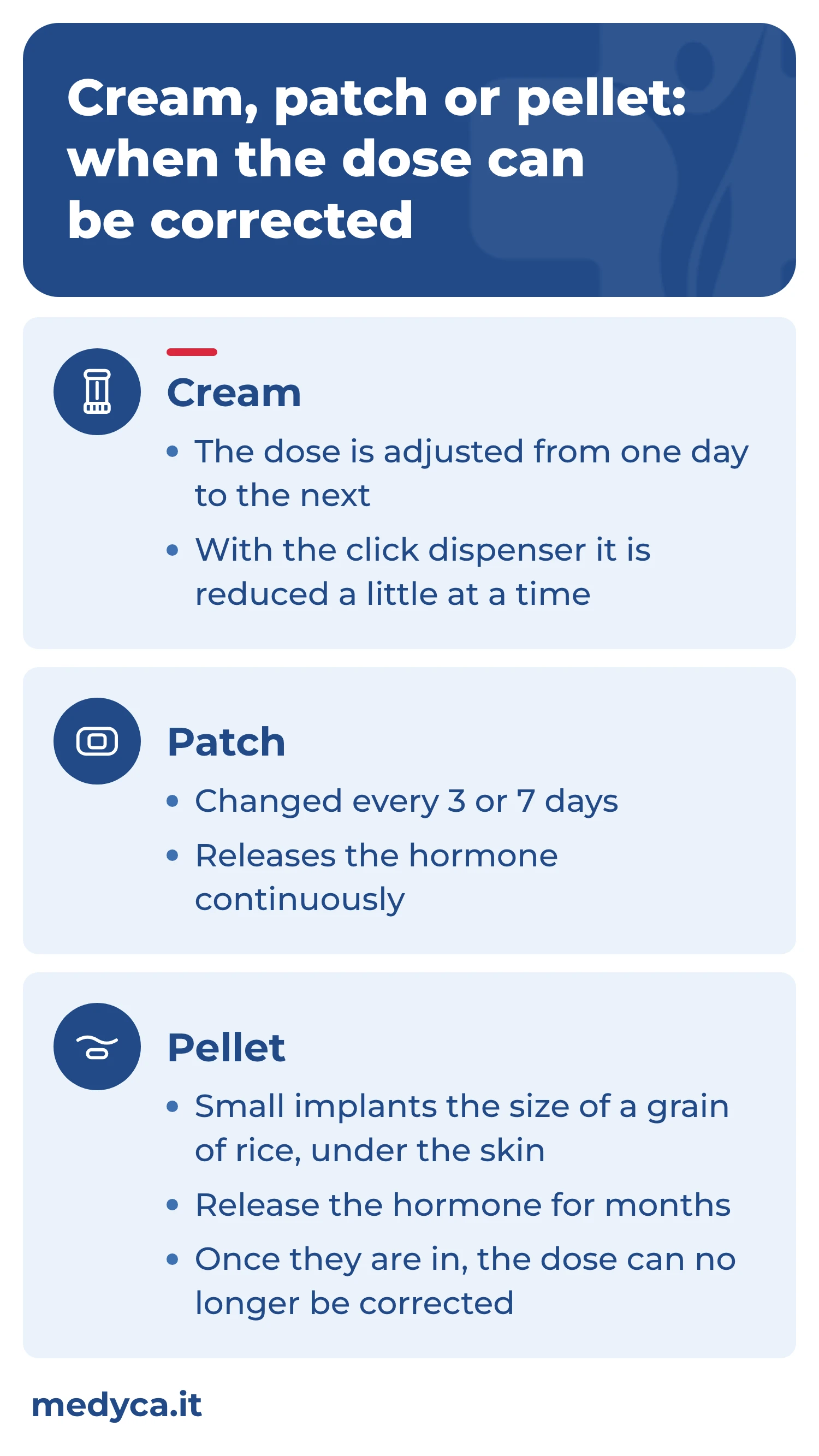
With a cream the dose can be adjusted from one day to the next: if you apply it one evening and the next day your breasts feel tender, you can stop it at once, and with the click dispenser it is reduced a little at a time. A patch, on the other hand, is changed every 3 or 7 days and releases the hormone continuously: this is why, in my view, it is harder to manage when the dose needs correcting.
The same goes for pellets, the small implants the size of a grain of rice that are placed under the skin and release the hormone for months. Once they are in, the dose can no longer be corrected: if something changes how the hormones are absorbed or metabolised, levels go too high or too low, and creams are needed to step in. So, in my view, you may as well use creams from the start and renew them every three months.
«Progesterone cream does not protect the endometrium»
The transdermal route is a recognised route of administration, like the oral one. With a cream, progesterone absorption can vary, and this is why scientific societies write that protection of the endometrium is not guaranteed. By mouth, too, absorption varies from woman to woman. For more stable levels I prescribe two applications a day, and protection of the endometrium is followed with regular gynaecological check-ups, as with oral therapy. The progesterone dose, moreover, must always be balanced with the oestrogen dose.
There is no progesterone dose above which the endometrium is certainly protected: there is no threshold value. I go by symptoms: the aim is the smallest amount of hormones that makes the woman feel well, and if the symptoms you had go away, it usually means the hormones are circulating throughout the body and protecting it. Regular gynaecological check-ups are there to confirm it.
«Blood (or saliva) tests are no use for dosing hormones»
I use only blood tests: I have little trust in saliva tests, because the result also depends on what you have eaten and on the acidity of the pH.
I use blood tests to set the starting dose and then, usually at the second check-up, to confirm that the hormonal balance has been restored.
The traditional way is to see the patient rarely and leave her on the same therapy for years. A personalised therapy only works with more frequent contact, especially at the beginning: you start with a low dose, check after about three months and adjust. A patient on a personalised preparation cannot be seen every two years: you have to stay in close contact. If many doctors do not do this yet, it is because training in hormone therapy has not kept pace.
Do compounded hormones cost more?
Yes, by a few euros a month. A combination of registered oestradiol and progesterone costs roughly between €11 and €25 a month, a compounded preparation between €20 and €30. Some registered packs are in class A, that is paid for by the SSN, apart from any regional prescription charge, if your doctor prescribes them on an SSN prescription; a compounded preparation, instead, you pay for in full. In both cases it is a healthcare expense, deductible from your taxes in Italy.
The price of a compounded preparation is not set by the individual pharmacy: it follows the national tariff. And the prescribing doctor cannot receive any commission on preparations.
How long does a compounded preparation last?
About six months. The stability studies by the maker of the base confirm it: oestradiol, oestriol and progesterone remain stable for six months at room temperature. In a compounded cream the hormones do not react with one another, and the only possible change over time is the oxidation of the base: this is why the expiry is shorter than that of a registered medicine, and it is written on the label, with the date of preparation. It should be kept at room temperature, away from sources of heat such as direct sunlight or a radiator.
How do you choose between compounded and registered?
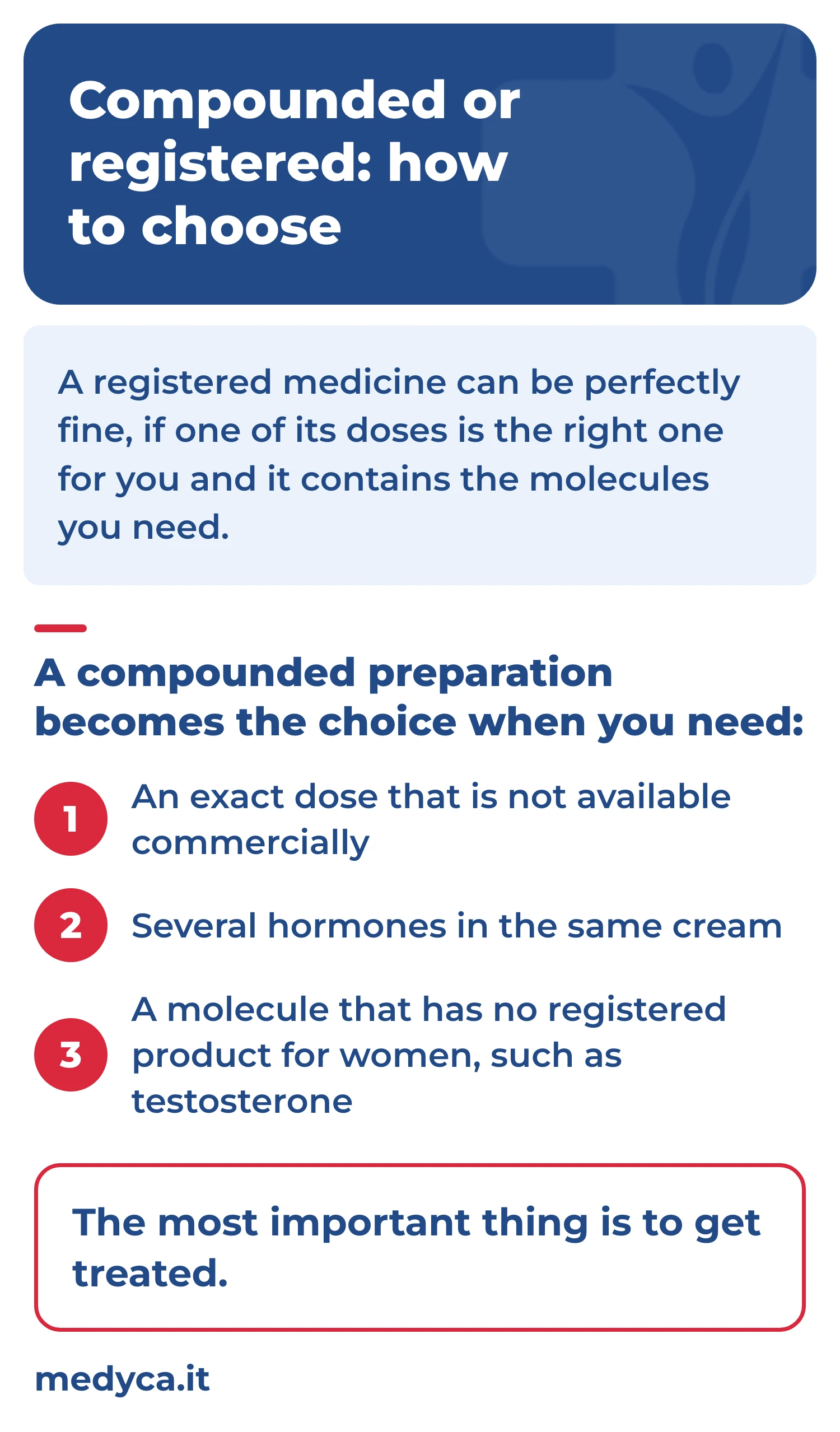
A registered medicine can be perfectly fine, if one of its doses is the right one for you and it contains the molecules you need. The most important thing is to get treated: do not be afraid to see a doctor and take hormone therapy, whether synthetic or bioidentical.
A compounded preparation becomes the choice when you need something registered medicines do not offer: an exact dose that is not available commercially, several hormones in the same cream, or a molecule that has no registered product for women, such as testosterone. Scientific societies also recognise these cases.
I always prescribe compounded preparations, because I can personalise them: with registered ones I cannot. Personalisation removes the typical side effects of a therapy that does not fit the individual woman's profile: not only doses that are too high or too low, but also the absence of a molecule, or of the combination of molecules, that this patient needs.
In the Bioidentical Hormone Pathway the therapy is built on your symptoms and your tests, and followed over time, with the dose changing when you change.
Do you want to find out whether the therapy is right for you?

Dr Cristina Lenzi
Dr Cristina Lenzi is an internal medicine physician and the Medical Director of Medyca, where she looks after women's health in perimenopause and menopause with bioidentical hormone therapy.

Medyca is a medical service founded by Dr Cristina Lenzi, one of the few doctors in Italy specialising in bioidentical hormone therapy. A specialist in Internal Medicine, cum laude, from the Università di Siena, she holds a PhD in osteometabolic diseases and Level I and Level II Master's degrees in bioidentical hormones from the Marion Gluck Clinic in London.
The first introductory consultation is free and without obligation: it is the way to find out more and understand whether the pathway is right for you. We look after patients from anywhere in Italy by video call, and in person at our practice in Siena.
Find out more:
- What are bioidentical hormones, and how do they differ from synthetic hormones?
- Compounded bioidentical hormone preparations: how they are made and who checks their quality
- Hormone replacement therapy in menopause: what it is, when it is recommended, risks and how to start
Sources
- ACOG Committee on Gynecologic Practice. Committee Opinion No. 322: Compounded bioidentical hormones. Obstet Gynecol 2005;106(5 Pt 1):1139-40. doi:10.1097/00006250-200511000-00059
- American College of Obstetricians and Gynecologists, Committee on Clinical Consensus–Gynecology. Compounded bioidentical menopausal hormone therapy. Clinical Consensus No. 6. Obstet Gynecol 2023;142(5):1266-73. doi:10.1097/AOG.0000000000005395
- Lello S, Capozzi A, Cagnacci A, et al., for SIGiTE and SIM. Expert opinion by SIGiTE and SIM on hormone therapy with bioidentical hormones. Eur J Obstet Gynecol Reprod Biol 2025;308:67-69. doi:10.1016/j.ejogrb.2025.02.045
- Panay N, Fenton A, Hamoda H, et al. International Menopause Society recommendations and key messages on women's midlife health and menopause. Climacteric 2025;28(6):634-56. doi:10.1080/13697137.2025.2585487
- Panay N. BMS Consensus Statement: Bioidentical HRT. Post Reprod Health 2026;32:89-92. doi:10.1080/20533691.2026.2660569
- Toth B, Ott J, Gruber DM, et al. Peri- und Postmenopause: aktuelle diagnostische und therapeutische Aspekte für die DACH-Region. Konsensuspapier der OEGGG, DGGG, DMG und SGGG. Wien Klin Wochenschr 2026. doi:10.1007/s00508-026-02832-7
- The North American Menopause Society. The 2022 hormone therapy position statement of The North American Menopause Society. Menopause 2022;29(7):767-94. PubMed 35797481
- Kling JM, MacLaughlin KL, Schnatz PF, et al. Menopause management knowledge in postgraduate family medicine, internal medicine, and obstetrics and gynecology residents: a cross-sectional survey. Mayo Clin Proc 2019;94(2):242-53. doi:10.1016/j.mayocp.2018.08.033
- Simon JA, Robinson DE, Andrews MC, et al. The absorption of oral micronized progesterone: the effect of food, dose proportionality, and comparison with intramuscular progesterone. Fertil Steril 1993;60(1):26-33. PubMed 8513955
- Wheatley S, Bell RJ, Stuckey BGA, et al. Clinical audit of estradiol implant therapy: long duration of action and implications in non-hysterectomised women. Maturitas 2016;94:84-6. doi:10.1016/j.maturitas.2016.09.008
- Polonini H, Kegele CS, Marianni B. Evidence-Based Beyond-Use Dates for Pentravan® Compounded Formulations in Hormone Therapy and Pain Management. Int J Pharm Compd 2025;29(6):505-19. PubMed 41401041
- Polonini H, Kegele CS, Marianni B. Chemical and Microbiological Stability Supporting Extended BUDs in Pentravan® Based Transdermal Preparations. Int J Pharm Compd 2026;30(2):158-73. PubMed 42143785
- AIFA (Italian Medicines Agency), Banca Dati Farmaci: package leaflet of Progeffik; class and packs of medicines based on oestradiol, progesterone and testosterone. medicinali.aifa.gov.it
- AIFA, reporting adverse reactions. aifa.gov.it
- Italian Ministry of Health, Ministerial Decree of 18 November 2003, procedures for preparing magistral and officinal preparations (Gazzetta Ufficiale no. 11 of 15/01/2004); Italian Pharmacopoeia, Good Preparation Practice (Norme di Buona Preparazione).